
Tasman Bay — large V-shaped bay on New Zealand’s northern South Island
Tasman Bay is a broad V-shaped bay on the northern coast of New Zealand’s South Island, noted for the Boulder Bank, fertile agricultural plains, coastal towns including Nelson, and links to Abel Tasman National Park.
Overview
Tasman Bay is a broad, V-shaped inlet on the northern shore of the New Zealand South Island. Opening westward into the Tasman Sea, it lies on the western side of the Cook Strait. The bay extends across a wide coastal margin with a coastline that transitions from exposed headlands and national park to sheltered plains and estuaries. The central coastal plain of the bay is the most heavily settled part of the island’s northern seaboard.
Image gallery
2 Images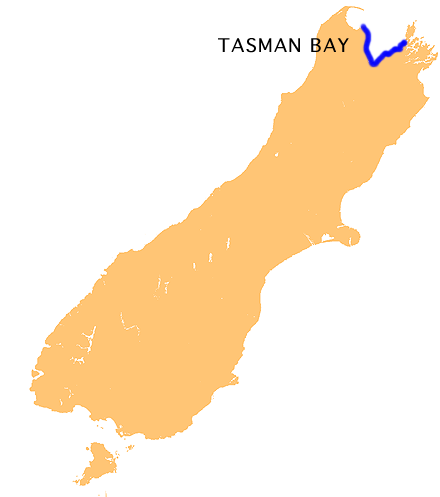

Geography and extent
Tasman Bay is often described as roughly 120 km long and about 70 km wide at its mouth, forming a shallow V that collects several small rivers and streams. To the west the coastline rises into heavily vegetated and rugged country that connects with parts of the Abel Tasman National Park, while the east side is shaped by valleys and inlets that lead toward the Marlborough Sounds. The western margin of the bay is especially noted for dense coastal forest and scrub vegetation.
Rivers, estuaries and geology
A number of rivers drain into Tasman Bay, including the Waimea, Motueka, Riwaka and Serpentine. Their floodplains and estuaries create fertile alluvial soils used for horticulture, and they also support wetland and estuarine ecosystems. One of the bay’s most distinctive geological features is the Boulder Bank, a long natural bank of cobbles and boulders that shelters the inner harbour and has been the subject of scientific interest for its influence on coastal processes.
Climate and biodiversity
The region has a temperate maritime climate, with relatively mild winters and warm summers that favour a wide range of plants and productive farmland. Coastal and marine habitats around Tasman Bay include sandy and rocky shores, estuaries, seagrass beds and nearshore reefs. These areas support fish, shellfish, seabirds and a variety of intertidal invertebrates, and they are important for recreational fishing and local aquaculture.
Land use and economy
The central bay plains are an intensive agricultural zone. Orchards, vineyards and hop fields are common: apples and kiwifruit are grown alongside grapes and olives, while hops have a long local association. In the mid twentieth century small-scale tobacco cultivation took place in parts of the region and its memory is preserved in local collections and a museum in Motueka tied to tobacco history. Fishing, aquaculture, tourism and light industry also contribute to the regional economy.
Settlements, transport and services
The bay’s coastline supports the city of Nelson and towns such as Motueka, Riwaka and Richmond. Nelson is the primary service, cultural and port centre for the area; smaller towns provide gateways to beaches, reserves and national park tracks. Road and ferry connections link the bay to neighbouring regions, while local boat ramps and marinas support recreational and commercial craft.
Conservation, recreation and challenges
Proximity to Abel Tasman National Park and a network of reserves makes Tasman Bay a popular area for boating, walking, birdwatching and beach recreation. Conservation efforts focus on protecting native habitats, managing sediment and nutrient runoff from farming, and controlling invasive species that affect estuaries and shorelines. Pressure from coastal development and changing land use are ongoing management concerns addressed by regional authorities and community groups.
- Key rivers: Waimea, Motueka, Riwaka, Serpentine.
- Notable features: Boulder Bank, coastal plains and sheltered inner waters.
- Main centres: Nelson, Motueka, Riwaka, Richmond.
- Nearby conservation area: Abel Tasman National Park.
For more local and practical information on visiting, navigation and conservation initiatives, consult regional guides, park authorities and community resources that provide maps, safety advice and details about recreational opportunities.
Related articles
Author
AlegsaOnline.com Tasman Bay — large V-shaped bay on New Zealand’s northern South Island Leandro Alegsa
URL: https://en.alegsaonline.com/art/96471