
Sweet potato (Ipomoea batatas)
Starchy, sweet-tasting root crop in the morning glory family, valued worldwide for food, nutrition and versatile culinary uses; includes varieties with orange, white, purple flesh and edible leaves.
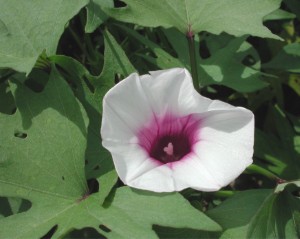
The sweet potato (Ipomoea batatas) is a perennial vine grown mainly for its enlarged, sweet-tasting storage roots. It belongs to the morning glory family, Convolvulaceae, and is cultivated across temperate and tropical regions for its caloric and nutritional value. For further botanical context see related resources.
Image gallery
10 Images


Description and biology
Sweet potatoes produce trailing vines and heart-shaped leaves; the edible portion is a tuberous storage root rather than a true potato-like tuber. Roots vary in shape, size and skin color, and the flesh ranges from deep orange to pale cream or purple. Plants are commonly propagated from cuttings or "slips"—shoots grown from an existing root—rather than seed.
History and cultivation
Domesticated in the Americas, the crop spread worldwide after premodern exchanges. It grows well in warm climates with well-drained soils and a long growing season. Farmers select varieties for yield, taste, pest resistance and storage life. Cultural practices include vine cuttings for propagation and simple soil mounding for root development.
Uses and nutrition
Sweet potatoes are eaten boiled, baked, roasted, fried or mashed and appear in both savory and sweet dishes. Young leaves and shoots are edible as greens in many cuisines. Nutritionally, many varieties are notable for fiber and provitamin A (beta-carotene), along with vitamin C and complex carbohydrates.
Varieties, distinctions and notable facts
- Common categories include orange-fleshed types high in beta-carotene, pale-fleshed milder types, and purple-fleshed kinds valued for antioxidant pigments.
- They are often confused with yams; botanically they are distinct crops from different plant families.
- Beyond food use, sweet potatoes provide starch for industrial applications and can be used for animal feed in some regions.
Practical notes: Proper curing and dry storage extend shelf life, and simple culinary methods reveal different textures and sweetness levels. Crop management focuses on rotation, pest control and maintaining healthy planting material to reduce disease risk.
Related articles
Author
AlegsaOnline.com Sweet potato (Ipomoea batatas) Leandro Alegsa
URL: https://en.alegsaonline.com/art/95496
Sources
- elgaleon.weebly.com : "Nahuatl Influences in Tagalog"
- doi.org : 10.1007/bf02985351
- jstor.org : 4252401
- hanahou.com : "The Uber Tuber,"
- books.google.com : Economic Aspects of the History of the Civilization of Japan, p. 352
- books.google.com : A History of Korea: From 'Land of the Morning Calm' to States in Conflict, p. 255
- commons.wikimedia.org : Sweet potato