
Subtraction: the arithmetic operation of taking differences
Subtraction is the arithmetic process of finding the difference between quantities. This article explains notation, core properties, common algorithms, extensions to vectors and matrices, history, and everyday uses.
Overview
Subtraction is the arithmetic procedure used to determine how much one quantity differs from another. In elementary notation it appears as minuend − subtrahend = difference: for example, 7 − 4 = 3. If the first number (the minuend) is smaller than the second (the subtrahend), the result is a negative number, as in 17 − 25 = −8. Subtraction can be viewed either as removing a part from a whole or as finding the amount that must be added to the subtrahend to reach the minuend.
Image gallery
10 Images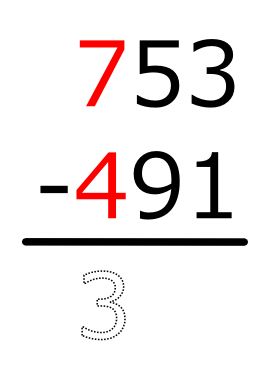

Terms and notation
The standard names appearing in a subtraction expression are useful when describing procedures: the minuend is the quantity you start with, the subtrahend is the quantity removed, and the difference is the remainder. In algebra, subtraction is commonly expressed as addition of an additive inverse: a − b = a + (−b), which connects subtraction to the operation of addition and to more abstract structures.
Basic properties and common algorithms
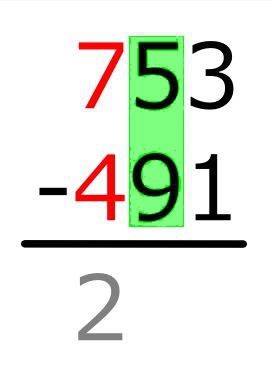
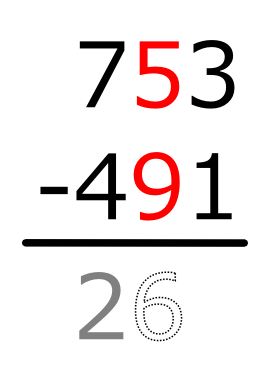
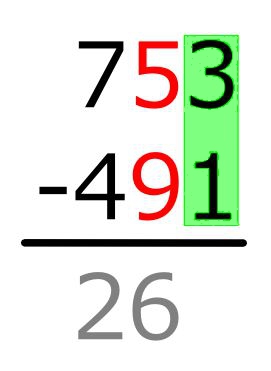
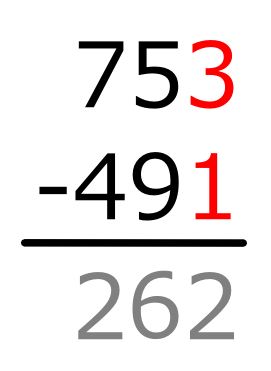
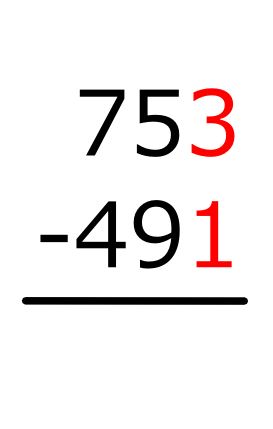
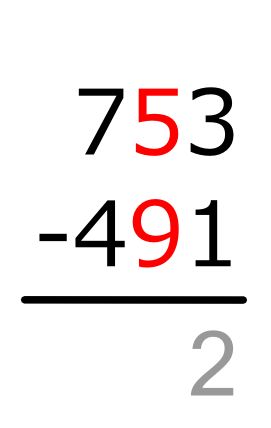
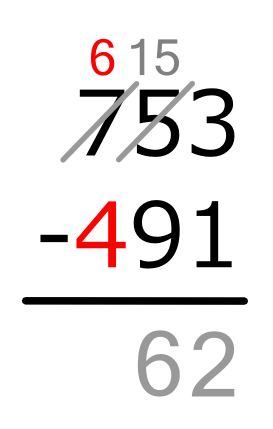
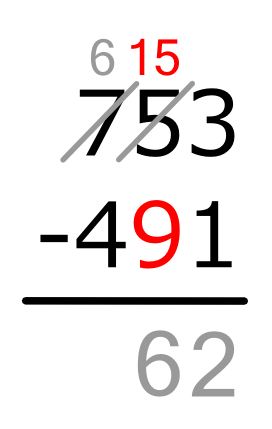
Unlike addition, subtraction is not commutative (a − b ≠ b − a in general) and not associative. Many algorithmic techniques exist to compute differences efficiently by hand or by machine. Primary school methods include columnar or long subtraction with borrowing (also called regrouping). Complement methods, such as using 9's or 10's complements, provide alternative hand- or machine-friendly ways to subtract large numbers, and computers typically implement subtraction using binary arithmetic and representations such as two's complement for signed integers.
- Non-commutative: order matters; 5 − 2 = 3 but 2 − 5 = −3.
- Inverse of addition: solving a − b = c is equivalent to a = b + c.
- Algorithmic variations: borrowing/regrouping, complements, and bitwise subtraction in hardware.
Extensions to other mathematical objects
Subtraction extends naturally beyond integers and real numbers. For vectors and matrices, subtraction is performed componentwise: subtract corresponding entries to obtain a new vector or matrix. In abstract algebra, subtraction is defined whenever an additive inverse exists, so the same formal idea applies in groups and modules. Modular arithmetic supports subtraction with wraparound (for example, clock arithmetic). For more on how subtraction interacts with different structures, see vectors, matrices, and general algebraic contexts.
History and development
Methods for subtracting quantities appear in the earliest known arithmetic records. Ancient civilizations developed practical subtraction techniques to manage trade, land measurement, and accounting. Over centuries, notation and systematic algorithms became standardized in school arithmetic; refinements in numeral systems and mechanical or electronic computation later influenced how subtraction is implemented in calculators and computers.
Uses, examples and notable facts
Subtraction is ubiquitous in everyday life: making change at a store, comparing measurements, computing differences in time, and determining deficits or net results. A cashier calculating change performs a basic subtraction operation by taking the payment amount minus the purchase cost. In science and engineering it appears in error estimation, signal processing, and differential calculations. For practical guides and exercises, consult resources on elementary operations and computational methods provided by many educational sites and calculators (practice, tutorials).
Notable distinctions: because subtraction can produce negative values, it bridges counting notions (how many remain) and algebraic concepts (additive inverses). In computing, implementation details such as overflow behavior and representation of negatives are essential practical concerns.
Related articles
Author
AlegsaOnline.com Subtraction: the arithmetic operation of taking differences Leandro Alegsa
URL: https://en.alegsaonline.com/art/94534