
Sudoku: the logic-based number-placement puzzle
Sudoku is a logic puzzle in which the solver fills a grid so each row, column and region contains the required digits without repetition. Widely published in print and digital formats, with many variants.
Sudoku is a logic-based number-placement puzzle that challenges solvers to fill a grid so that each row, column and designated region contains the required set of digits without repetition. The most common form uses a 9×9 grid divided into nine 3×3 boxes, with the digits 1–9 placed so that none repeats in any row, column or box. Although modern popularity is global, the puzzle's roots and rise involved publications, collectors and later digital distribution — see general puzzle resources and its emergence in Japan.
Image gallery
5 Images


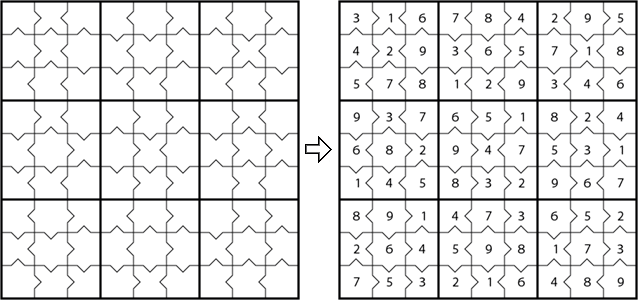
Rules and basic structure
The standard Sudoku presents some digits already filled in. The solver must complete the grid while obeying these simple constraints: each digit appears exactly once in every row, once in every column and once in every subgrid (typically 3×3). Solutions depend on logic rather than arithmetic. Key practical points include:
- Grid sizes: common sizes are 9×9 (with 3×3 boxes), but smaller (4×4) and larger (16×16) variants exist; some puzzles use irregular regions instead of square boxes. Variants and sizes.
- Clues and uniqueness: well-designed puzzles usually have a single valid solution; many competitions and publications insist on uniqueness. creation and editing.
- No arithmetic required: the challenge is deductive reasoning and pattern recognition, not calculation. See notes on solving approaches.
History and development
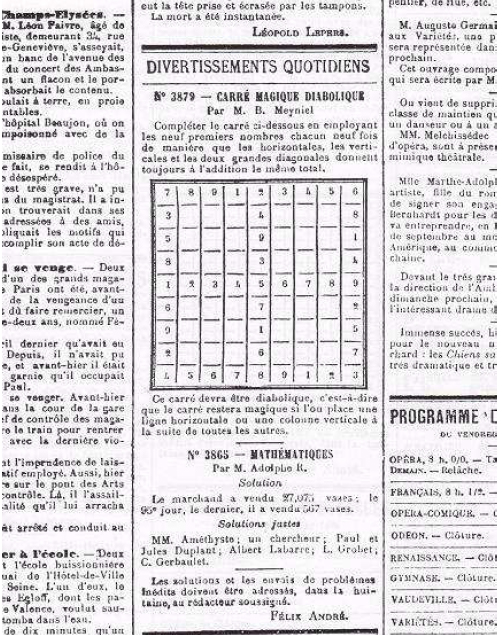
The form widely recognized today was first published in the United States in the late 20th century and later reached strong popularity in Japanese puzzle magazines and newspapers, which helped coin and spread the name now commonly used. From print appearances it spread to collections and dedicated books, then to handheld electronic devices and later websites and mobile apps. For more on its early publications and publishers, consult newspaper listings and magazine archives.
Solving methods and common strategies
Solvers use a hierarchy of techniques, from simple to advanced. Beginners start with scanning and elimination to find 'singles' (cells with only one possible digit) and fill obvious placements. Intermediate methods include penciling in candidate digits and identifying pairs or triples that constrain a region. Advanced logical patterns — sometimes given names like X-wing or swordfish — link candidates across rows and columns. Many guides and tutorials collect these methods; see pencil-and-paper tips and published strategy guides.
Variants, publishing and play
Beyond the classic puzzle there are many popular variants: overlapping grids ("samurai"), puzzles that use arithmetic constraints ("killer" Sudoku), and puzzles with additional region rules. Puzzles appear daily in newspapers and magazines, in books of graded difficulty, as handheld electronic games and on countless websites and mobile apps. For an introduction to formats and where to play, see book collections, newspaper pages, magazine columns, electronic devices, and online web platforms or apps.
Sudoku's enduring appeal lies in its elegant simplicity and depth: a concise set of rules yields puzzles that range from quick exercises to intricate logical challenges. The problem also has theoretical interest — generalized Sudoku decision problems have been studied in theoretical computer science — but for most players it remains a portable, logic-focused pastime suitable for casual and competitive play alike.
Questions and answers
Q: What is Sudoku?
A: Sudoku is a puzzle game that originated in Japan and was created in Indianapolis in 1979. It consists of a grid with nine rows, nine columns, and nine boxes that contain numerals from 1 to 9. The goal is to fill in all the empty squares without using the same numeral twice in each column, row, or box.
Q: How do you solve Sudoku puzzles?
A: Sudoku puzzles are solved by logic and no math is required. To solve the puzzle, a person must fill in all the empty squares without using the same numeral twice in each column, row, or box, and without changing the numerals that are already in the grid.
Q: Where can you find Sudoku puzzles?
A: Sudoku puzzles can be found in books containing collections of these puzzles with tips and strategies for completing them as well as newspapers and magazines where typically a different puzzle appears every day with its solution printed somewhere else or on the next issue. They can also be played on the Internet or mobile apps.
Q: Who created Sudoku?
A: Sudoku was created by Howard Garns in 1979 and appeared Dell Magazines afterwards.
Q: Is math required to solve a sudoku puzzle?
A: No, math is not required to solve a sudoku puzzle as they are solved by logic instead.
Q: Are there any tools available to help complete sudokus?
A: Yes, there are small handheld machines that generate sudokus for users to solve as well as books containing collections of these puzzles with tips and strategies for completing them which can help when solving them.
Q: Can you play sudokus online? A:Yes ,Sudokus can be played online on websites or mobile apps .
Related articles
Author
AlegsaOnline.com Sudoku: the logic-based number-placement puzzle Leandro Alegsa
URL: https://en.alegsaonline.com/art/94595
Sources
- onlinesudoku.hu : "Sudoku Variations"