
Stuart Symington
American businessman and Democratic politician; first U.S. Secretary of the Air Force and long-serving U.S. Senator from Missouri (1953–1976).
William Stuart Symington Jr. (June 26, 1901 – December 14, 1988) was an American businessman and public official who became a prominent member of the Democratic Party. Over a long career in government he helped shape early post‑World War II military organization and Cold War policy, then represented Missouri in the U.S. Senate for more than two decades.
Image gallery
1 Image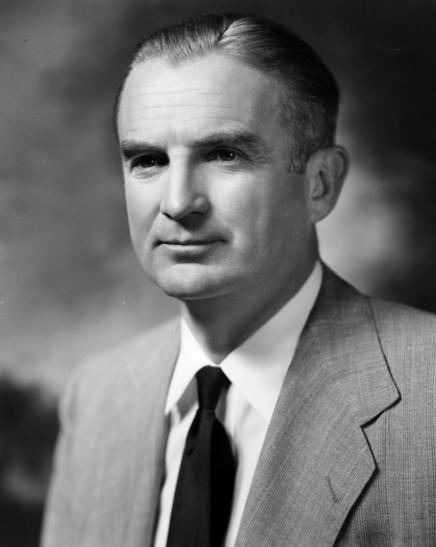
Early life and education
Symington was born in Amherst, Massachusetts, and came from a family with substantial business interests. He completed his studies at Yale University and worked in private industry before entering public service. His background in commerce and management influenced his later approach to defense procurement and administration.
First Secretary of the Air Force
In 1947 Symington became the inaugural United States Secretary of the Air Force, serving until 1950. As the first civilian leader of the newly independent service, he was responsible for organizing administrative structures, setting priorities for air power in the early Cold War, and overseeing the transition from wartime to peacetime systems. His tenure helped to establish the Air Force as a separate branch of the armed forces and set early policy directions for strategic aviation and research.
Senate career and policy interests
After a return to private life, Symington was elected to the U.S. Senate as the senator from Missouri and served from 1953 until 1976. In the Senate he served on committees with jurisdiction over defense and national security and became known for his attention to military readiness, fiscal oversight, and arms programs. He was viewed as a pragmatic legislator who combined business experience with a commitment to national defense during a period of rapid technological change.
- United States Secretary of the Air Force, 1947–1950 (office)
- U.S. Senator from Missouri, 1953–1976 (senate)
1960 presidential campaign and later years
Symington sought the Democratic nomination for president in 1960, running on his national security credentials, but he was unsuccessful and lost the contest to John F. Kennedy. He continued in the Senate through the Vietnam era and the early 1970s, resigning in 1976 shortly before the end of his final term.
Personal life and legacy
Symington married Evelyn Wadsworth; their marriage lasted until her death in 1972. The couple had a son, James W. Symington, who later served in the United States House of Representatives. A member of a politically active family, his cousin Fife Symington served as Governor of Arizona in the 1990s. Stuart Symington died in New Canaan, Connecticut, on December 14, 1988, from angina pectoris at the age of 87.
Symington is remembered for helping to build the institutional foundations of the independent Air Force, for his long Senate service on defense matters, and for bringing a businesslike approach to government administration during the formative early decades of the Cold War.
Related articles
Author
AlegsaOnline.com Stuart Symington Leandro Alegsa
URL: https://en.alegsaonline.com/art/94374