
Massachusetts: Overview, History, and Key Facts
Comprehensive overview of Massachusetts — its geography, history, government, economy, education, culture and notable facts, written for general reference.
Overview
Massachusetts, officially the Commonwealth of Massachusetts, is a state on the northeastern Atlantic coast of the United States. For official information see state resources. Its capital and largest city is Boston, a regional center for culture, education, commerce and transportation. Massachusetts is one of the six states commonly called New England and has a long coastline on the Atlantic Ocean.
Image gallery
10 Images


Geography and places
The state's landscape ranges from sandy shores and barrier beaches to rolling hills and upland forests. Notable coastal features include Cape Cod, islands and harbors; inland there are rivers, small mountain ranges and agricultural valleys. Massachusetts borders several states: Rhode Island, Connecticut, New York, Vermont and New Hampshire. Major municipalities beyond Boston include Boston (metro area), Worcester, Springfield and historic Plymouth.
History and origins
The name "Massachusetts" is derived from a Native American language and is often interpreted to mean "place with hills" or similar geographic description; this origin is noted by scholars and local tradition and is referenced by Native American sources. European settlement began in the early 17th century when English colonists and religious refugees arrived; early contact and colonization by Europeans shaped the region. In 1620 a group of pilgrims who sought religious freedom landed at Plymouth — the event and the colony are commonly linked to the story of the Pilgrims who had sailed from England.
Massachusetts played a central role in colonial politics and later in the founding of the United States. The colony and later the state were scenes of high-profile events in the Revolutionary period, including incidents that contributed to unrest and war. Key moments include the protest commonly called the Boston Tea Party and the opening engagements at the Battles of Lexington and Concord. Those events are among several connected to the broader movement toward independence often described in accounts of the American Revolution.
Culture, education and economy
Massachusetts is home to many institutions of higher education and research. It hosts some of the nation’s oldest and most influential universities, such as Harvard University, and leading technical institutes such as MIT. The state's economy is diverse: key sectors include higher education, health care, biotechnology, finance, information technology and advanced manufacturing. Historically, the state was an early center of textile and other industrial production and has long-standing maritime and trade connections.
Social movements, distinctions and civic life
Massachusetts has frequently been prominent in social reform movements, including early abolitionist activity and campaigns for civil rights; it was an important center of the anti-slavery movement in the 19th century. The northern New England character, combined with urban centers, has produced a distinct mix of political and cultural institutions. At one time the district that is now the state of Maine was part of Massachusetts before separating in the early 19th century.
Sports, landmarks and notable facts
Sports and local traditions are part of modern identity: professional teams, collegiate athletics and community events are widely followed; the NFL team commonly associated with the region is the New England Patriots. The state also retains many historic landmarks and commemorative sites connected to early colonial life and the Revolutionary era. Visitors and residents alike find a mix of urban neighborhoods, suburban towns and rural areas, with cultural institutions, museums, performing arts venues and natural areas that illustrate the state's layered history.
Quick reference
- Capital and largest city: Boston
- Historic settlement: Plymouth
- Regional center: Worcester
- Western city: Springfield
- Notable university: Harvard; MIT
This article provides a concise introduction to the Commonwealth of Massachusetts: its geography, historical development, cultural institutions and economic roles. For deeper study consult printed histories, archives and the official resources linked above.
Geography
Massachusetts is located in Massachusetts Bay, bordered by New Hampshire and Vermont to the north, New York to the west, Connecticut and Rhode Island to the south. To the east lies the Atlantic Ocean. The islands of Martha's Vineyard and Nantucket lie on the southeastern coast. The largest city is Boston. Other major cities include Cambridge, New Bedford, Worcester, Lowell, Springfield, and Pittsfield. The highest point in Massachusetts is Mount Greylock in Berkshire County (1,063 m). The peninsula in southeastern Massachusetts is called Cape Cod and is a popular summer vacation spot. The Cape Cod National Seashore is located there.
The state has a total area of 27,336 km², water bodies occupy 7,031 km² of it.
Structure
- List of counties in Massachusetts

Population
The population in 2010 was 6,547,629, of which 80.4% were white, 6.6% African American, 5.3% Asian, 0.3% Native American, and 9.6% Hispanic or Latino, which can be counted as any ethnicity.
Religions
The religious communities with the largest number of members in 2000 were the Catholic Church with 3,092,296, the United Church of Christ with 121,826 and the Anglican Episcopal Church with 98,963 adherents. The Jewish communities counted about 275,000 members.
Largest cities
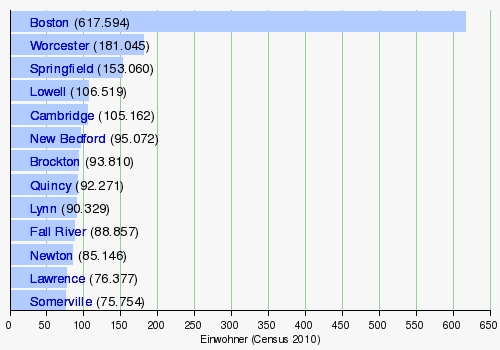
- List of cities in Massachusetts
- List of cities in Massachusetts by population

Related articles
Author
AlegsaOnline.com Massachusetts: Overview, History, and Key Facts Leandro Alegsa
URL: https://en.alegsaonline.com/art/62692
Sources
- commons.wikimedia.org : Massachusetts
- quickfacts.census.gov : "Massachusetts"
- ngs.noaa.gov : "Greylock RM 1 Reset"
- kff.org : "Median Annual Household Income"
- mass.gov : "Massachusetts General Laws, Chapter 2, Section 35: Designation of citizens of commonwealth"
- books.google.com : "Collections"
- books.google.com : History of New York During the Revolutionary War
- washingtonpost.com : "States where English is the official language"
- factfinder.census.gov : "Language spoken at home by ability to speak English for the population 5 years and over – 2014 American Community Survey 1-Year Estimates"
- statesymbolsusa.org : "Black-Capped Chickadee:Massachusetts State Bird"
- statesymbolsusa.org : "Wild Turkey:Massachusetts State Game Bird"
- sec.state.ma.us : "Massachusetts Facts"
- statesymbolsusa.org : "Cod: Massachusetts State Fish"
- statesymbolsusa.org : "Mayflower: Massachusetts State Flower"
- statesymbolsusa.org : "Ladybug: Massachusetts State Insect"