
Strait of Malacca
A narrow, strategic sea lane between Peninsular Malaysia and Sumatra linking the Andaman Sea and Java Sea; one of the world’s busiest maritime passages and a regional chokepoint.
Overview
The Strait of Malacca is a long, narrow waterway that separates the Malay Peninsula (often referred to as Malaya) from the Indonesian island of Sumatra. It forms the principal passage connecting the Andaman Sea to the northwest with the Java Sea to the southeast. The strait lies along a key international maritime corridor, serving as a natural link between the Indian Ocean and the South China Sea and supporting dense regional and transoceanic shipping traffic.
Image gallery
8 Images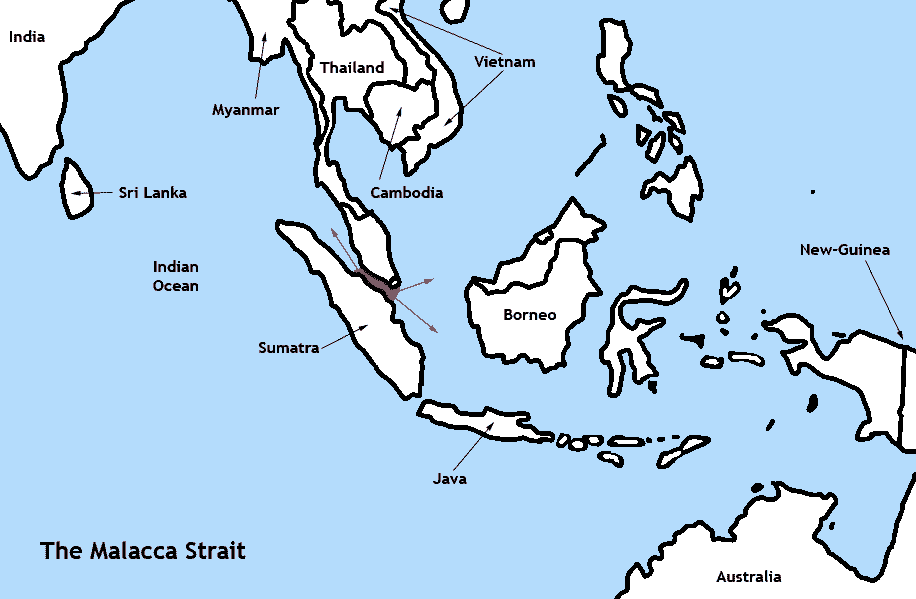



Physical characteristics
- Length: roughly 800 km from its northern to southern approaches.
- Width: varies widely — most stretches measure between about 50 km and 300 km across.
- Narrowest point: as little as 1.5 nautical miles (about 2.8 km) at some choke points.
- Depth: parts of the strait are shallow, with minimum depths near 25 metres in places, imposing limits on deep-draft vessels.
History and development
For centuries the strait has been a conduit for regional trade, linking ports of the Indian Ocean world with those of Southeast Asia and East Asia. It played a central role in the movement of spices, textiles and other goods during the pre-modern period and attracted interest from maritime powers as global sea routes expanded. Over time, coastal ports and settlements developed along its shores, shaping local economies and regional politics.
Economic and strategic importance
The Strait of Malacca is among the world’s busiest shipping lanes. Large volumes of oil, liquefied natural gas, containerized cargo and other commodities pass through it, making it strategically important for energy security and international trade. Its narrow and shallow sections can create bottlenecks and increase transit time and risk, which is why alternative routes and proposals — including more southerly passages and land-based corridors — receive attention in strategic planning.
Navigation, safety and environment
Navigation through the strait requires careful traffic management because of heavy traffic, constrained channels and shallow areas. Measures such as traffic separation schemes, pilotage and navigational aids aim to reduce collisions and groundings. The area has also experienced incidents of piracy and maritime crime in modern times, prompting coordinated patrols by regional states. Environmental concerns include the risk of oil spills, impacts on coastal ecosystems and pressure on fisheries and mangrove habitats along the coasts of Malaya and Sumatra.
Notable facts and distinctions
- Because of its combination of high traffic and narrow geography, the strait is commonly described as a strategic maritime chokepoint.
- Shallow sections restrict passage of the largest modern tankers and container ships, influencing ship design and routing choices.
- Regional cooperation among littoral states is important to ensure safe, secure and environmentally sustainable use of the waterway.
Related articles
Author
AlegsaOnline.com Strait of Malacca Leandro Alegsa
URL: https://en.alegsaonline.com/art/94159