
St Catharine's College, Cambridge
A concise guide to St Catharine's College, Cambridge: its foundation, name, architecture, academic life, and notable alumni including cultural and historical highlights.
Overview
St Catharine's College is one of the constituent colleges of the University of Cambridge in England. Commonly known to students as "Catz," the college combines a long history with a compact site close to the city centre. It admits undergraduate and graduate students across a wide range of subjects and typically has a student body of roughly six hundred, supported by a community of teaching Fellows and administrative staff.
Image gallery
10 Images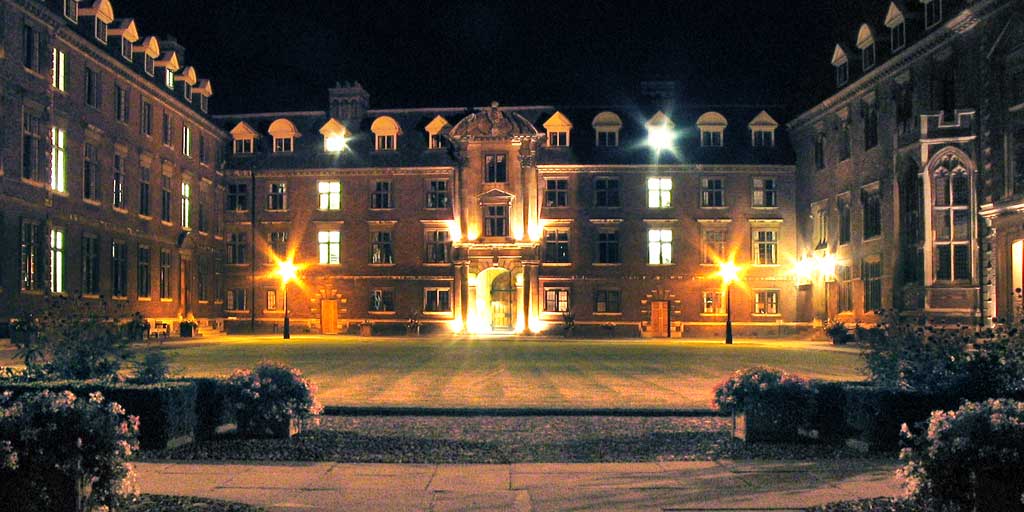




History and foundation
The college was founded in 1473 by Robert Wodelarke, a cleric associated with the university. Its initial statutes emphasised instruction in religious and philosophical disciplines, reflecting the medieval university curriculum, and over the centuries the college broadened its academic scope to include the full range of arts and sciences taught at Cambridge. Like many Cambridge colleges, St Catharine's grew slowly at first, expanding its buildings and endowments in stages as resources allowed.
Name and patronage
The college takes its name from Catherine of Alexandria, a Christian martyr traditionally recognised as a patron of learning. The association with Catherine reflected the medieval emphasis on scholarship and piety. At the same time, historical connections with the royal family—among them the era of Henry VI—have also been noted in explanations of the college's identity. The Christian heritage of the college is part of a broader cultural context in which universities were closely linked to the Church (Christianity), but today St Catharine's is a secular academic institution serving a diverse student body.
Buildings, courts and architecture
St Catharine's occupies a compact site with a mix of late medieval, 17th- and 18th-century, and more modern buildings. The principal quadrangle (often called the First Court) is distinctive for being three-sided; its construction and later alterations spanned several periods, with significant building work taking place between the late 17th century and the mid-18th century. The college chapel, hall and accommodation blocks reflect successive phases of Cambridge college architecture, blending traditional materials with later additions made to meet growing student numbers.
Academics and student life
Originally focused on theology and philosophy, St Catharine's now supports study across the university's full range of subjects. Teaching is provided by a body of Fellows (Fellows) who combine research with undergraduate supervision and graduate supervision. Social life includes collegiate societies, formal hall dinners, and sporting and cultural activities. The college provides pastoral support, scholarships and accommodation for students at different stages of study.
Notable connections and attempts at change
Over its history St Catharine's has been modest in size compared with some neighbouring colleges, and proposals for institutional change have occasionally emerged. For example, plans to re-examine closer links with the adjacent King's College were discussed in the 19th century but did not proceed. Alumni of the college include individuals who have achieved distinction in public life and the arts; among the better-known former students is the actor Ian McKellen. The college retains a reputation for a close-knit community and an emphasis on teaching alongside research.
Key facts
- Founded: 1473 by Robert Wodelarke.
- Common nickname: "Catz".
- Patron saint association: Catherine of Alexandria.
- Historic focus: theology and philosophy.
- Close historical association with other Cambridge colleges such as King's College.
For further reading about its role within the University of Cambridge, about college life and admissions policies, consult college publications and official university sources (University information) or specialised histories of Cambridge colleges and architecture.
Additional online and print resources can illuminate particular aspects of St Catharine's: its archives, lists of past Fellows and students, and accounts of architectural change. These sources provide context for the college's development from a small foundation with a narrow curriculum to a modern constituent college engaged in teaching and research across disciplines.
Related articles
Author
AlegsaOnline.com St Catharine's College, Cambridge Leandro Alegsa
URL: https://en.alegsaonline.com/art/93155