
St. Lucia Day: Scandinavian festival of light
St. Lucia Day, observed on December 13, is a Nordic festival honoring Saint Lucy with candlelit processions, saffron buns (lussekatter), songs, and community ceremonies across Sweden, Norway, Denmark and Finland.
Overview
St. Lucia Day is celebrated on December 13 in parts of northern Europe as a festival of light marking the darkest weeks of winter. The observance takes place in several European countries, most prominently in Sweden, Denmark, Norway and Finland. Its focus is remembrance of Saint Lucy, a Christian martyr traditionally associated with bringing light into darkness.
Image gallery
10 Images


Typical features and symbols
The central image is a young woman chosen to represent Lucia, usually dressed in a white robe with a red sash and wearing a crown of candles or a circlet of lights. She leads a procession of attendants and singers through schools, churches and town squares. Processions commonly include "Lucia girls" (tärnor), boys sometimes dressed as star-bearers (stjärngossar), and musicians. Songs specific to the occasion are sung; their words and melodies vary by country and community but emphasize light, hope and warmth amid long winter nights.
Foods, music and rituals
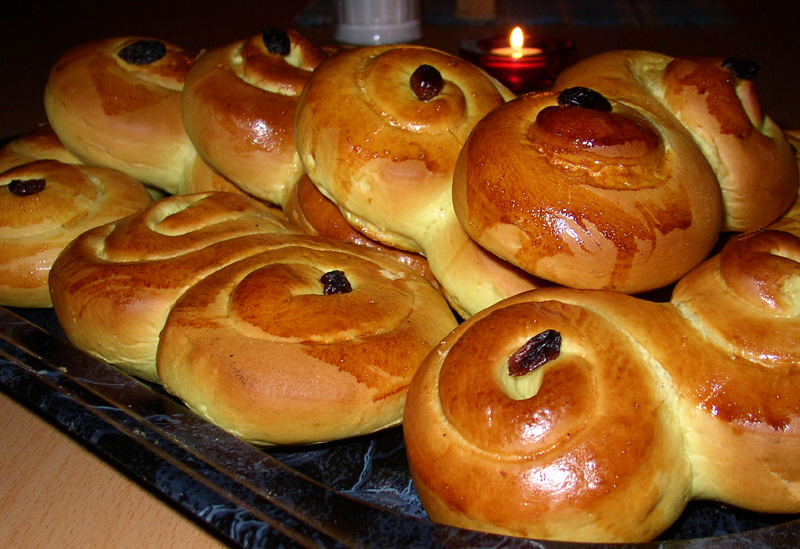
Food and drink play an important role. A traditional pastry is the saffron-flavored bun called lussekatt or "Lucia bun," often formed into an S-shaped swirl and decorated with raisins. These are typically eaten with coffee or mulled wine (glögg) during the morning or at community gatherings. Processions are accompanied by choral singing and simple hymns; in many schools and workplaces a Lucia ceremony serves as a communal marker of the Advent season.
History and origins
The festival links a Christian feast day with older, pre-Christian winter customs that emphasize light during the darkest time of year. Saint Lucy (Lucia of Syracuse) was a 3rd–4th century martyr whose name is derived from the Latin word for light. The choice of December 13 as her feast originally belonged to the medieval church calendar; in Scandinavia the celebration evolved into its modern form over several centuries and became widely popular in the 18th–20th centuries as a national and cultural tradition rather than a strictly religious observance.
Regional variations and modern practice
Each country and locality adapts the ceremonies: some maintain church services while others emphasize school pageants, televised ceremonies or municipal events. Practical changes—electric candle crowns replacing real candles in many places, and mixed-gender processions—reflect safety and contemporary social norms. The event is used to mark community, express cultural identity and provide comfort during the winter season.
Significance and notable facts
Beyond its religious origins, St. Lucia Day functions as a cultural anchor in Scandinavia that highlights music, food and communal ritual. It is an entry point for children into seasonal customs, a fixture in school calendars, and a subject of modern reinterpretation both at home and in diaspora communities. For further information and resources about dates, local customs and educational materials, see local guides and cultural organizations linked below.
More detailed regional information: Sweden, Denmark, Norway, Finland. General background: European observance, liturgical history: about Saint Lucy, celebration date: December 13, symbolism of the crown: crown of candles.
Related articles
Author
AlegsaOnline.com St. Lucia Day: Scandinavian festival of light Leandro Alegsa
URL: https://en.alegsaonline.com/art/93117