
South Saqqara Stone
Inscribed Old Kingdom stone listing events and regnal years of Sixth Dynasty pharaohs; later reused as a sarcophagus lid and now a fragmentary but valuable source for chronology and royal annals.
The South Saqqara Stone is an inscribed ancient Egyptian monument that preserves a sequence of royal annual records associated with rulers of the early Old Kingdom. The surviving text lists several monarchs of the Sixth Dynasty and summarizes events and activities attributed to each reign. Although the stone is damaged and portions of the inscription have been lost, it remains an important piece of the royal-annals tradition that documents how Egyptian kings recorded their years and major undertakings.
Image gallery
1 Image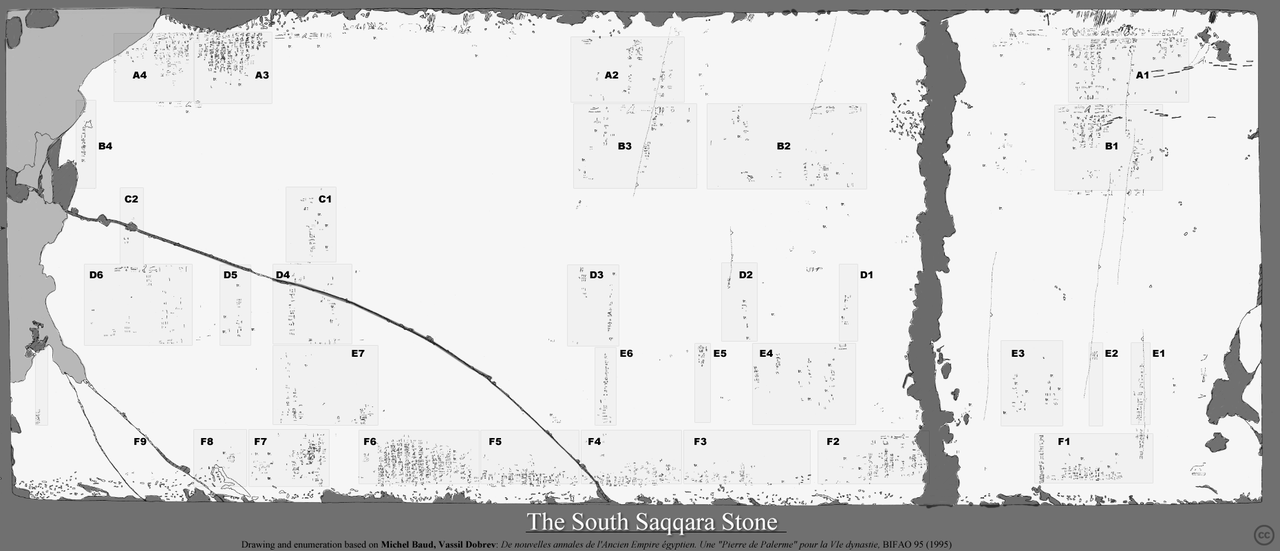
Overview and contents
The inscription contains entries for a succession of pharaohs commonly identified as belonging to the Sixth Dynasty. The names preserved include Teti, Userkare, Pepi I, Merenre and Pepi II, with the list terminating at Pepi II. Because the record ends with Pepi II, scholars infer that the monument was composed during or shortly after his reign. The entries follow a year-by-year style typical of Egyptian annals, noting royal activities, official decrees, and occasional state projects.
Physical description and reuse
The surviving piece is a large slab of stone bearing hieroglyphic text arranged in horizontal bands. At some later date the slab was taken from its original context and reused in funerary architecture: it served as the lid of a sarcophagus for a queen named Ankhesenpepi (also spelled Ankhenespepi). Reuse of older inscribed blocks in later burials and structures is common in Egyptian sites, and this secondary use contributed to abrasion and loss of much of the original inscription.
Historical context and discovery
The South Saqqara Stone comes from the Saqqara necropolis, a vast cemetery complex used throughout ancient Egyptian history. It belongs to a group of Old Kingdom documents that recorded royal years and notable events, comparable in function to other annalistic fragments found at different sites. Because it specifically preserves Sixth Dynasty names and year entries, the stone is a direct source for the political and administrative history of a period marked by long reigns and dynastic continuity.
Scholarly importance and limitations
Researchers use the South Saqqara Stone as a chronological tool when reconstructing regnal lengths, sequences and the timing of royal projects in the Old Kingdom. Its year-by-year format can corroborate or challenge information from king lists, tomb inscriptions and later historical compilations. At the same time, the slab's fragmentary state and the loss of many lines mean that readings are often tentative; scholars must combine it with other evidence to form reliable reconstructions. The stone thus exemplifies both the promise and the problems of working with reused, partial inscriptions in Egyptology.
Notable features
- Records a sequence of Sixth Dynasty rulers and associated annual entries.
- Ends with Pepi II, indicating a terminus in or shortly after his reign.
- Was later reused as a sarcophagus lid for Queen Ankhesenpepi, contributing to damage.
- Serves as part of the broader Old Kingdom annals tradition used for chronological work.
Questions and answers
Q: What is the South Saqqara Stone?
A: The South Saqqara Stone is a large piece of stone with a list of pharaohs of the 6th dynasty of ancient Egypt.
Q: Which pharaohs are included in the list on the South Saqqara Stone?
A: The list includes Teti, Userkare, Pepi I, Merenre, and Pepi II.
Q: Who was the last pharaoh listed on the South Saqqara Stone?
A: Pepi II was the last pharaoh listed on the South Saqqara Stone.
Q: What does it indicate that Pepi II was the last pharaoh listed on the South Saqqara Stone?
A: It indicates that the list was probably written during his rule.
Q: What kind of information does the list on the South Saqqara Stone contain?
A: The list on the South Saqqara Stone contains a record of the events that took place during each king's rule.
Q: What happened to the South Saqqara Stone later on?
A: The South Saqqara Stone was used as the lid of a sarcophagus for the burial of the ancient Egyptian queen Ankhenespepi.
Q: Is all of the writing on the South Saqqara Stone still readable?
A: No, a lot of the writing on the South Saqqara Stone can no longer be read.
Related articles
Author
AlegsaOnline.com South Saqqara Stone Leandro Alegsa
URL: https://en.alegsaonline.com/art/92214
Sources
- egyptsites.wordpress.com : egyptsites.wordpress.com/2009/02/17/introduction-to-saqqara/
- xoomer.virgilio.it : xoomer.virgilio.it
- xoomer.alice.it : Francesco Raffaele: "The South Saqqara Stone"