
South Bronx
A neighborhood in the southwestern Bronx of New York City, noted for its industrial history, urban decline and recovery, and its central role in the emergence of hip-hop and related cultural movements.
Overview
The South Bronx is a district in the southwestern portion of the Bronx borough of New York City. Its informal boundaries vary by source, but it commonly refers to neighborhoods south of Fordham Road and east of the Harlem River. The area includes a mix of residential blocks, small commercial corridors, light industrial sites and public open spaces. It has long been recognized for strong community institutions, active local politics and a high profile in cultural history.
Image gallery
10 Images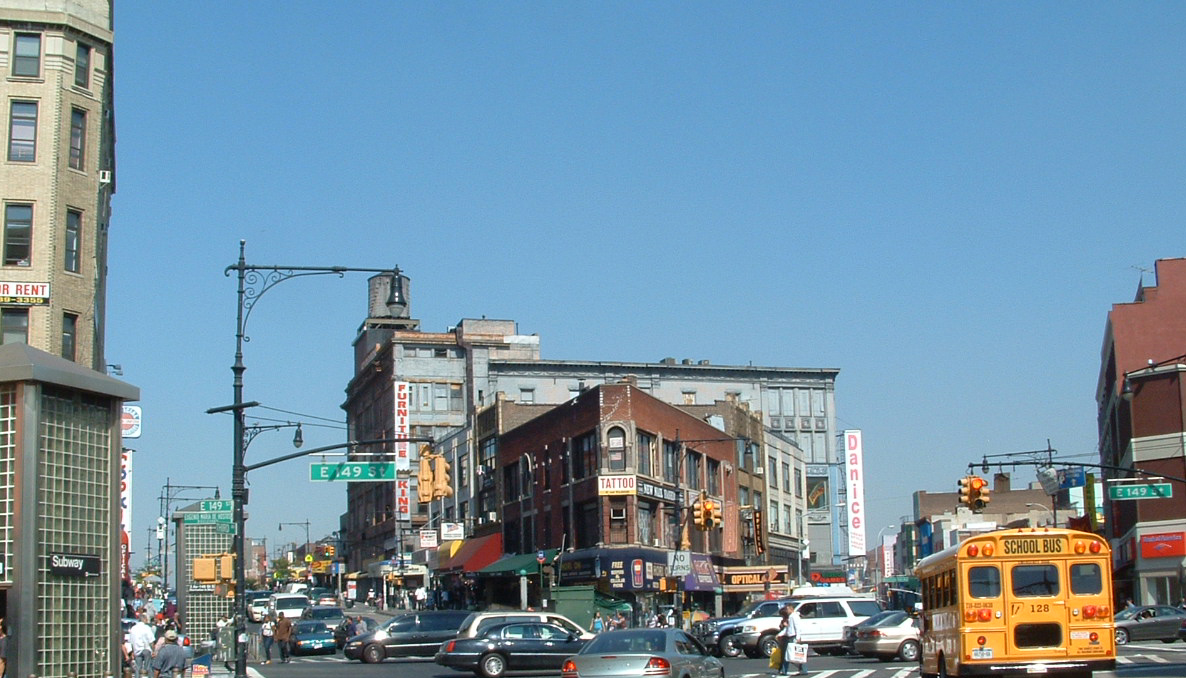




Geography and character
Parts of the South Bronx were once the estate lands of colonial families; one notable section was known as Morrisania for the Morris family. By the late 19th century much of that farmland and estate property was converted to factories, warehouses and worker housing, transforming it into an industrial suburb. The built environment contains nineteenth- and early twentieth-century rowhouses, brick tenements, and later public-housing developments.
History and development
The neighborhood’s history includes an early phase of suburban and industrial growth, a mid-20th-century period of economic decline and housing abandonment, and later waves of community organizing and reinvestment. In the postwar decades, job losses, discriminatory lending practices, and arson contributed to depopulation and deterioration in many blocks. Beginning in the 1980s and accelerating in later decades, public and private initiatives, along with local activism, supported rebuilding, affordable-housing projects and new public amenities.
Cultural influence and the origins of hip-hop
The South Bronx is widely cited as one of the birthplaces of modern hip-hop culture in the early 1970s, where DJs, MCs, breakers and graffiti artists developed a new urban movement. While many scholars and participants point to block parties, community centers and parks in the South Bronx as key sites, there are competing accounts that emphasize events elsewhere—such as parties in Queensbridge, parts of Harlem, Brooklyn neighborhoods like Bed–Stuy and Long Island venues—as also critical to the scene's emergence. Debate continues, but the South Bronx remains closely associated with several core elements of hip-hop culture.
Notable cultural elements
- DJing and MCing: Early innovators used mixers and turntables at community parties to create new musical forms.
- Breakdancing: Street dance that became tied to youth culture and competitions across the city.
- Graffiti: Visual tagging and mural work that transformed subway cars and building facades into public canvases; graffiti in and around the South Bronx gained attention for its bold styles and social commentary (graffiti).
Contemporary South Bronx
Today the South Bronx is a place of contrasts: long-standing communities and cultural organizations exist alongside new development, arts projects and transit improvements. Local museums, parks and performance venues document and celebrate the area’s contributions while social advocates continue to address affordable housing, environmental justice and economic opportunity. For further background and maps, see municipal and historical resources about the Bronx and the city at large.
Because of its layered history—estate lands, industrial growth, dramatic decline and cultural renewal—the South Bronx remains a widely discussed example of urban change and creative resilience.
Related articles
Author
AlegsaOnline.com South Bronx Leandro Alegsa
URL: https://en.alegsaonline.com/art/92128