
Solar eclipses on Mars
Solar eclipses on Mars are caused by its tiny moons Phobos and Deimos. They produce brief transits and small shadows rather than the dramatic total eclipses seen on Earth, and have been imaged by spacecraft.
Overview
Solar eclipses on Mars occur when one of the planet's natural satellites passes between the Sun and the Martian surface. Because both moons are tiny compared with Earth's Moon, these events look very different from the total solar eclipses familiar on Earth: they appear as rapid transits or small, drifting shadows rather than long-duration total obscurations of the solar disk. For general context on the phenomenon, see solar eclipses.
Image gallery
10 Images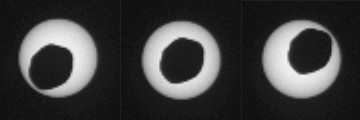




Moons that cause transits
Mars has two moons: its small satellites, Phobos and Deimos. Phobos is the larger of the pair (roughly a few tens of kilometres across) and orbits close to Mars. Deimos is smaller and much farther out. Both are dramatically smaller than the Moon as seen from Earth, so neither usually covers the Sun completely.
Appearance and duration
From the Martian surface these events most often look like dark spots crossing the solar disk — comparable to transits of Mercury or Venus seen from Earth. Phobos’ silhouette is large enough to produce a noticeable dark disk and sometimes a brief annular effect when alignment is favorable; however, a true, long-lasting total eclipse is not possible because the moons’ apparent diameters are smaller than the Sun’s. Transits are brief: a Phobos crossing typically lasts only a short time (often under a minute at a given location), while Deimos produces an even smaller, fainter dot.
Observations and scientific value
Orbital cameras and surface landers have recorded multiple transits and moving shadows. Spacecraft imagery provides precise timing of events that helps refine orbital models; surface recordings can also probe atmospheric scattering by comparing sunlight levels before, during and after a transit. Automated instruments have used these predictable crossings for instrument checks and for measuring how the thin Martian atmosphere affects solar light.
History and future trends
The two moons were discovered in the 19th century, and modern missions have since photographed their passages across the Sun. Phobos is slowly spiraling inward due to tidal interaction with Mars; over geologic time its orbit will change, altering apparent size and the character of transits. For current mission reports and images see spacecraft mission pages at Mars satellite resources and mission archives (Phobos, Deimos).
Key points and distinctions
- Phobos and Deimos produce transits or small partial/annular events rather than long total eclipses.
- Phobos’ short orbital period means some locations can experience several transits in a single Martian day.
- Deimos transits are much smaller and frequently barely perceptible without sensitive instruments.
- These events are useful for refining moon orbits and studying atmospheric effects on sunlight.
Related articles
Author
AlegsaOnline.com Solar eclipses on Mars Leandro Alegsa
URL: https://en.alegsaonline.com/art/91633
Sources
- msnbc.msn.com : "See a solar eclipse from Mars"
- jpl.nasa.gov : "NASA Rovers Watching Solar Eclipses by Mars Moons"