
Phobos (moon)
Phobos is the larger, irregular moon of Mars. It orbits very close to the planet, is heavily cratered and grooved, and is slowly spiraling inward; its origin and long-term fate remain topics of study.
Overview
Phobos is the innermost and larger of Mars's two natural satellites; its smaller companion is Deimos. It was discovered in 1877 by the American astronomer Asaph Hall. The moon is irregular in shape and small compared with typical planetary satellites, yet it has been the subject of much scientific interest because of its proximity to Mars and because its origin is not fully settled. The name derives from the Greek god Phobos, whose name means "fear" in Greek mythology.
Image gallery
10 Images




Discovery and observation history
After its discovery, Phobos was imaged and tracked by Earth-based telescopes and then by multiple spacecraft. Early flybys and orbital imaging carried out by missions such as the Mariner and Viking programs provided the first detailed pictures. Later missions, including Soviet probes in the Phobos program and orbiters such as Mars Express, furnished higher-resolution mapping and compositional data. Several mission proposals and attempts have targeted Phobos to better understand its composition and to obtain samples for return to Earth; some attempts have failed, while new missions are planned.
Physical characteristics
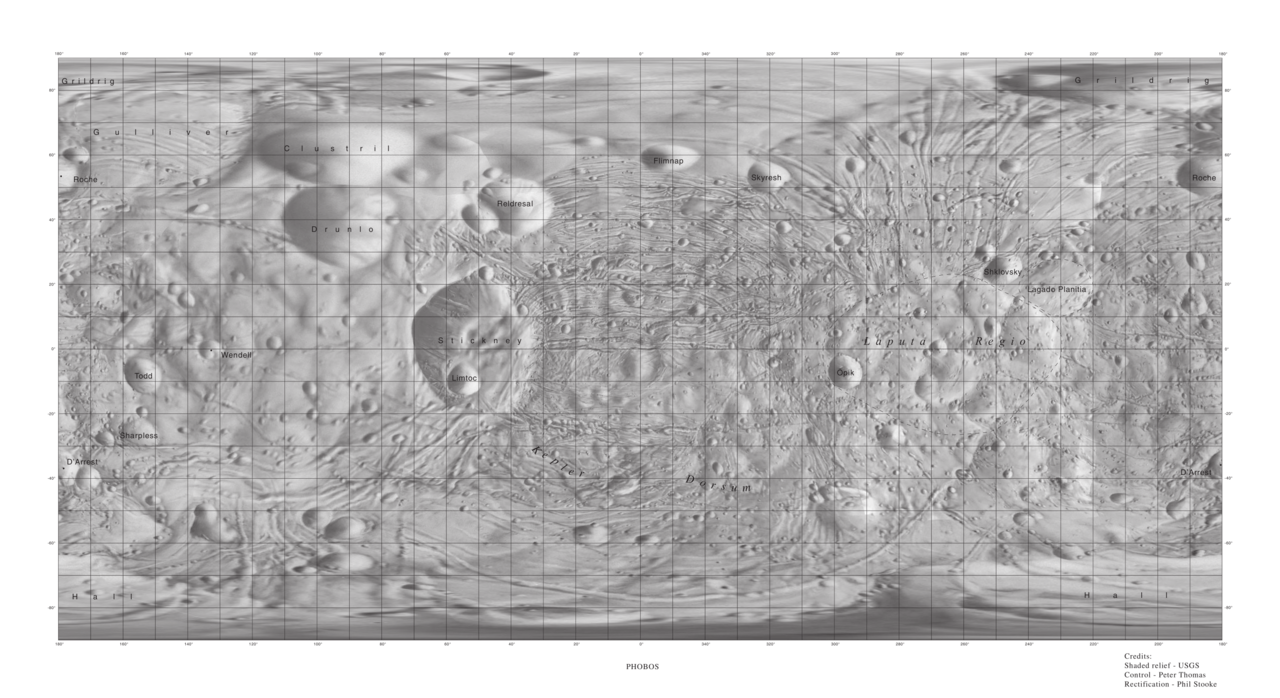
Phobos is small and irregular: typical measures place its longest dimension at around 27 kilometres, with shorter axes on the order of tens of kilometres (other dimensions vary by measurement method). The surface is heavily cratered and crossed by long linear grooves and troughs. The most prominent impact feature is the large Stickney crater, which dominates one hemisphere. The surface is covered by a layer of loose material and dust (regolith) produced by impacts and space weathering. Phobos has very low gravity compared with planets and larger moons, so surface processes and ejecta behave differently than on larger worlds.
Orbit and dynamics
Phobos orbits extremely close to Mars — only a few thousand kilometres above the surface — and completes an orbit in less than eight hours. It is tidally locked, so the same face always points toward Mars. Because its orbital period is shorter than the length of a Martian day, Phobos appears to rise in the west and set in the east. Tidal interactions between Mars and Phobos are slowly drawing the moon inward; estimates of orbital decay are commonly given on the order of a few metres per century. Over geologic timescales this inward drift may bring Phobos near the planet's Roche limit, where tidal forces could overcome its structural cohesion.
Origin and likely fate
The origin of Phobos is debated. One hypothesis proposes capture of a primitive asteroid, perhaps similar to carbon-rich D-type bodies, which is partly supported by some spectral similarities. An alternative hypothesis suggests Phobos formed from debris created by a large impact on Mars early in the planet's history; computer models have shown that an impact-origin scenario could produce moonlets in close, low-inclination orbits. Neither scenario is conclusively proven; reconciling composition, porosity, and orbital history remains an active area of research.
Because of orbital decay, many models predict Phobos will eventually move inside the Roche limit and be disrupted by tidal stresses. When that occurs — estimates place this possibility in tens of millions of years rather than billions — the moon may be torn into fragments; some debris could re-impact Mars while some could form a temporary system of rings around the planet. For background on tidal disruption and ring formation see discussions of the Roche limit and planetary rings.
Exploration and scientific importance
Phobos has been observed by a succession of spacecraft, and interest in sample return has driven mission planning. The Soviet-era Phobos program obtained valuable close-range data though with mixed outcomes. A notable more-recent attempt to return a sample failed to leave Earth orbit, while international efforts now include a planned sample-return mission intended to bring material from Phobos to Earth for detailed analysis. Understanding Phobos's composition and internal structure would help determine whether it is a captured asteroid or the product of an impact, and would clarify the relationship between Mars and its small satellites.
Notable facts and distinctions
- Phobos is much smaller than Earth's Moon (see comparison) but has well-studied surface features for a body of its size.
- Its grooves, crater patterns and regolith point to a complex impact history and to mechanical properties that may include high porosity.
- Phobos orbits closer to its planet, relative to planetary radius, than most other moons in the Solar System, which affects tidal evolution and makes it a compelling natural laboratory for small-body dynamics (impact cratering).
- Because of low gravity and proximity to Mars, Phobos has been considered as a potential staging base for future robotic or human missions to the Martian system.
For further reading and mission archives consult specialized planetary science resources and agency pages that discuss Deimos, comparative studies with Earth's Moon, and technical reviews of impact processes and small-body dynamics.
Questions and answers
Q: What is Phobos?
A: Phobos is one of Mars' moons.
Q: What is the other moon of Mars?
A: The other moon of Mars is Deimos.
Q: What is the size of Phobos?
A: Phobos is only 27 kilometers in diameter.
Q: What is Phobos named after?
A: Phobos is named after the god Phobos in Greek mythology, and its name means "fear".
Q: What is happening to Phobos' orbit?
A: Phobos is trapped in tidal drag, and its orbit is lowering roughly 1.8 meters per century.
Q: What is likely to happen to Phobos in about 50 million years?
A: Phobos will reach the Roche limit, where it is likely to be torn apart. Some fragments will fall on Mars and some will form a planetary ring or rings around Mars.
Q: What is Deimos?
A: Deimos is the smaller of the two moons of Mars.
Related articles
Author
AlegsaOnline.com Phobos (moon) Leandro Alegsa
URL: https://en.alegsaonline.com/art/76526
Sources
- exp.arc.nasa.gov : NASA Celestia
- solarsystem.nasa.gov : "Mars: Moons: Phobos"
- ssd.jpl.nasa.gov : "Planetary Satellite Physical Parameters"
- dlr.de : "Mars Express closes in on the origin of Mars' larger moon"
- oarval.org : "Classic Satellites of the Solar System"