
Deimos — moon of Mars
Deimos is the smaller, outer moon of Mars. About 15 km across and heavily cratered, it completes an orbit in ~30.3 hours and is of interest as a possible captured asteroid and mission waypoint.
Overview
Deimos is the smaller of Mars’ two natural satellites and was named from the Greek word for terror. It is a small, irregular body that follows a nearly circular, equatorial orbit around Mars. Its orbital period is 30.3 hours, a fact often referenced in studies of Martian satellites; see orbital period for data and context. Deimos is synchronously locked to Mars, keeping the same face toward the planet.
Image gallery
10 Images





Physical characteristics
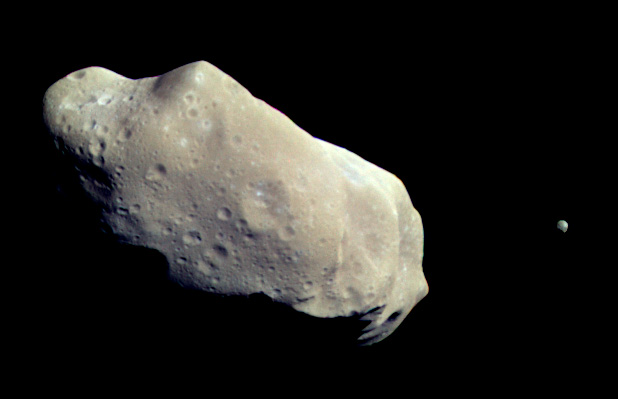
Deimos measures only on the order of 10–20 kilometers across; sources commonly state an average size near 15 kilometers, and it has a very low surface gravity. Its surface is dark and covered with loose regolith and impact features. Much of what is visible are small to medium craters and a generally smooth, dusty appearance; comparisons of its cratered surface to other airless bodies are often made (craters). The moon’s composition is consistent with carbonaceous, C-type asteroids, suggesting a primitive, rock-rich makeup.
Origin and history
Deimos was discovered in 1877 by the American astronomer Asaph Hall. Two main ideas have been proposed for its origin: a captured asteroid from the outer main belt or coalescence from debris left after a large impact on Mars. Its small size, irregular shape, and spectral similarities to dark asteroids support the capture hypothesis, though some models allow for local formation from impact ejecta.
Orbit and dynamics
Deimos orbits farther from Mars than its sibling Phobos and revolves more slowly than Mars rotates, so it is slowly receding from the planet rather than falling inward. Its nearly circular, low-inclination orbit makes it dynamically quiet and predictable, a feature that has practical implications for spacecraft planning and long-term orbital evolution studies.
Exploration and practical interest
Deimos has been imaged and studied by multiple spacecraft missions that have explored Mars and its neighborhood. Observations from orbiters have provided surface maps, shape models, and spectral data. Scientists consider Deimos interesting both for understanding solar-system formation and as a potential staging point or resource for future human missions to Mars. Its low gravity means landing and takeoff would be energetically inexpensive compared with Mars itself.
Notable facts and comparisons
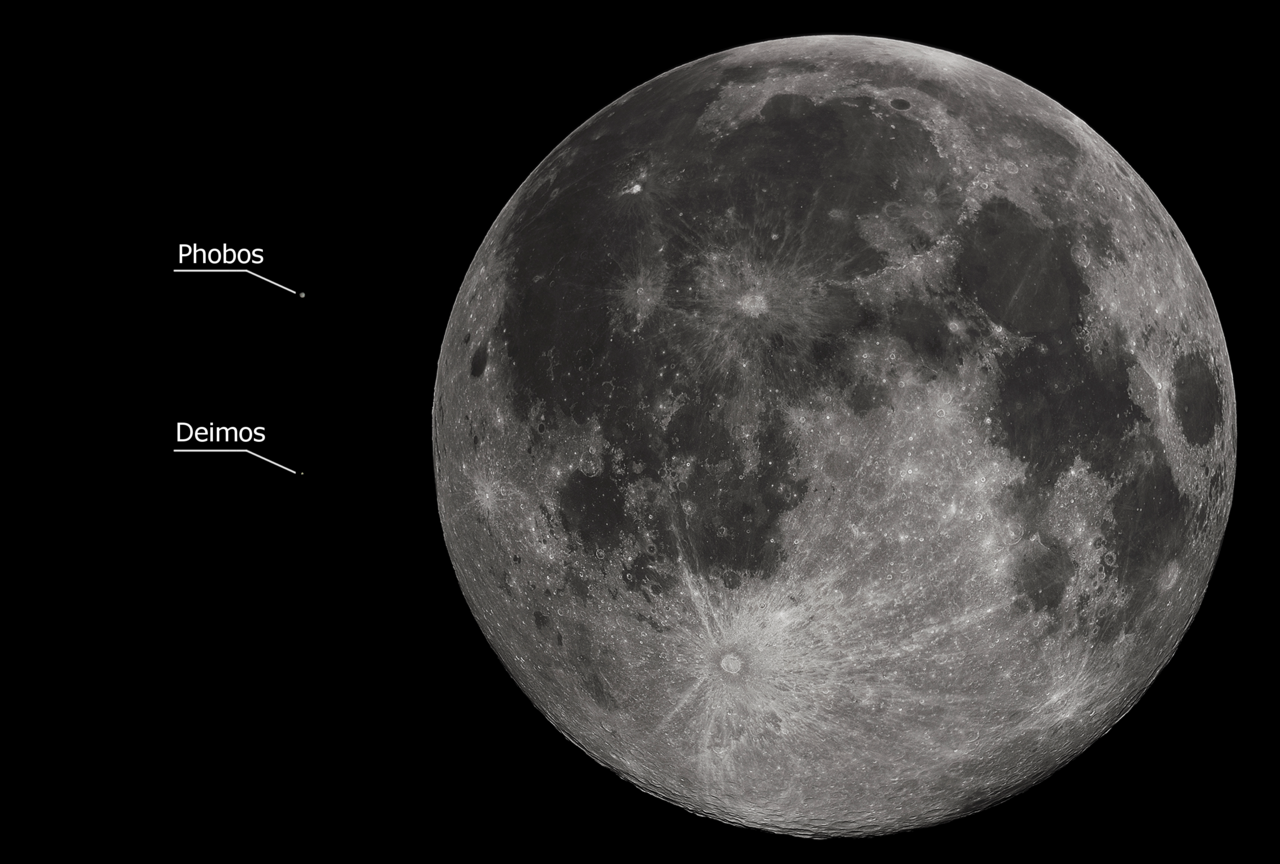
Although tiny compared with Earth’s Moon, which is often referenced for contrast, Deimos shares the common trait of a cratered, atmosphere-free surface; see a basic comparison to Earth’s Moon here. Its small size (commonly cited near 15 kilometers) and slow orbital motion make it distinct among planetary satellites and a continuing subject of scientific and mission-planning interest.
Related articles
Author
AlegsaOnline.com Deimos — moon of Mars Leandro Alegsa
URL: https://en.alegsaonline.com/art/26315