
Sodium sulfate (Glauber's salt): properties, production, and uses
Overview of sodium sulfate (Na2SO4), its forms, physical and chemical properties, industrial and historical uses, methods of production, and safety/environmental considerations.
Overview
Sodium sulfate is an inorganic salt with the chemical formula Na2SO4. Commonly encountered as a white, crystalline powder or as the hydrated mineral known as Glauber's salt (Na2SO4·10H2O), it consists of sodium cations and sulfate anions. The compound is ionic and forms readily soluble salts in water; aqueous solutions are typically neutral in pH. For basic identification and general data see compound data or references on its ions such as sodium and sulfate.
Image gallery
1 Image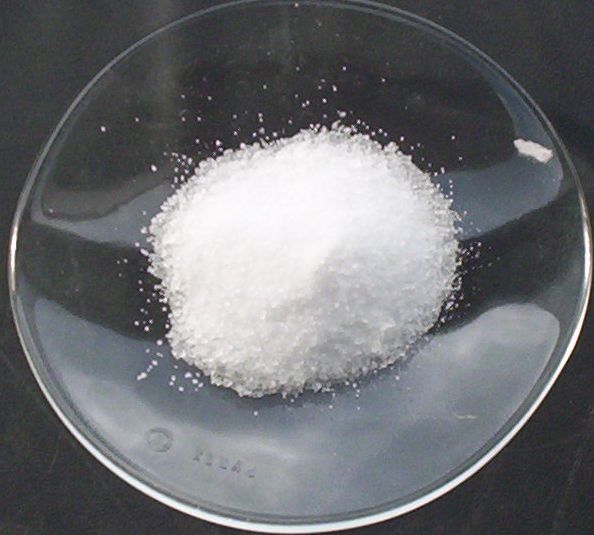
Physical and chemical characteristics
Sodium sulfate is colorless to white and has a mildly bitter taste in solid form. It exists in several hydrated states; the decahydrate (Glauber's salt) is the most notable. The sodium ions are in the +1 oxidation state while the sulfate ion carries a -2 charge. It is chemically stable under normal conditions and behaves as a typical salt: nonflammable, soluble, and ionizing in water. For measured properties consult technical sources such as material safety documents.
Production and occurrence
Industrial production commonly involves neutralization reactions between sodium hydroxide or sodium carbonate and sulfuric acid, producing sodium sulfate as a primary or by‑product. It also appears in mineral deposits and as an industrial byproduct from processes such as kraft pulping and chemical manufacturing. Practical production notes and reaction details can be found at reaction summaries and reagent pages like sodium hydroxide or sulfuric acid references.
Uses and applications
Sodium sulfate has a broad range of commercial uses. It serves as a filler in powdered detergents, in the manufacture of paper and glass, in textile dyeing as a leveling agent, and as a heat storage medium in some thermal energy systems using the decahydrate's phase change. Historically it was used pharmaceutically as a laxative. Industry guides and product categories include detergent formulations and pulp & paper processes; see detergent and industrial uses for further context.
Common applications (summary)
- Filler and builder in detergent powders (consumer products).
- Raw material or additive in pulp and paper production.
- Glass and ceramics manufacture; textile processing.
- Thermal storage and phase‑change material research.
Safety, environmental impact, and historical notes
As a bulk chemical, sodium sulfate is relatively low in acute toxicity but can cause cathartic effects if ingested in quantity; environmental concerns focus on elevated sulfate concentrations in water which can affect taste and aquatic life. Handling follows standard industrial precautions; safety data sheets provide specifics. The hydrated form is named after Johann Rudolf Glauber, an early chemist who identified its medicinal and industrial uses; see historical sources at Glauber for more on the discovery and early uses.
Related articles
Author
AlegsaOnline.com Sodium sulfate (Glauber's salt): properties, production, and uses Leandro Alegsa
URL: https://en.alegsaonline.com/art/91544