
Seven Summits: the highest peaks on each continent
The Seven Summits are the highest mountains on each of the seven continents. Lists vary by continental definition; the most common versions contrast Kosciuszko and Puncak Jaya (Carstensz Pyramid).
Overview
The term "Seven Summits" describes the highest mountain on each of the world's seven continents. Climbing all Seven Summits is a recognized mountaineering goal that combines altitude, technical climbing and logistics. Many climbers regard completion as an important benchmark in high‑altitude mountaineering and adventure travel.
Image gallery
10 Images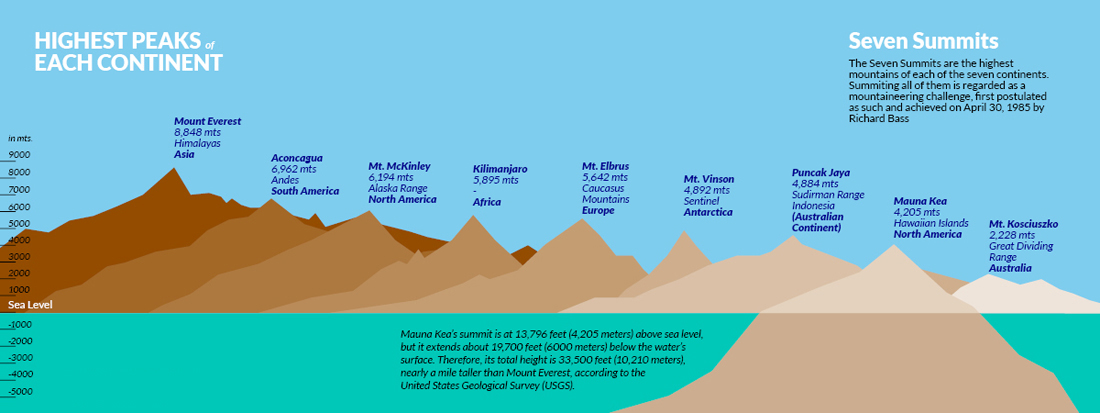




Typical list and alternative
The most widely cited list includes, in rough order of elevation: Mount Everest, Aconcagua, Mount Elbrus, Puncak Jaya (also called Carstensz Pyramid), the highest peaks in Africa and North America—commonly Mount Kilimanjaro and Denali (formerly Mount McKinley)—and Antarctica's Mount Vinson. The exact roster depends on how one defines the seven continents and their highest summits.
- Bass list: includes Mount Kosciuszko as the Australian continent high point (easier, lower elevation).
- Messner list: replaces Kosciuszko with Puncak Jaya to represent the Australasian continental plate (more remote and technical).
Characteristics and challenges
Each summit presents distinct difficulties. Everest is the world’s highest point and involves altitude, crowding and objective hazards. Denali demands extreme cold and self‑sufficiency; Aconcagua is very high but non‑technical in summer; Elbrus is a glaciated peak with route‑finding; Puncak Jaya requires rock climbing and jungle access; Vinson is remote and logistically complex; Kilimanjaro is long but non‑technical. Climbers therefore need a mix of technical skills, acclimatization experience and expedition planning.
History and notable ascents
Interest in the Seven Summits grew in the late 20th century as mountaineers sought new objectives beyond single high peaks. Two names often associated with popularizing the concept are Richard Bass, who completed his version in the 1980s, and Reinhold Messner, who argued for the alternative Australasian summit. Since then dozens of climbers have completed both versions; some have done them rapidly or in winter seasons for additional challenge.
Importance and distinctions
Completing the Seven Summits is valued for its diversity: it tests endurance, technical climbing, polar logistics and rock skills across vastly different environments. Records associated with the challenge include speed, age and style of ascent, but comparisons are complicated by the differing lists. For practical information about routes, seasons and permits, prospective climbers consult specialized guides and expedition operators linked to authoritative sources such as Aconcagua route descriptions or operator pages for Elbrus and Puncak Jaya.
For further reading, general resources include mountaineering encyclopedias, expedition logs and national park services that govern access to many of the Seven Summits. Additional context on definitions and records can be found through organizations and historical summaries that track first ascents and notable achievements.
Related articles
Author
AlegsaOnline.com Seven Summits: the highest peaks on each continent Leandro Alegsa
URL: https://en.alegsaonline.com/art/89207