
Setebos (Uranian moon)
Setebos is a distant, retrograde irregular moon of Uranus discovered in 1999. It is small and non-spherical, possibly related dynamically to other outer moons but differing in surface colour.
Overview
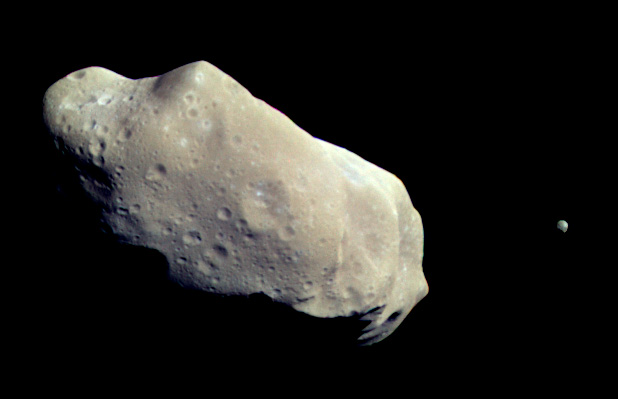
Setebos is one of Uranus's distant irregular satellites. It follows a retrograde orbit far from the planet and does not have a spherical shape. Discovered in 1999, it forms part of the population of small, irregular moons thought to be captured objects or fragments from past collisions. The term "non-spherical" applied to such moons describes bodies whose self-gravity is insufficient to pull them into a round shape; see more on irregular moons via non-spherical satellites.
Image gallery
6 Images


Discovery and designation
Setebos was identified on 18 July 1999 by a team led by John J. Kavelaars and others. Upon discovery it received the provisional designation S/1999 U 1 and was later confirmed as Uranus XIX. Many of the outer Uranian moons were discovered in surveys of faint objects around the planet during the late 20th century, using improvements in CCD imaging and longer exposures.
Name and cultural origin
The name Setebos comes from William Shakespeare's play The Tempest, in which the character Caliban and the spirit Sycorax are said to invoke a deity or spirit named Setebos. The connection to Shakespeare follows the convention of naming Uranian satellites after characters from the works of Shakespeare and Alexander Pope; the play itself is sometimes referenced directly in astronomical name citations (The Tempest).
Orbit, grouping and dynamics
Setebos orbits Uranus in a distant, eccentric, retrograde path typical of irregular moons. Orbital studies have noted that its orbital elements—such as inclination and eccentricity—place it near a dynamical grouping that includes Sycorax and Prospero. This clustering has led to the hypothesis that these moons might share a common origin, possibly as fragments of a larger captured body disrupted by collisions or tidal interactions.
Physical characteristics
- Shape and size: small and irregular in shape; not massive enough to be rounded.
- Surface colour: observations in visible light indicate a generally neutral or grey hue.
- Comparison: its grey colour is similar to Prospero but contrasts with the light red colour observed for Sycorax, suggesting differences in surface composition or space-weathering history.
Relationship with nearby moons
Although Setebos, Sycorax and Prospero share broadly similar orbital regions—leading to proposals they form a collisional cluster—their differing spectral colours complicate a straightforward common-origin interpretation. Sycorax is notably redder, whereas Setebos appears grey; Prospero's colour is closer to Setebos's. These mismatches mean that dynamical clustering alone is not conclusive evidence of a single fragmentation event. For more on Sycorax and Prospero see entries for Sycorax and Prospero.
Observation and scientific importance
Setebos is faint and challenging to observe from Earth. Photometric and spectral measurements using large ground-based telescopes help determine its colour and rough surface properties, while long-term astrometric observations refine its orbit. Studying Setebos and similar irregular moons contributes to understanding the capture processes, collisional history, and dynamical evolution of the outer regions of planetary satellite systems.
Overall, Setebos is a representative member of Uranus's distant irregular satellite family: small, non-spherical, and orbiting retrograde at great distance. Its ambiguous links to neighbouring moons illustrate how combining dynamical data with spectral observations is necessary to reconstruct the history of these remote objects.
Related articles
Author
AlegsaOnline.com Setebos (Uranian moon) Leandro Alegsa
URL: https://en.alegsaonline.com/art/89157
Sources
- arxiv.org : Preprint
- arxiv.org : Preprint
- arxiv.org : Preprint
- cfa-www.harvard.edu : cfa-www.harvard.edu/iau/NatSats/NaturalSatellites.html
- ssd.jpl.nasa.gov : ""Planetary Satellite Mean Orbital Parameters""