
Seyfert galaxy — nearby active galactic nuclei
A Seyfert galaxy is a nearby active galaxy with a bright, compact nucleus powered by a supermassive black hole. It shows strong emission lines, multiwavelength variability, and clear host galaxies.
Overview
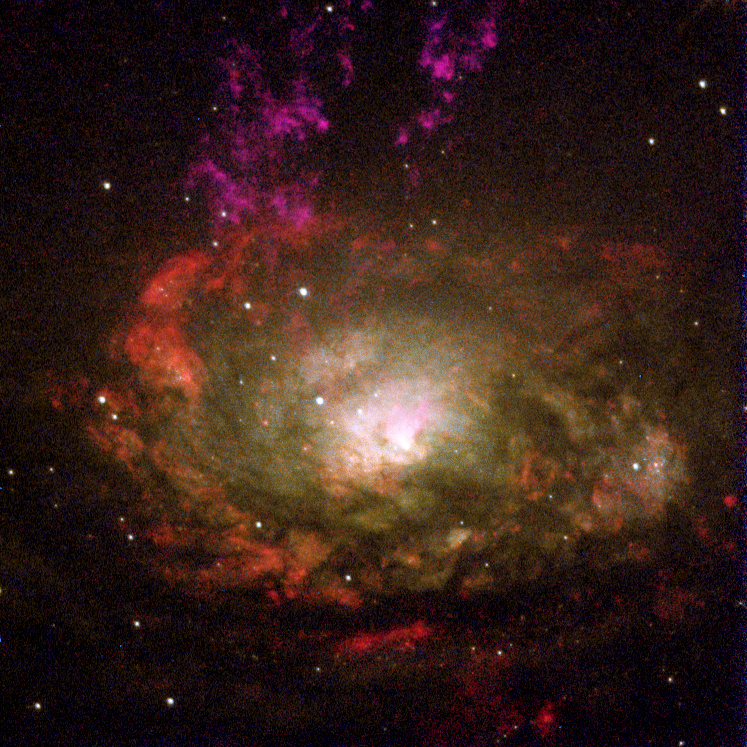
Seyfert galaxies are a class of active galaxies first identified by Carl Seyfert in 1943. They host very luminous, compact nuclei that emit across the electromagnetic spectrum and can outshine the starlight in their central regions. As members of the broader family of active galaxies, Seyferts are often compared with the more distant and luminous quasars, but unlike quasars their host galaxies remain clearly visible in optical images. The nucleus produces intense radiation from radio waves through X-rays, driven by accretion of matter onto a central supermassive black hole.
Image gallery
10 Images


Spectral properties and classification
The defining observational hallmark of Seyfert galaxies is their emission-line spectra. Their spectra show strong, often broad and narrow, lines from highly ionized atoms rather than just the absorption lines typical of normal galaxy starlight; see a discussion of emission line spectra. High-ionisation features reveal energetic photoionizing sources and fast gas motions, summarized under the heading of high-ionisation lines. Ultraviolet features and absorption lines are particularly informative for probing gas close to the nucleus and are often studied via UV spectroscopy. Observationally Seyferts are grouped into Type 1 systems, which show both broad and narrow lines, and Type 2 systems, which show only narrow lines; intermediate classes exist as well.
Physical origin and unified model
Most researchers agree that Seyfert nuclei are powered by accretion onto supermassive black holes (SMBHs) surrounded by an accretion disc and various circumnuclear structures. The accretion disc emits strongly in the ultraviolet and optical bands, while hot coronae and jets can produce X-rays and radio emission. The unified model attributes different observational types to orientation and obscuration: a dusty torus or other intervening material can hide the fast-moving broad-line region from some lines of sight, producing the appearance of a Type 2 Seyfert even when the same central engine is present.
Observational methods and multiwavelength behaviour
Understanding Seyfert galaxies relies on observations across the electromagnetic spectrum. Optical spectroscopy reveals emission-line ratios; ultraviolet studies show absorption features and ionization states; infrared traces warm dust and obscured regions; X-ray observations probe the immediate environment of the SMBH. Seyfert nuclei are variable on timescales from hours to years, which constrains the size of the emitting regions. Typical observational approaches include:
- Optical and ultraviolet spectroscopy to measure emission-line strengths and widths.
- Infrared imaging and spectroscopy to detect heated dust and obscured nuclei.
- X-ray timing and spectroscopy to probe the innermost accretion flow.
- Radio measurements to detect jets or compact cores in a subset of objects.
Occurrence, importance and distinguishing facts
Seyfert galaxies make up a significant minority of the galaxy population—roughly one in ten nearby galaxies shows Seyfert-like activity in large surveys—and are among the most intensively studied active nuclei because they are comparatively nearby and bright, making detailed observations feasible (survey statistics). The bolometric output of some Seyfert nuclei can rival the luminosity of an entire galaxy: their cores often approach the luminosity of a galaxy the size of the Milky Way in certain bands. Their relatively modest distances compared with quasars allow spatially resolved study of the interaction between the active nucleus and its host galaxy, including feedback on star formation and gas dynamics.
Notable examples and further resources
Well-known Seyfert galaxies include NGC 1068 and NGC 4151, both long-studied archetypes that illustrate obscuration, broad and narrow emission regions, and multiwavelength variability. For introductory reviews and catalogues, readers can consult general treatments of active galaxies and comparative material on quasars. For targeted technical studies, resources on UV spectroscopy, emission line spectra, and surveys summarised in survey statistics are commonly cited entry points.
Questions and answers
Q: Who first described Seyfert galaxies?
A: Carl Seyfert first described them in 1943.
Q: What are the two main types of active galaxies?
A: The two main types of active galaxies are Seyfert galaxies and quasars.
Q: What makes Seyfert galaxies different from quasars?
A: Unlike quasars, their host galaxies are clearly visible in Seyfert galaxies. They are also closer and less luminous than quasars.
Q: How much of all galaxies are made up by Seyferts?
A: About 10% of all galaxies are made up by Seyferts.
Q: What is believed to be the source of the observed ultraviolet radiation in these objects?
A: It is believed that the accretion discs surrounding supermassive black holes at their centers are the source of the observed ultraviolet radiation in these objects.
Q: How can we analyse the material surrounding a Seyfert galaxy?
A: Ultraviolet emission lines and absorption lines can be used to analyse the material surrounding a Seyfert galaxy.
Q: What does a typical Seyfert galaxy look like when seen in visible light?
A: When seen in visible light, most Seyfert galaxies look like normal spiral galaxies.
Related articles
Author
AlegsaOnline.com Seyfert galaxy — nearby active galactic nuclei Leandro Alegsa
URL: https://en.alegsaonline.com/art/89308
Sources
- adsabs.harvard.edu : adsabs.harvard.edu/doi/10.1086/144488
- ned.ipac.caltech.edu : ned.ipac.caltech.edu/level5/Cambridge/frames.html
- astro.bas.bg : astro.bas.bg/~petrov/galaxies_files/agn.html
- adsabs.harvard.edu : adsabs.harvard.edu/abs/1995ApJ...454...95M
- adsabs.harvard.edu : adsabs.harvard.edu/abs/1993Sci...259..327D
- wikidata.org : wikidata.org/wiki/Q213930
- d-nb.info : 4181123-9
- id.loc.gov : sh87001641