
Shape of the Universe: curvature, topology, and observational status
An accessible account of what scientists mean by the 'shape' of the universe — local curvature, global topology, observational tests, leading models, and why the question matters.
Overview
The phrase "shape of the universe" refers to the large-scale geometric and topological properties of space (and spacetime), not to a visual outline like that of an object. Any meaningful discussion requires the language of modern relativity rather than everyday Euclidean ideas. In that sense the topic is rooted in Einsteinian relativity and departs from the flat, familiar geometry of Euclidean geometry. Two broad aspects are usually separated: the local geometry (how space is curved at a point) and the global topology (how space is connected overall).
Image gallery
5 Images



Local geometry and curvature
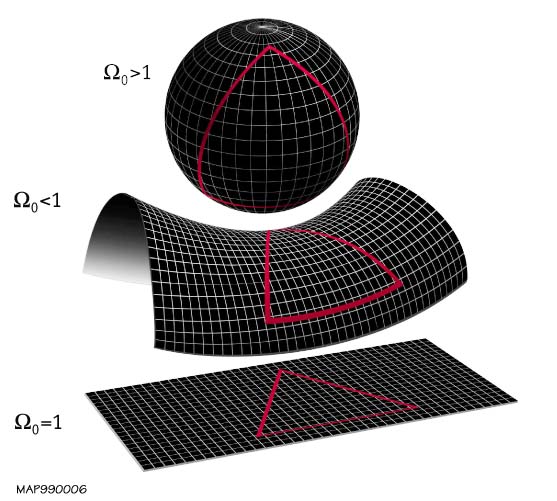
Local geometry concerns curvature, which determines whether parallel lines converge, remain the same distance apart, or diverge. Physicists commonly classify spatial curvature as positive, zero, or negative:
- Positive curvature — space is locally like the surface of a sphere.
- Zero curvature — space is locally flat, following Euclidean rules.
- Negative curvature — space is locally saddle-shaped.
These possibilities are formalized in cosmological solutions of general relativity, such as the Friedmann–Lemaître–Robertson–Walker (FLRW) family of models. Curvature is a measurable quantity tied to the overall energy content and expansion history of the cosmos; observers infer it from multiple data sets including the cosmic microwave background and large-scale structure. For clarity, the region we can probe observationally is the observable universe, a spherical volume centered on each observer defined by how far light has traveled since the Big Bang.
Global topology and overall shape
Topology asks whether space is finite or infinite, simply connected or multiply connected, and whether it has nontrivial identifications that make it "wrap around" in one or more directions. A space can be finite but without edges (often described as "finite but unbounded") if it has a compact topology. Topological possibilities include straightforward infinite Euclidean space, spherical spaces, and more exotic compact manifolds. Determining global topology is more difficult than measuring local curvature, because identical local curvature can be associated with many different topologies. Researchers explore signatures such as repeated patterns in the sky or matched circles in the cosmic microwave background to test these ideas. For technical background see topology discussions in cosmology.
Observations, models, and current status
Modern cosmology tests shape hypotheses by asking whether a given mathematical model matches observations. Teams of astrophysicists and cosmologists combine data from the cosmic microwave background, galaxy surveys, baryon acoustic oscillations, supernova distances and other probes. High-precision measurements from missions and experiments have shown that, within current uncertainties, the large-scale spatial curvature is extremely small. For example, space is consistent with being very nearly flat; some summaries by space agencies report deviations from flatness of order a few tenths of a percent. Agencies such as NASA and collaborations analyzing Planck and other data provide the detailed likelihoods for competing models. Within the FLRW framework the simplest model that fits most data is an infinite flat geometry, although alternative topologies and slightly curved models are still explored.
Why the shape matters and notable distinctions
Knowing the shape of the universe has practical and conceptual consequences. Locally measured curvature is linked to the cosmic energy budget and the dynamics of expansion; global topology bears on whether the universe is spatially finite and whether distant regions might repeat. Useful distinctions to keep in mind:
- Local curvature is a pointwise geometric property and can be constrained by observations.
- Global topology determines finiteness and connectivity and may be much harder to measure.
- The observable universe is only a portion of the whole; different observers have their own observable spheres.
In summary, the "shape" of the universe is a precise scientific question expressed in the language of relativistic geometry and topology. It is probed by observations but interpreted through theoretical models. Active research continues to refine measurements, to search for nontrivial topologies, and to understand how geometry and topology influence the cosmos' origin and long-term fate. For more background on curvature and measurements see curvature and the concept of the observable universe.
Questions and answers
Q: What is the shape of the universe according to current observations?
A: According to recent measurements, NASA has stated that the universe is flat with only a 0.4% margin of error.
Q: How does special relativity affect our understanding of the shape of the universe?
A: Due to the relativity of simultaneity, it is impossible to say whether two distinct events occur at the same time if those events are separated in space. This means that we cannot speak of different points in space as being "at the same point in time" nor, therefore, of "the shape of the universe at a point in time".
Q: What type of geometry do astrophysicists use when discussing the shape of the Universe?
A: Astrophysicists use Einsteinian relativity when discussing and testing models for describing and predicting aspects about the Universe. They also consider local geometry which relates especially to curvature and global geometry which relates to topology.
Q: Is every location in the Universe part of an observable universe?
A: Yes, every location in the Universe has its own observable universe which may or may not overlap with one centered on Earth.
Q: What is meant by 'flat' when referring to a model for describing/predicting aspects about The Universe?
A: Within one model, called FLRW (Friedmann-Lemaître-Robertson-Walker), 'flat' refers to an infinite flat model found to fit observational data best. It means that space appears uniform no matter where you look and there are no curves or bends present within this particular model.
Q: Are there other models that fit observational data besides FLRW's infinite flat model?
A: Yes, there are other models that also fit observational data besides FLRW's infinite flat model.
Related articles
Author
AlegsaOnline.com Shape of the Universe: curvature, topology, and observational status Leandro Alegsa
URL: https://en.alegsaonline.com/art/89482
Sources
- map.gsfc.nasa.gov : "WMAP- Shape of the Universe"
- books.google.com : "Topology of the universe and the cosmic microwave background radiation"
- ui.adsabs.harvard.edu : 2003eucm.book..159D
- books.google.com : Extract of page 161