
Screwdriver — overview, types, parts, history, and uses
A screwdriver is a hand or powered tool used to turn screws. This article explains its parts, common tip shapes, historical development, typical uses, safety and maintenance, and notable distinctions.
A tool used to insert and remove threaded fasteners, the screwdriver transmits rotational force to a screw head so the fastener advances or withdraws. The basic manual screwdriver consists of an axial shaft with a shaped tip that mates to a screw head and a handgrip or handle at the opposite end. Turning the handle — either by hand or by a powered driver — produces a twisting motion that, when applied correctly, converts user effort into controlled torque. The screwdriver is a simple mechanism but one of the most common tools in construction, maintenance and manufacturing.
Image gallery
10 Images


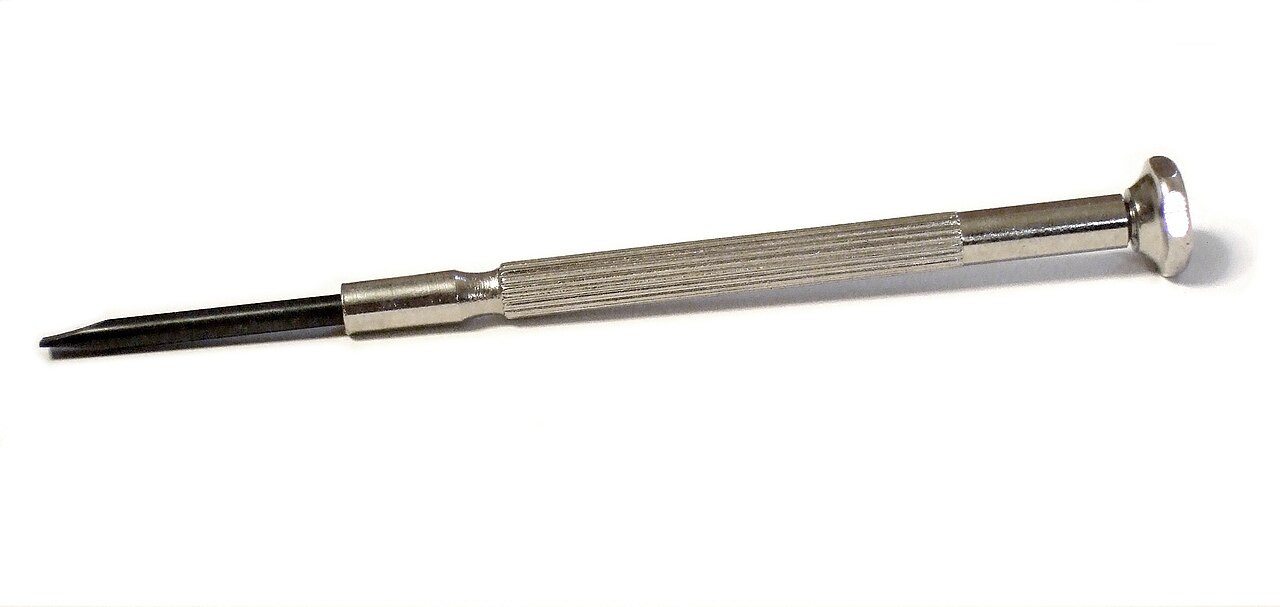


Parts and characteristics
Most screwdrivers share three main elements: the handle, the shaft, and the tip. Handles are often made of plastic, wood or composite materials and are shaped for grip and comfort; some are insulated for electrical work. Shafts are usually metal and may be fixed or removable; they determine reach and leverage. Tips are ground or machined into a geometry that fits the groove or recess of a screw head. Using the correct tip shape and size is essential to avoid slipping and damaging the screw or tool.
Common tip types and identification
- Slotted (flat) — a single straight slot, the oldest common type.
- Phillips — a cross-shaped slot designed to allow higher torque and to cam out under overload; widely adopted in the 20th century. Screws with this head are common in consumer products.
- Pozidriv — similar to Phillips but with improved torque transfer and less cam-out.
- Robertson (square) — a square recess favored for quick alignment and reduced slipping.
- Torx (star) — a six-point star-shaped recess developed to permit high torque without cam-out; popular in electronics and automotive work.
- Hex/Allen — a hexagonal recess used on machinery and furniture assembly.
History and development
Threaded fasteners and drivers evolved together: as screws became more widely used in the late medieval and early modern periods, corresponding tools were developed to turn them. Standardized head shapes and matching drivers emerged over time to improve efficiency, reduce slippage and facilitate mass production. Innovations in the 20th century, including the Phillips cross-head and later star and hex designs, reflected needs in manufacturing and automotive assembly where reliable torque transfer and rapid assembly were priorities.
Manual versus powered drivers
Handheld screwdrivers rely on the operator for torque and control, making them ideal for precision work and tasks near delicate materials. Powered drivers and electric screwdrivers provide greater speed and torque for repetitive or heavy-duty tasks; many accept interchangeable bits so a single driver can work with multiple head types. Impact drivers add percussive force for stubborn fasteners but require care to avoid over-tightening.
Uses, care and best practices
Screwdrivers are used in carpentry, electronics, appliance repair, automotive maintenance and countless household tasks. To extend tool life and protect fasteners: select the right tip shape and size; keep tips clean and undamaged; apply steady pressure while turning; use the appropriate torque setting or a torque-limiting tool when required; and store drivers to avoid tip wear. For electrical work, use tools rated for insulation and follow safety procedures.
Notable facts and distinctions
- Choosing the wrong tip increases the chance of stripping a screw head or slipping, which can cause injury or damage to surrounding material.
- Some screwdrivers have interchangeable bits, magnetic tips, or ratcheting handles to improve usability.
- Specialty screw heads and matching drivers are used for tamper resistance in public fixtures and electronics repair.
For technical specifications, standards and sizing conventions, consult manufacturer's documentation or industry standards relevant to your region and application. Additional practical guidance can be found in tool handbooks and reputable online resources: handle ergonomics, proper rotation techniques, and tool selection guides are useful starting points. For a deeper look at screw types and driver interactions see torque considerations and comparative histories at reference sources linked below: mechanism design, handle materials, and fastener types.
Related articles
Author
AlegsaOnline.com Screwdriver — overview, types, parts, history, and uses Leandro Alegsa
URL: https://en.alegsaonline.com/art/88217
Sources
- britannica.com : "Screwdriver"