
Orbital inclination: definition, measurement, and significance
Orbital inclination is the angle between an orbiting body's orbital plane and a chosen reference plane. It determines prograde/retrograde motion, transit visibility, and orbital dynamics for planets, moons, and satellites.
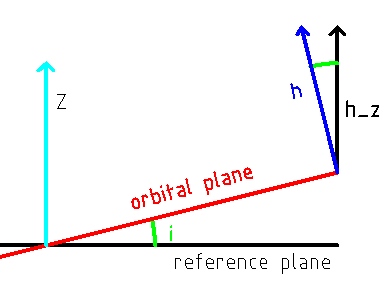
Orbital inclination is the angle measured between two orbital planes. In practical astronomy it denotes how tilted an object's orbit is relative to a chosen reference plane; this basic concept is often expressed as the angle between orbital planes. The value is customarily given in degrees and ranges from 0° (coplanar, same direction) to 180° (coplanar, opposite direction).
The choice of reference plane depends on context. For objects in the Solar System the common reference is the ecliptic, the plane defined by Earth's orbit, while for stellar systems one may use the galactic plane. The geometric concept itself refers to orbital planes in general and applies to bodies such as stars within galaxies and planets around stars.
For satellites and natural moons the reference is often the host planet's equatorial plane. An inclination of 0° means the satellite orbits in the planet's equatorial plane and typically in the same rotational direction; this is true for many regular moons. When speaking of a moon, zero inclination implies alignment with the planet's equator and prograde motion.
Image gallery
4 Images


How inclination is used and measured
Astronomers report inclination as the angle between an orbit and its reference plane, measured at the ascending node where the orbit crosses the reference plane from south to north. Important practical consequences include whether a planet will produce transits as seen from Earth, spacecraft mission design, and interpreting Doppler (radial velocity) data, where measured masses are often M·sin(i).
Typical values and notable cases
- Many major planets have relatively small inclinations to the ecliptic, while some minor planets and dwarf planets can be highly tilted.
- An inclination near 90° is called polar; values greater than 90° indicate retrograde orbits (opposite the primary body's rotation).
- Mutual inclination measures the tilt between two orbits and affects long-term dynamics and stability.
Understanding inclination helps explain orbital families, resonance behavior, and observational selection effects for exoplanets and binaries. It is a simple geometric parameter with broad consequences across celestial mechanics, mission planning, and observational astronomy.
Related articles
Author
AlegsaOnline.com Orbital inclination: definition, measurement, and significance Leandro Alegsa
URL: https://en.alegsaonline.com/art/72978