
Scutum (constellation)
Scutum is a small southern constellation on the Milky Way, known for the Wild Duck Cluster and for giving its name to Delta Scuti variables and a nearby spiral arm.
Overview
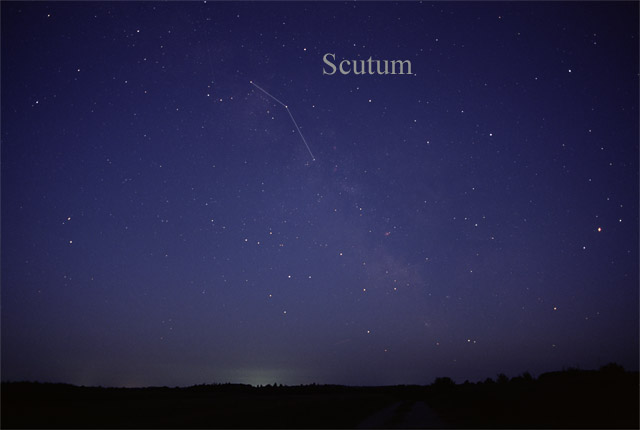
Scutum is a compact constellation located along the plane of the Milky Way in the southern celestial hemisphere. It contains few very bright stars but lies in a rich star field, making it notable for star clusters and Milky Way structure rather than lone bright stars. Scutum is most easily seen when the summer Milky Way is prominent in the evening sky of the northern hemisphere.
Image gallery
7 Images




Location and characteristics
The constellation sits between the constellations Aquila and Sagittarius and occupies a modest area of sky. Because it lies near the densest part of the Milky Way, Scutum hosts several open clusters and nebulae that are popular targets for amateur telescopes. Its stars are generally of moderate brightness, so Scutum is better recognized by its deep-sky objects and the nearby star clouds than by a distinctive pattern of bright stars.
History and name
Scutum was introduced in the late 17th century by the astronomer Johannes Hevelius. He named it Scutum Sobiescianum (the Shield of Sobieski) in honor of the Polish king John III Sobieski; the name was later shortened to Scutum, Latin for "shield." It is one of the more recent constellations by classical standards, created during the era when many astronomers added new figures to fill gaps in celestial maps.
Notable stars and deep-sky objects
- Alpha Scuti — the brightest star in the constellation, but only modestly bright compared with the major winter and summer stars.
- Delta Scuti — a prototype of a class of short-period pulsating variable stars known as Delta Scuti variables, important in stellar astrophysics.
- Wild Duck Cluster (Messier 11) — a rich, compact open cluster visible in small telescopes and binoculars; one of the most striking objects in Scutum.
- Messier 26 — another open cluster within the constellation.
Observing and significance
Scutum is a rewarding area for observers interested in star clusters and Milky Way structure. The so-called Scutum Star Cloud—an especially bright segment of the Milky Way near the constellation—provides dense star fields and is visually impressive under dark skies. The name Scutum also appears in galactic nomenclature: the Scutum–Centaurus Arm is a major spiral arm of the Milky Way, named in part after the constellation that lies along its line of sight.
For more general information on this and neighboring constellations see constellation references. Scutum illustrates how a relatively small, faint pattern can be of outsized interest because of its rich collection of clusters and its location within the Milky Way.
Related articles
Author
AlegsaOnline.com Scutum (constellation) Leandro Alegsa
URL: https://en.alegsaonline.com/art/88245