
Scorpius–Centaurus Association (Sco–Cen): nearest OB association
A nearby OB association of young, massive and low-mass stars roughly 380–470 ly away. Includes Antares, several southern bright stars, and evidence of past supernovae shaping the local interstellar medium.
Overview
The Scorpius–Centaurus Association, often abbreviated Sco–Cen or Sco OB2, is the nearest OB association to the Sun. It is a loose grouping of young stars that share a common origin and similar space motion. Located at distances of roughly 380–470 light years from Earth, Sco–Cen contains thousands of members spanning massive O- and B-type stars down to low-mass pre-main-sequence stars, and it is a prime laboratory for studying early stellar and planetary evolution.
Image gallery
8 Images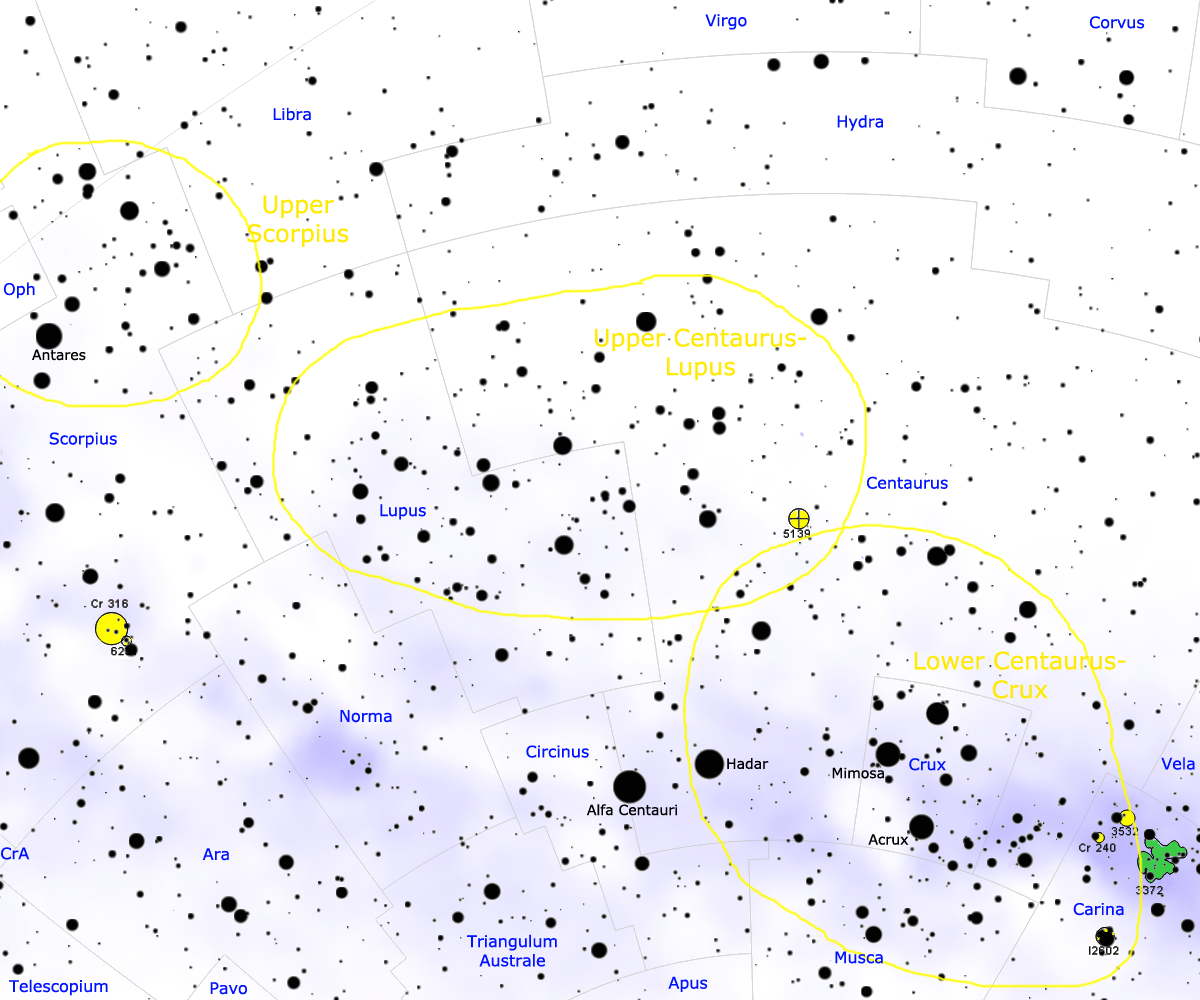


Structure and notable members
Sco–Cen is subdivided into several overlapping subgroups distinguished by age and position. The principal components are commonly called Upper Scorpius, Upper Centaurus–Lupus, and Lower Centaurus–Crux. These subgroups have slightly different ages, positions on the sky and stellar content, but all formed from the same extended molecular cloud complex. The association includes bright, well-known stars such as Antares and a number of bright southern stars, some of which appear near the Southern Cross when viewed from the southern hemisphere.
Kinematics and physical state
Members of Sco–Cen move with nearly parallel space velocities, reflecting their common birth. Their motion relative to the Sun is on the order of tens of kilometres per second; internal velocity dispersion within the subgroups is small (typically a few km/s), indicating a common origin but little remaining gravitational binding. Because the group is expanding or dispersing, it is not a long-lived, gravitationally bound cluster but rather an unbound association of coeval stars.
History, environment and supernovae
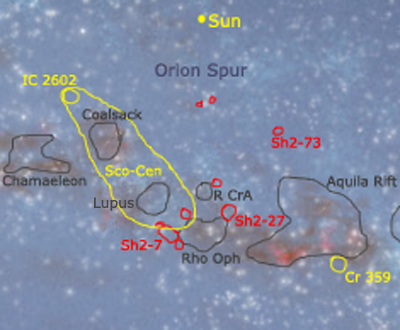
Sco–Cen is part of a larger complex of recent and ongoing star formation in the local region. Over the past ~15 million years several massive stars in the association have exploded as supernovae. Those explosions created expanding shells and superbubbles in the surrounding interstellar medium and contributed to structures in the local environment. Traces of nearby past supernovae have been inferred from concentrations of the radioactive isotope iron-60 found in deep-sea deposits: studies report iron-60 in fossil material and fossilised bacteria and in sea-floor sediments, consistent with at least one supernova event a few million years ago. The group’s bulk motion and individual velocity vectors also help reconstruct these events and their potential impact on the local interstellar medium and the heliosphere.
Scientific importance and observations
As the closest OB association, Sco–Cen is extensively studied across the electromagnetic spectrum. It provides accessible examples of very young stars, circumstellar disks, debris systems, and early planet formation. Astronomers use Sco–Cen to test models of stellar evolution, disk lifetimes, and the effect of massive-star feedback on surrounding clouds. The association is best observed from the southern hemisphere, but its members are bright and nearby enough to be followed in detail by many telescopes.
Summary and notable facts
- Distance: roughly 380–470 light years from the Sun (near the Sun).
- Age: predominantly young stars, typically on the order of 10–20 million years.
- State: an unbound OB association with low internal velocity dispersion.
- Impact: multiple past supernovae have left chemical and structural evidence in nearby space and on Earth.
Sco–Cen remains a cornerstone for understanding how groups of massive and low-mass stars form together, interact with their natal environment, and disperse into the field population of the Galaxy.
Questions and answers
Q: What is the Scorpius-Centaurus Association?
A: The Scorpius-Centaurus Association is a group of stars near the Sun that are between 380 to 470 light years away.
Q: How old are the stars in the Scorpius-Centaurus Association?
A: The stars in the Scorpius-Centaurus Association range from 11 to 15 million years old.
Q: How did the stars in the Scorpius-Centaurus Association form?
A: The stars in the Scorpius-Centaurus Association all formed from the same cloud of material.
Q: What is the main part of the complex of recent and ongoing star-formation?
A: The main part of the complex of recent and ongoing star-formation is the Sco-Cen OB association.
Q: What is the velocity of the stellar members of the Scorpius-Centaurus Association?
A: The stellar members of the Scorpius-Centaurus Association have nearly parallel velocity vectors, moving at about 20 km/s with respect to the Sun.
Q: Why is the Scorpius-Centaurus Association no longer held together by gravity?
A: The variation of velocity within the subgroups is about 1-2 km/s, and the group is most likely no longer held together by gravity.
Q: What does the presence of iron-60 in sea floor sediments suggest?
A: The presence of iron-60 in fossilized bacteria in sea floor sediments suggests there was a supernova near the solar system about 2,000,000 years ago.
Related articles
Author
AlegsaOnline.com Scorpius–Centaurus Association (Sco–Cen): nearest OB association Leandro Alegsa
URL: https://en.alegsaonline.com/art/88081
Sources
- iopscience.iop.org : "A Hipparcos census of nearby OB Associations"
- arxiv.org : astro-ph/9809227
- ui.adsabs.harvard.edu : 1999AJ....117..354D
- doi.org : 10.1086/300682
- arxiv.org : 1112.1695
- ui.adsabs.harvard.edu : 2012ApJ...746..154P
- doi.org : 10.1088/0004-637X/746/2/154
- adsabs.harvard.edu : adsabs.harvard.edu/abs/2012ApJ...746..154P
- arxiv.org : 0809.0407
- ui.adsabs.harvard.edu : 2008hsf2.book..235P
- arxiv.org : astro-ph/0110617
- ui.adsabs.harvard.edu : 2002A&A...381..446M
- doi.org : 10.1051/0004-6361:20011458
- ui.adsabs.harvard.edu : 1992A&A...262..258D
- cosmosmagazine.com : "Ancient bacteria store signs of supernova smattering"