
Oort cloud — the distant, icy reservoir of long‑period comets
The Oort cloud is a vast, distant shell of icy bodies surrounding the Solar System, thought to supply long‑period comets and to mark the outer limit of the Sun's gravitational domain.
Overview
The Oort cloud is a theoretical, very distant reservoir of small, icy bodies that surrounds the Solar System. It is invoked to explain the origin of most long‑period comets seen from Earth. Because individual objects are extremely faint and remote, the cloud has not been observed directly; its existence is inferred from the distribution of comet orbits and arrival directions studied by astronomers.
Image gallery
10 Images




Structure and extent
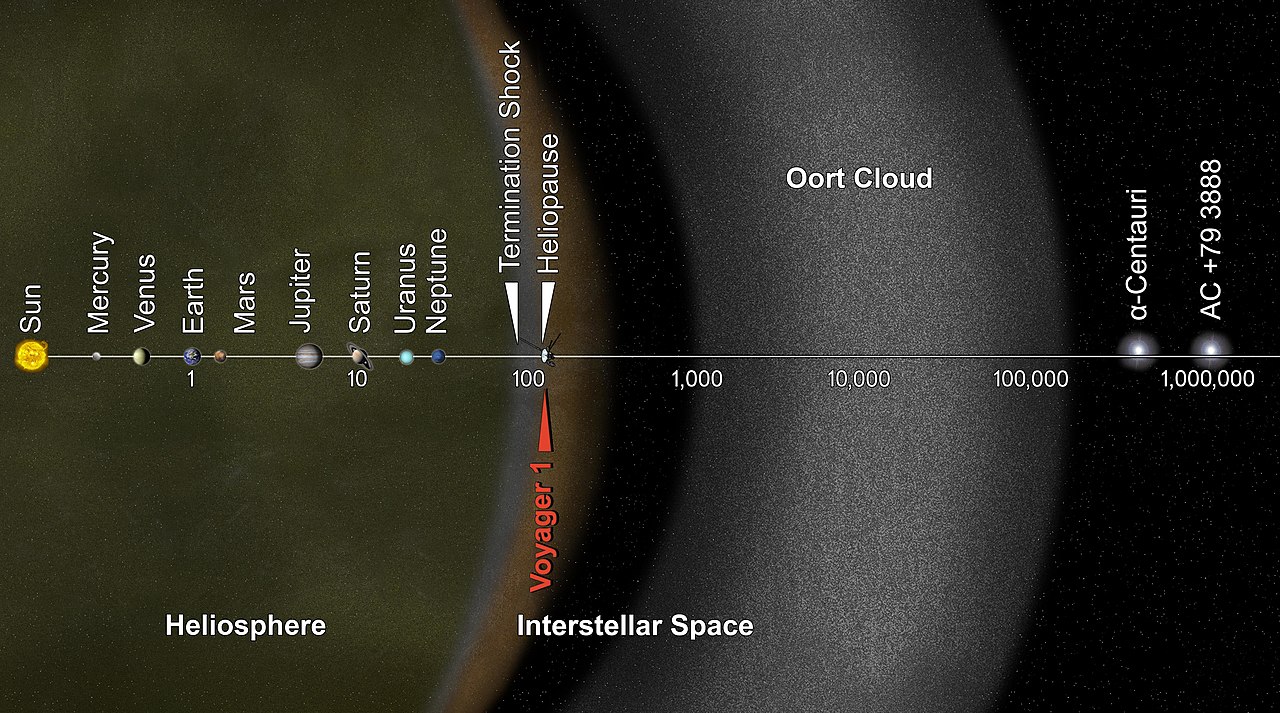
Current models divide the Oort cloud into an inner region, sometimes called the Hills cloud, and a much more extended, roughly spherical outer cloud. The outer boundary is commonly estimated to lie at tens of thousands of astronomical units (AU) from the Sun, with representative values of order 20,000–100,000 AU quoted in the literature. At such distances the Sun's gravity is weak compared with tidal forces from the Galaxy and the perturbing effect of passing stars. The cloud thus lies far beyond the orbits of the major planets and even beyond distant dwarf planets such as Pluto. It sits well outside the Kuiper belt and the scattered disc, and contains members distinct from the nearer populations of trans‑Neptunian objects. The cloud's outer edge represents, in practice, a boundary where the Sun's gravitational dominance gives way to the surrounding interstellar environment; in scale it is a nontrivial fraction of the distance toward nearby stars such as Proxima Centauri.
Origin and formation
The prevailing formation scenario holds that icy planetesimals formed in the region of the giant planets early in the Solar System's history and were scattered outward by gravitational interactions. A fraction of those bodies were placed onto distant, loosely bound orbits and were subsequently lifted to large semimajor axes by the combined effects of planetary encounters and external perturbations. Over long timescales the planetary orbits, galactic tides and occasional close encounters with passing stars or molecular clouds altered the orbital distribution and produced the approximately isotropic outer cloud inferred from comet data.
Dynamics and injection of comets
The orbits of Oort cloud objects are sensitive to small perturbations. Steady forces such as the Galactic tide can slowly change perihelia and push some bodies into the planetary region, while stochastic events — near passages of other stars or encounters with dense regions of the interstellar medium — can cause sudden injections. When an object is deflected onto a path that brings it into the inner Solar System it appears as a long‑period comet, often with a highly eccentric orbit and an inclination unrelated to the plane of the planets.
Observational evidence and limits
No direct survey has yet detected a confirmed Oort cloud object at typical distances, because even large icy bodies there would be extremely faint. Evidence comes indirectly from the orbital energies, arrival directions and frequency of long‑period comets, which match statistical expectations for an isotropic, distant source. Advances in wide‑field survey telescopes and deep imaging may eventually reach the sensitivity needed to detect nearby Oort cloud members or constrain the population more tightly.
Composition and population estimates
Objects in the Oort cloud are generally assumed to be composed of ices and dust similar to those of observed comets, including water ice, carbon‑bearing volatiles and refractory material. Estimates of the total number and mass of Oort cloud bodies vary widely because they rely on models of injection rates and the observed comet flux; authors typically describe these as order‑of‑magnitude estimates rather than precise inventories.
Significance and related reservoirs
The Oort cloud is important for understanding the long‑term delivery of cometary material to the inner Solar System, the early dynamical evolution of the giant planets and the processes that shape small‑body populations. It contrasts with nearer reservoirs such as the flat, disc‑like Kuiper belt and the scattered disc, which have different dynamical histories and supply short‑period comets and centaur objects.
History and naming
The modern concept is most closely associated with the Dutch astronomer Jan Hendrik Oort, who in 1950 synthesised comet data and theoretical arguments to propose a distant reservoir of comets. Earlier ideas and related analyses by other researchers were part of the development of the concept; the name "Oort cloud" honours Oort's influential contribution.
Research directions
Ongoing work combines dynamical modelling, surveys of comet populations and improvements in telescopic sensitivity. Topics of active research include the detailed structure of the inner and outer cloud, the role of the so‑called Hills cloud as a near source of long‑period comets, the effects of the Sun's birth cluster on early evolution, and prospects for direct detection. For further reading, see general overviews of cometary science, survey summaries by observational teams and reviews in planetary science journals; data compilations on distant small bodies and catalogs of trans‑Neptunian objects are also useful resources. Additional introductory material is available from institutional pages about the Solar System, the Kuiper belt and the scattered disc.
Questions and answers
Q: What is the Oort cloud?
A: The Oort cloud is a cloud of comets and other objects believed to be located way beyond the orbits of Pluto and the Kuiper belt.
Q: What is the source of long-period comets in the Solar System?
A: The Oort cloud is believed to be the source of long-period comets in the Solar System.
Q: How far is the Oort cloud from the Sun?
A: The Oort cloud may lie about 50,000 AU or nearly a light-year from the Sun.
Q: How does the distance between the Oort cloud and the Kuiper belt compare?
A: The distance of the Oort cloud is nearly a quarter of the way to Proxima Centauri, while the Kuiper belt and scattered disc, the other two reservoirs of trans-Neptunian objects, are less than one thousandth of the Oort cloud's distance.
Q: What is the significance of the outer limit of the Oort cloud?
A: The outer limit of the Oort cloud defines the boundary of the Solar System and the region of the Sun's gravitational dominance.
Q: Who published the Oort cloud idea?
A: The Dutch astronomer Jan Hendrik Oort published the Oort cloud idea in 1950.
Q: What were named after Jan Hendrik Oort?
A: The Oort cloud, Oort comet, and Oort constants were named after Jan Hendrik Oort.
Related articles
Author
AlegsaOnline.com Oort cloud — the distant, icy reservoir of long‑period comets Leandro Alegsa
URL: https://en.alegsaonline.com/art/72719
Sources
- rsta.royalsocietypublishing.org : "A review of cometary sciences"
- ui.adsabs.harvard.edu : 1987RSPTA.323..339W
- doi.org : 10.1098/rsta.1987.0090
- doi.org : "The fundamental role of the Oort cloud in determining the flux of comets through the planetary system"
- doi.org : 10.1111/j.1365-2966.2007.12269.x
- arxiv.org : astro-ph/0512256
- arxiv.org : astro-ph
- solarsystem.nasa.gov : "Kuiper Belt & Oort Cloud"
- articles.adsabs.harvard.edu : "The structure of the cloud of comets surrounding the Solar System and a hypothesis concerning its origin"
- wikidata.org : wikidata.org/wiki/Q40864
- id.loc.gov : sh86000523
- uli.nli.org.il : 000773523
- viaf.org : 307321359
- worldcat.org : viaf-307321359