
Band Aid (band)
British–Irish charity supergroup formed in 1984 by Bob Geldof and Midge Ure to record "Do They Know It's Christmas?" for Ethiopian famine relief; later re-recordings and a lasting influence on benefit music projects.
Overview
Band Aid was a short‑lived charity supergroup made up of prominent musicians from the British and Irish pop and rock scenes. Conceived in 1984 by organizer and musician Bob Geldof together with Midge Ure, its purpose was to raise funds and public awareness for famine relief. The project produced the single "Do They Know It's Christmas?", recorded quickly with a large ensemble of artists and released to benefit victims of famine in Ethiopia. The record became a major chart success and helped popularize the idea of celebrity charity singles.
Image gallery
7 Images


Formation and recording
Band Aid was organized as an urgent response to news and photographs documenting widespread starvation. Geldof and Ure wrote and produced the song, recruiting dozens of well‑known singers, instrumentalists and producers to record in a single session. The one‑off nature of the group meant its membership varied by appearance and by later re‑recordings; the focus was on rapid production, high visibility and channeling proceeds to relief organizations.
Recordings and re‑recordings
The original 1984 single topped charts at Christmas and raised substantial funds for relief efforts. The project was revisited several times by new lineups of contemporary artists to renew fundraising and public interest. Notable versions include:
- Band Aid (1984) – original recording that initiated the campaign.
- Band Aid II (1989) – a late 1980s reinterpretation with then‑current pop stars.
- Band Aid 20 (2004) – marked the twentieth anniversary with updated contributions.
- Band Aid 30 (2014) – another anniversary edition that responded to renewed crises.
Impact and legacy
Band Aid helped establish a template for benefit singles and large‑scale celebrity fundraising in popular music. Its commercial success demonstrated how music releases could mobilize public donations and media attention. The initiative also inspired related efforts elsewhere, including multinational charity concerts and collaborative records. In addition to raising money, the project triggered wider debate about the role of celebrity activism, the effectiveness of aid distribution, and how humanitarian crises are portrayed in media and popular culture.
Criticism and notable facts
While widely praised for raising funds quickly, Band Aid has also been critiqued for simplistic messaging and for reinforcing stereotypes about affected populations. Debates about representation and long‑term aid strategy have been part of the enduring conversation around the recordings. Despite such criticisms, the Band Aid singles remain landmark examples of popular music used explicitly for charitable relief and have had a lasting influence on how artists engage with humanitarian causes.
For further context on charity singles, their organization and historical reception, see articles on the broader phenomenon and contemporary discussions of celebrity philanthropy. Additional details and participant lists can be found via archival and music‑history sources.
Band Aid
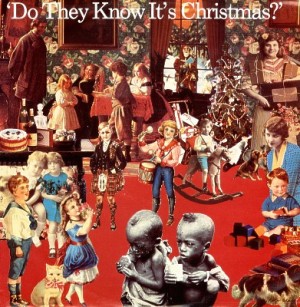
On 28 November 1984, the single Do They Know It's Christmas? was released in the UK. The song reached number 1 in 13 countries, including the Federal Republic of Germany.
Following the success of Band Aid, Bob Geldof organised a worldwide benefit concert Live Aid on 13 July 1985. The first Band Aid project involved (according to the order on the record cover):
- Freddie Mercury
- Adam Clayton (U2)
- Phil Collins (Genesis)
- Bob Geldof
- Steve Norman (Spandau Ballet)
- Chris Cross (Ultravox)
- John Taylor (Duran Duran)
- Paul Young
- Tony Hadley (Spandau Ballet)
- Glenn Gregory (Heaven 17)
- Simon Le Bon (Duran Duran)
- Simon Crowe (The Boomtown Rats)
- Marilyn
- Keren Woodward (Bananarama)
- Martin Kemp (Spandau Ballet)
- Jody Watley (Shalamar)
- Bono (U2)
- Paul Weller
- James "JT" Taylor (Kool & The Gang)
- George Michael
- Midge Ure (Ultravox)
- Martyn Ware (Heaven 17)
- John Keeble (Spandau Ballet)
- Gary Kemp (Spandau Ballet)
- Roger Taylor (Duran Duran)
- Sarah Dallin (Bananarama)
- Siobhan Fahey (Bananarama)
- Pete Briquette (The Boomtown Rats)
- Francis Rossi (Status Quo)
- Robert "Kool" Bell (Kool & The Gang)
- Dennis Thomas (Kool & The Gang)
- Andy Taylor (Duran Duran)
- Jon Moss (Culture Club)
- Sting (The Police)
- Rick Parfitt (Status Quo)
- Nick Rhodes (Duran Duran)
- Johnnie Fingers (The Boomtown Rats)
- David Bowie
- Boy George
- Holly Johnson (Frankie Goes to Hollywood)
- Paul McCartney
The designer of the record cover, Peter Blake, was also mentioned.
Not on the album cover of the Phonogram single, but were named in the booklet of The Story of the Official Band Aid Video:
- Stuart Adamson (Big Country)
- Bruce Watson (Big Country)
- Tony Butler (Big Country)
- Mark Brzezicki (Big Country)
Also listed there is Paula Yates, Geldof's then partner and later wife.
Band-Aid singles from the Mercury label additionally list Annie Lennox (Eurythmics) and Nigel Planer (from the comedy series The Young Ones) as contributors.
The example of Band Aid was followed by pop stars in other countries. In the USA, USA for Africa was founded in early 1985. The worldwide success of their single We Are the World also helped to alleviate the need in Africa. In Germany, the Band for Africa project initiated by Herbert Grönemeyer reached number 3 in the charts with the single Nackt im Wind.
Band Aid II
Five years later, in 1989, after another drought in Ethiopia, a second Band Aid project was formed. Under the name Band Aid II, Do They Know It's Christmas? was recorded a second time; this time in the typical sound of the producers Stock Aitken Waterman. This recording also reached #1 in the UK charts, though it flopped in all other countries.
Band Aid II consisted of:
Bananarama, Big Fun, Bros, Cathy Dennis, D Mob, Jason Donovan, Kevin Godley, Glen Goldsmith, Kylie Minogue, The Pasadenas, Chris Rea, Cliff Richard, Jimmy Somerville, Sonia, Lisa Stansfield, Technotronic and Wet Wet Wet.
Related articles
Author
AlegsaOnline.com Band Aid (band) Leandro Alegsa
URL: https://en.alegsaonline.com/art/8669