
Salvador Laurel: Filipino lawyer, opposition leader and vice president
Profile of Salvador 'Doy' Laurel (1928–2004), Filipino lawyer and politician who helped lead the UNIDO coalition, served as vice president and briefly prime minister after the 1986 People Power Revolution.
Salvador Román Hidalgo Laurel, commonly known as Doy Laurel, was a Filipino lawyer and politician whose career spanned law, party leadership and government service. Born in 1928 and deceased in 2004, he is best known for his central role in the opposition to the 1970s–1980s authoritarian era and for serving as Vice President of the Philippines from 1986 to 1992 under President Corazon Aquino and the Aquino administration. He also held the short-lived post of Prime Minister during the transition period in 1986.
Laurel emerged as a prominent figure in the United Nationalist Democratic Organization (UNIDO), a broad coalition of parties and civic groups formed to challenge the rule of President Ferdinand Marcos. As a UNIDO leader he helped build consensus among opposition forces and mobilize public support that contributed to the 1986 People Power Revolution. That peaceful uprising forced the end of the martial-law era and the dictatorship that had governed the country for years.
Image gallery
5 Images


Public roles and responsibilities
After the revolution, Laurel served as vice president for a full term. In that capacity he chaired various commissions and acted as a senior adviser to the president, engaging in coalition management and policy discussions during a period of national reconstruction. For a brief interval immediately following Marcos's departure he was appointed prime minister to help oversee the transition to civilian rule.
Laurel came from a politically active family and his career combined legal training with pragmatic politics. He was an advocate for restoring democratic institutions, strengthening civil liberties and promoting consensus politics. His style was often described as conciliatory and law-oriented, reflecting his background in legal practice and coalition-building.
Elections, later life and legacy
Laurel sought the presidency in 1992 but was defeated by Fidel Ramos. After leaving elective office he remained a respected elder statesman and figure in public life, involved in party affairs and in occasional civic initiatives. Observers credit him with helping to broker alliances that preserved democratic gains during a turbulent political transition and with representing a moderate, institutional approach to governance.
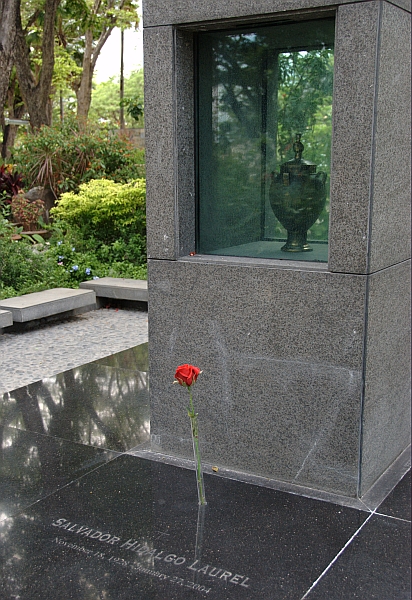
Salvador Laurel died of lymphoma on January 27, 2004, in Atherton, California, at the age of 75. His legacy is tied to the peaceful re-establishment of democratic rule in the Philippines and to the example of legal-technical leadership during a delicate period of national change.
- Key positions: UNIDO leader; Vice President (1986–1992); Prime Minister (Feb–Mar 1986)
- Notable contributions: Coalition-building for democratic transition; adviser in post-1986 reconstruction
- Remembered for: Legal background, conciliatory politics, and role in post-Marcos governance
Related articles
Author
AlegsaOnline.com Salvador Laurel: Filipino lawyer, opposition leader and vice president Leandro Alegsa
URL: https://en.alegsaonline.com/art/86575
Sources
- freewebs.com : Jose P. Laurel Memorial Foundation