
Rensselaer County, New York: Geography, History, and Communities
County in eastern New York anchored by Troy; spans Hudson River valley and Taconic foothills, borders Vermont and Massachusetts; named for Dutch patroon Kiliaen van Rensselaer.
Rensselaer County is a county in the U.S. state of New York. The county is named for Kiliaen van Rensselaer, a Dutch merchant and early patroon whose 17th‑century landholdings shaped the region's colonial development (Kiliaen van Rensselaer). The county seat and one of its principal cities is Troy, which has long been an administrative, cultural and industrial center; the term county seat describes this role.
Image gallery
6 Images


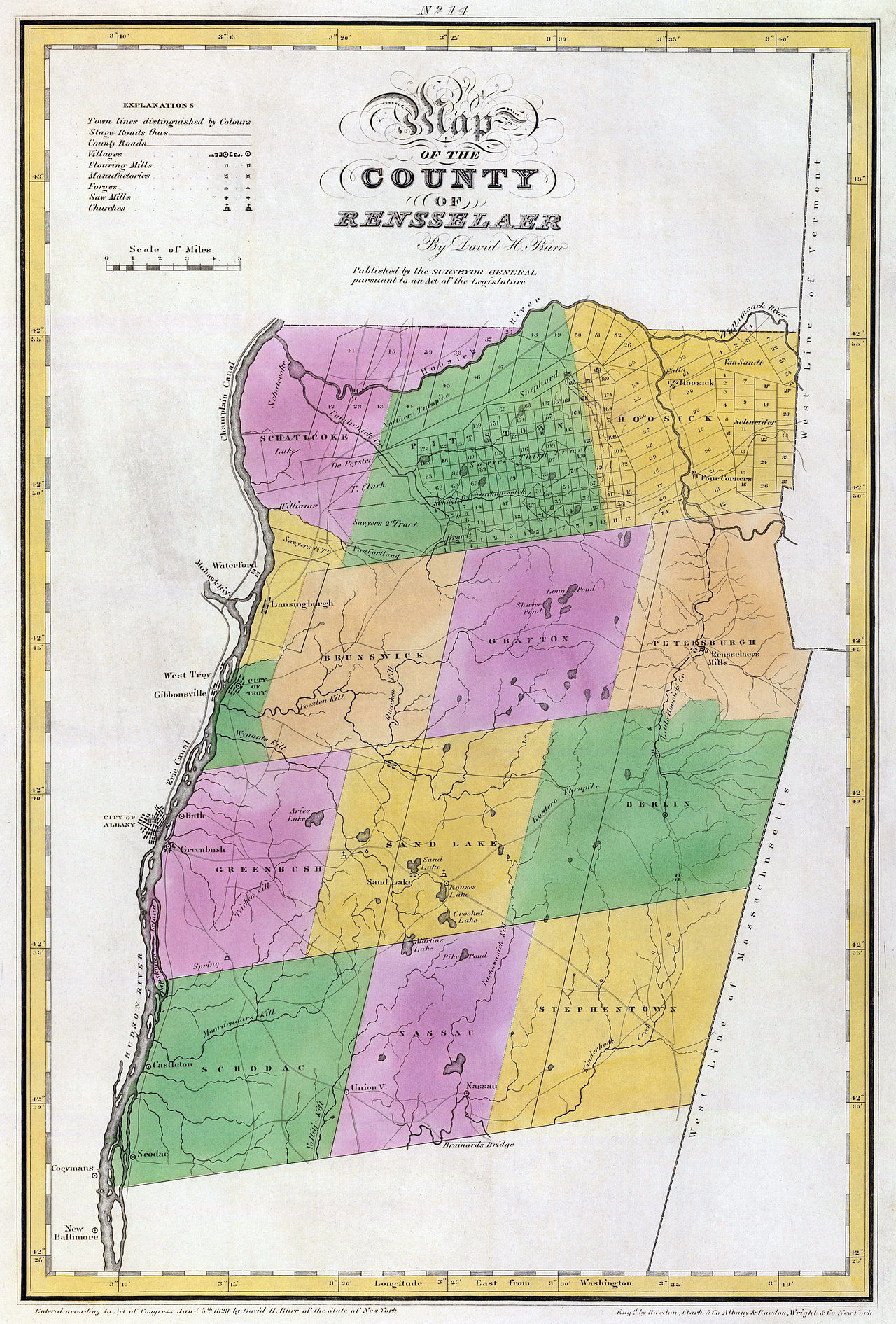


Geography
Rensselaer County occupies a varied landscape on the eastern edge of New York State. Its eastern boundary follows the state lines with Vermont and Massachusetts. The county's total area is commonly reported as about 665 square miles, of which the great majority is land and a small portion is inland water. Elevations range from sea level along the Hudson River to upland ridges in the Taconic Range; Berlin Mountain, in the town of Berlin, is the county's highest point at roughly 2,818 feet above sea level. The Hoosic (Hoosick) River, a tributary of the Hudson, drains the northern portion of the county and has influenced settlement and industry.
History
The county's settlement and administrative history reflect colonial land grants, the patroon system introduced by Dutch investors, and later American territorial organization. Farms, mills and textile works were established along rivers and falls, and 19th‑century manufacturing—ironworking and textile production among them—helped shape urban growth, most notably in Troy. Local historical studies often discuss the patroon era and the long‑term effects of early landholding patterns on development.
Population and government
At the 2000 census the county's population was reported as 152,538. Population figures have changed since then; for current totals and demographic breakdowns consult recent census and county sources. Rensselaer County's government provides services across cities, towns and villages; municipal and county offices handle courts, public records and other civic functions, often based in the county seat, Troy.
Economy and transportation
The modern economy mixes manufacturing, education, health care, retail, agriculture and services. Historic industrial facilities and riverfront districts remain important for redevelopment and tourism. Regional transportation links connect the county with the broader Albany area and neighboring states; passenger rail, freight lines and major highways provide regional access and contribute to economic ties with nearby urban centers.
Communities and land use
The county comprises a range of settlement types: urban neighborhoods in Troy and other cities, suburban corridors, and rural agricultural and forested areas. Local planning balances historic preservation, adaptive reuse of mills and factories, and conservation of upland and riverine landscapes. Small towns and villages maintain local character while participating in countywide initiatives for economic development and environmental protection.
Recreation, parks and landmarks
Outdoor recreation opportunities include hiking in the Taconic foothills, riverfront trails along the Hudson and Hoosic rivers, fishing and seasonal activities in upland areas such as Berlin Mountain. Architectural and industrial heritage—mansion districts, commercial blocks, former mill complexes and historic neighborhoods—draw visitors and researchers. Cultural institutions in Troy and neighboring communities provide museums, performing arts and educational programs that reflect the county's history.
Further information
- State and municipal resources provide administrative and demographic details (state, New York).
- Local histories treat the patroon era and Kiliaen van Rensselaer's role in early settlement (patroon history).
- County and municipal pages identify the county seat and principal communities such as Troy.
- Regional boundary and map resources describe borders with Vermont and Massachusetts and report the county's area (area figures).
- Hydrological and conservation information is available for the Hudson River corridor and the Hoosic River.
Questions and answers
Q: What is Rensselaer County?
A: Rensselaer County is a county located in the U.S. state of New York.
Q: Who is Rensselaer County named after?
A: Rensselaer County is named after Kiliaen van Rensselaer, the Dutch person who owned the land in the area.
Q: What is the population of Rensselaer County?
A: As of the 2000 census, the population of Rensselaer County was 152,538 people.
Q: Where is the county seat of Rensselaer County located?
A: The county seat of Rensselaer County is located in Troy.
Q: What is the total area of Rensselaer County?
A: Rensselaer County has a total area of 665 square miles (1,723 km²).
Q: What is the highest point in Rensselaer County?
A: The highest point in Rensselaer County is Berlin Mountain, which is 2,818 feet (859 m) above sea level.
Q: What river tributary is in the north part of Rensselaer County?
A: The Hoosic River, which is a tributary of the Hudson River, is in the north part of Rensselaer County.
Related articles
Author
AlegsaOnline.com Rensselaer County, New York: Geography, History, and Communities Leandro Alegsa
URL: https://en.alegsaonline.com/art/82174