
Red River Rebellion (1869–1870): Métis resistance and the creation of Manitoba
An 1869–70 Métis uprising in Rupert's Land that produced a provisional government under Louis Riel, prompted the Manitoba Act and highlighted disputes over land, language, religion and jurisdiction.
Overview
The Red River Rebellion was a political and social crisis in 1869–1870 centered on the Red River Settlement, an area that became the nucleus of the province of Manitoba. The disturbance arose after the British Crown, acting through the Hudson's Bay Company, agreed to transfer control of a vast territory known as Rupert's Land to the Government of Canada. Local Métis inhabitants — people of mixed Indigenous and European ancestry — feared that rapid transfer and settlement would dispossess them of their lands and undermine their language, religion and customary rights.
Image gallery
7 Images




Causes and grievances
Key causes included uncertainty over land titles (many Métis used communal or informal systems of occupation), concerns about the arrival of English-speaking Protestant officials, and the absence of consultation about transfer or surveys. The sale negotiated by the Hudson's Bay Company and the Canadian government's intention to survey and settle the region without local consent intensified fears among the Métis.
Provisional government and demands
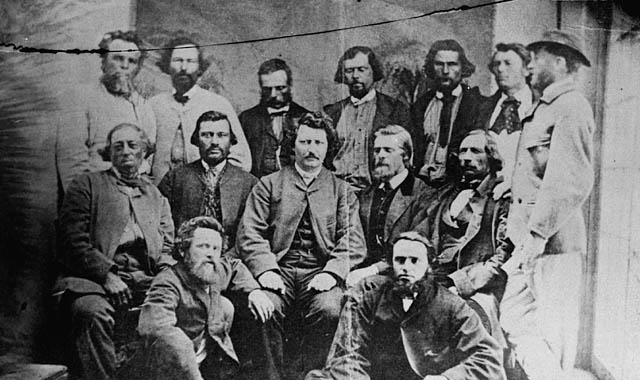
In late 1869 local leaders organized a provisional government to negotiate terms with Ottawa and to assert control of the territory. Louis Riel emerged as a leading figure; he guided a council that compiled a list of demands intended to protect the rights of the settlement's inhabitants. These demands — sometimes called the "List of Rights" — were presented in negotiations with representatives of the Canadian state.
- The right to land security and fair local titles
- Protection of the French language and Catholic schools
- Recognition of local civil institutions and legal practices
- Representation in any new provincial government
Negotiations and outcomes
After months of standoff and negotiation, the Parliament of Canada passed the Manitoba Act in May 1870, creating the province of Manitoba and incorporating several provisions aimed at addressing Métis concerns. The act promised land reserves, bilingual institutions in certain contexts, and denominational (religious) schooling protections. Nonetheless, implementation proved uneven: land surveys, administration, and local political dynamics meant that many Métis did not ultimately receive secure holdings or the protections they had sought.
Consequences and legacy
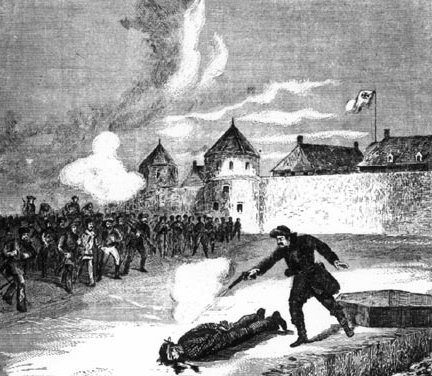
The rebellion had immediate and long-term effects. In the short term it led to the provisional transfer of power in the settlement and a period of tension, including the arrest and execution of a few opponents, which inflamed public opinion elsewhere in Canada and forced Riel into exile for a time. In the longer term, the episode set a precedent for how Canada managed western expansion — a mix of negotiation and coercion — and left unresolved issues that contributed to later conflicts, including Métis displacement and the North-West Rebellion of 1885. The Red River events remain a foundational episode in Canadian history, central to discussions of Indigenous and Métis rights, bilingualism, and regional autonomy.
For more detailed primary documents and contemporary interpretations consult historical collections and scholarly work that explore the Red River period, the text of the Manitoba Act and biographies of leaders such as Louis Riel. Additional context on the region and institutions involved can be found through resources concerning the Rupert's Land transfer, the operations of the Hudson's Bay Company, and parliamentary records from the time (Parliament of Canada).
Further reading and archival material are available through major libraries and provincial archives; for overview summaries see general histories of Manitoba and studies of Métis communities and treaties.
Related articles
Author
AlegsaOnline.com Red River Rebellion (1869–1870): Métis resistance and the creation of Manitoba Leandro Alegsa
URL: https://en.alegsaonline.com/art/81692