
Red dwarf star
Red dwarfs are the smallest, coolest common stars. This article explains their properties, internal structure, lifetimes, observational challenges, and relevance for planets and astronomy.
Overview
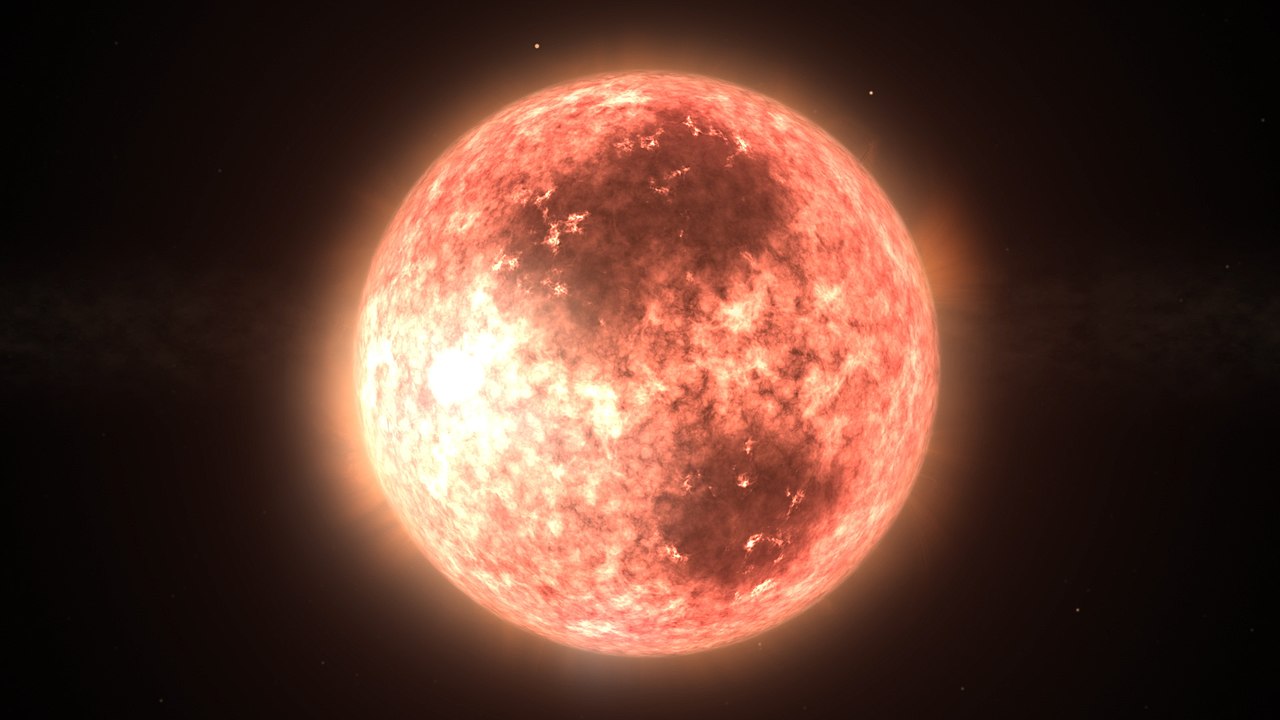
A red dwarf is a small, cool star of low luminosity and long lifetime. In astronomical classification red dwarfs belong mainly to spectral class M (and some late K types) and are often referred to simply as "M dwarfs." They generate energy by hydrogen fusion in their cores like the Sun, but do so at much lower rates, which makes them faint compared with hotter stars. For a basic definition see star.
Image gallery
8 Images





Physical characteristics
Red dwarfs have masses well below that of the Sun and radii correspondingly smaller; they are typically less than about half the Sun's mass. Their surface temperatures are also lower than those of the Sun, giving them a reddish color when observed with sensitive instruments. Their low energy output leads to low absolute brightness, so although red dwarfs are numerous they are not visible to the unaided eye from Earth; further reading on stellar size is available at red dwarf stars and general size comparisons at Sun.
Internal structure and lifetime
Many red dwarfs are fully convective: material circulates from core to surface and back, which helps them burn hydrogen more completely and efficiently than larger stars. Because they burn their nuclear fuel very slowly, red dwarfs can remain on the main sequence for extremely long times—far longer than the current age of the Universe. This longevity follows from their slow fusion rates; for an introduction to stellar burning see burn and fuel processes at fuel.
Observation and examples
Red dwarfs are the most common type of star in the Milky Way near the Sun, but their faintness makes them hard to spot without telescopes. The closest known star to Earth, Proxima Centauri, is a red dwarf and can be used as a nearby example; more on this object at Proxima Centauri and about nearby stars at Earth. Their low absolute magnitude helps explain why naked-eye catalogs contain few examples; see notes on brightness at absolute magnitude and hot star comparisons at hot.
Planets and habitability
Planets have been discovered orbiting several red dwarfs, and such systems are a major focus in the search for habitable worlds. However, red dwarfs can exhibit strong magnetic activity and flares that affect planetary atmospheres. The proximity of a temperate orbit to a faint star raises issues of tidal locking and radiation that are important when assessing habitability; see observational resources at naked eye and catalogs at light.
Distinctions and notable facts
- Red dwarfs are the most numerous stars in the Galaxy but contribute a modest fraction of its visible light.
- They are not the same as brown dwarfs: the latter do not sustain ordinary hydrogen fusion.
- Their slow evolution and long lifetimes make them important in studies of galactic population and long-term planetary environments; for background on stellar neighborhoods see fuel and burn.
For more introductory material and observational catalogs consult general astronomy resources and specialized surveys: star, red dwarf stars, and dedicated databases at hot and Earth.
Related articles
Author
AlegsaOnline.com Red dwarf star Leandro Alegsa
URL: https://en.alegsaonline.com/art/81650
Sources
- spiff.rit.edu : "Late stages of evolution for low-mass stars"