
Regulus (Alpha Leonis): the brightest star of Leo
Regulus (Alpha Leonis) is the blue-white, B-type star that marks the heart of Leo. A rapidly rotating, multiple-star system roughly 79 light-years away, notable for its brightness, oblateness and cultural history.
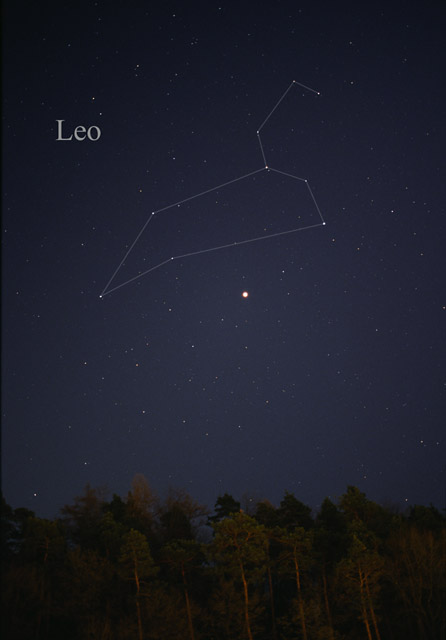
Regulus, catalogued as Alpha Leonis, is the brightest star in the constellation Leo. Visible to the naked eye, it appears blue-white and lies at a modest stellar distance from Earth of roughly 79 light-years. Observers often recognize it as the central, leading star of the lion figure.
Image gallery
5 Images



Physical characteristics
Regulus is a hot, B-type main-sequence star whose mass and size are several times those of the Sun. It rotates extremely rapidly, so fast that its equator bulges outward; this distortion produces measurable differences in surface temperature and brightness between polar and equatorial regions, a phenomenon known as gravity darkening. In addition to the bright primary, Regulus is part of a multiple-star system with one or more fainter companions.
History, name and visibility
The traditional name "Regulus" comes from Latin, meaning "little king" or "prince," reflecting its long-standing prominence in star lore and navigation. Because the star lies near the plane of the ecliptic it can be occulted by the Moon and, on rare occasions, by planets. Regulus has been used as a seasonal marker and appears in many ancient and medieval star catalogs.
Scientific importance and examples
Astronomers study Regulus to understand rapid stellar rotation, oblateness, and binary interactions. Its combination of brightness and proximity makes it accessible for high-resolution measurements and interferometry that reveal shape and surface temperature variations. The system also illustrates how mass and rotation affect a star's evolution.
- Brightest star in Leo and one of the brighter stars in the night sky.
- Blue-white B-type main-sequence primary with a mass several times that of the Sun.
- Rapid rotator showing significant equatorial bulge and gravity darkening.
- Part of a multiple-star system; close companions were detected through spectroscopy and careful observation.
For casual observers, Regulus is easy to find during late winter and spring in the Northern Hemisphere near the pattern that outlines Leo. Amateur and professional observers alike follow Regulus for both its cultural significance and the astrophysical insights it continues to provide. Further reading and catalogs can be consulted via dedicated star surveys and astronomy references: see links for constellation and stellar data such as Leo and related entries.
Related articles
Author
AlegsaOnline.com Regulus (Alpha Leonis): the brightest star of Leo Leandro Alegsa
URL: https://en.alegsaonline.com/art/81926
Sources
- earthsky.org : "Meet Regulus, the Lion's Heart | EarthSky.org"
- space.com : "Regulus: The Kingly Star"