
Rate of fire — measuring how quickly a weapon fires
Rate of fire quantifies how many projectiles a weapon can discharge per unit time, commonly given as rounds per minute or per second. It affects tactics, design, cooling and ammunition use.
Overview
Rate of fire describes how rapidly a given weapon can discharge its projectiles. It is conventionally reported as rounds per minute (RPM) or rounds per second (RPS). The figure quoted for a gun may represent a theoretical maximum, or a more practical rate that accounts for feeding, cooling and the operator.
Image gallery
2 Images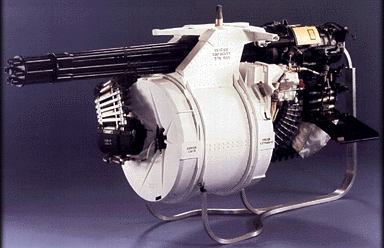

Common measures and categories
There are several ways to express and understand firing rate. Three widely used categories are:
- Cyclic rate: the mechanical maximum under continuous operation, often given by manufacturers.
- Sustained rate: a lower value reflecting limitations such as barrel heating and ammunition supply when firing for extended periods.
- Practical or effective rate: the rate achievable in combat conditions, including reloading, aiming, and controlled bursts.
Factors that determine rate of fire
Design features influence how fast a gun can fire: feeding system (magazine, belt, linkless feed), firing mechanism (semi‑automatic, fully automatic, rotary), cooling method (air, water, forced air), and barrel design. Human factors such as trigger discipline, recoil management and reloading also shape the effective rate. For example, small handguns like many pistols have relatively low practical RPM, while heavier automatic weapons can sustain much higher values.
Historical development and notable types
Early firearms relied on single-shot loading; repeating and automatic mechanisms transformed firing rates. Multi-barrel rotary guns, often called Gatling-type, achieve very high cyclic rates by distributing heat and load across rotating barrels. Modern machine guns and autocannons include recoil-operated, gas-operated and externally driven designs to manage heat and feeding at high speeds.
Examples and operational importance
Typical infantry automatic rifles and light machine guns generally cycle in the hundreds of rounds per minute; some heavy machine guns approach or exceed 1,000 RPM in cyclic terms. Aircraft and naval guns may use rotary or electrically driven systems to reach several thousand rounds per minute—an extreme example often cited is the M61 Vulcan, a rotary cannon known for very high cyclic rates tested in thousands of RPM. Choosing an appropriate rate balances firepower, barrel life, ammunition logistics and mission needs.
Practical implications and distinctions
High cyclic rates increase instantaneous firepower and the chance of hitting a fleeting target, but they amplify ammunition consumption and heat buildup. Lower sustained rates can be more controllable and conserve ammunition. Understanding the distinction between cyclic, sustained and practical rates is crucial for procurement, tactics and safe operation.
For further technical detail, consult sources on weapon mechanisms and field manuals that compare cyclic and sustained performance, or follow links to general articles on firearm design: machine guns, M61 Vulcan.
Related articles
Author
AlegsaOnline.com Rate of fire — measuring how quickly a weapon fires Leandro Alegsa
URL: https://en.alegsaonline.com/art/81262