
R136a1 — Extremely Massive Wolf–Rayet Star in the Tarantula Nebula
R136a1 is the most massive and luminous star known: a hydrogen-rich Wolf–Rayet in the R136 cluster of the Tarantula Nebula, in the Large Magellanic Cloud. Estimated ~265 M☉ and ~8.7 million L☉.
Overview
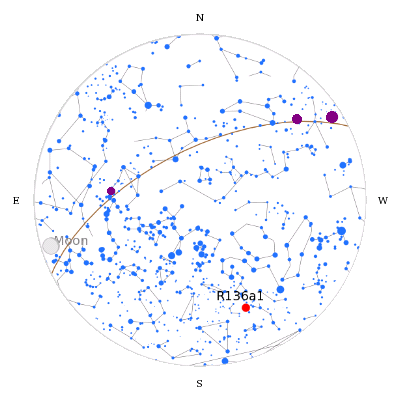
R136a1 is the most massive and luminous star currently known. Classified as a hydrogen-rich Wolf–Rayet object, it lies at the center of the compact young grouping R136 within the large open cluster NGC 2070. That cluster sits in the bright Tarantula Nebula, a star-forming region in the Large Magellanic Cloud at a distance of about 50 kiloparsecs (roughly 163,000 light‑years) from Earth. R136a1 is among a handful of exceptionally massive stars that dominate the energy output of their local environment.
Image gallery
10 Images





Physical characteristics
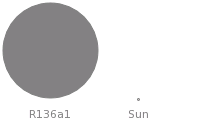
The best current estimates place R136a1 at roughly 265 times the mass of the Sun, and at an intrinsic brightness of around 8.7 million times the solar luminosity. Surface temperatures exceed 50,000 K, making it one of the hottest known stars. As a WNh-type Wolf–Rayet, it still shows hydrogen in its spectrum, indicating it is a very young, massive star that is peeling away layers through powerful stellar winds rather than a classical, hydrogen-depleted Wolf–Rayet.
Environment and origin
R136a1 is embedded in a dense cluster of massive stars that formed in a recent burst of star formation. The R136 core and the broader NGC 2070 region are only a few million years old — many studies estimate ages around 1–2 million years for the most massive members. The exceptional mass of R136a1 and its neighbors presents a challenge for theories of star formation, because assembling such large masses without fragmenting into multiple stars requires special conditions such as very dense gas, strong accretion, or stellar mergers.
Importance and observable effects
Stars like R136a1 have outsized influence on their surroundings. Their intense ultraviolet radiation ionizes nearby gas, and their strong, high‑velocity winds inject momentum and chemically processed material into the interstellar medium. In aggregate these effects regulate further star formation and contribute to the chemical enrichment of the host galaxy. Observationally, R136a1 and similar objects are prominent ultraviolet and optical sources in young star clusters and are often studied as prototypes of extreme stellar feedback.
Evolution and fate
The future of R136a1 is governed by extreme mass loss. Over its short lifetime it will shed a large fraction of its mass, and its ultimate end may be a core-collapse event that yields a supernova or a more energetic explosion and a compact remnant such as a black hole. Exact outcomes depend on mass-loss history and rotation; because of uncertainties in modelling very massive stars, predictions carry significant caveats and are an active area of research.
Notable facts and distinctions
- R136a1 is the most massive and luminous star currently recognized, but its precise mass and luminosity are model-dependent and have been revised as stellar models improve.
- It is one of several extremely massive stars clustered tightly within R136; together they outshine our Sun by many millions of times and power the brightness of the Tarantula Nebula.
- Its properties offer valuable tests of high-mass stellar physics — from formation to wind-driven mass loss and the approach to the Eddington limit — making it a key object in studies of massive-star evolution.
For further reading on massive stars, Wolf–Rayet phenomena, and the Tarantula region, see resources linked to the terms in this article and specialized reviews of high-mass stellar evolution.
Related articles
Author
AlegsaOnline.com R136a1 — Extremely Massive Wolf–Rayet Star in the Tarantula Nebula Leandro Alegsa
URL: https://en.alegsaonline.com/art/80655
Sources
- bbc.co.uk : bbc.co.uk/news/science-environment-35833873
- mnras.oxfordjournals.org : mnras.oxfordjournals.org/content/458/1/624