
Wolf–Rayet star
Wolf–Rayet stars are very hot, massive, evolved stars with powerful, fast winds and emission-line spectra; they are stripped stellar cores that often precede certain supernovae and compact remnants.
Wolf–Rayet (WR) stars are an evolved class of very massive stars characterized by extremely hot surfaces, strong, broad emission-line spectra and prodigious mass loss. They generally originate from stars that began life as massive stars, typically with initial masses above about 20 solar masses, and have lost most of their outer hydrogen layers. Visually WR stars appear blue or blue-white, but much of their radiated energy emerges at shorter wavelengths.
Image gallery
10 Images
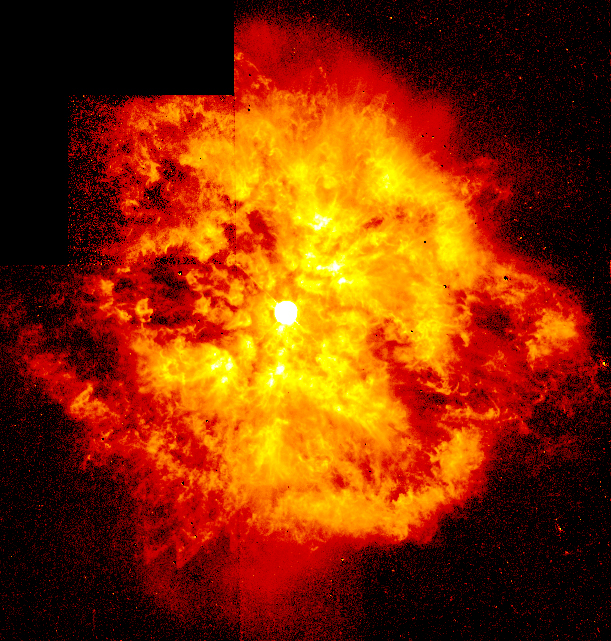


Physical characteristics
WR stars have surface temperatures ranging from roughly 30,000 K to well over 100,000 K, and in some cases up to a few hundred thousand kelvin. They are very luminous in a bolometric sense, with total energy outputs from tens of thousands to millions of times the Sun's bolometric luminosity. Their stellar winds are extremely strong: outflow speeds can reach up to a few thousand kilometres per second and mass-loss rates are typically of order 10−5 solar masses per year, many orders of magnitude greater than the solar wind (the Sun loses roughly 10−14 solar masses per year). Those winds produce broad emission lines and dense, often structured circumstellar environments.
Spectral types and surface chemistry
WR stars are identified spectroscopically by broad emission lines instead of the narrow absorption lines seen in most main-sequence stars. Subtypes reflect the surface chemical composition that is exposed after envelope stripping: WN-type spectra show strong helium and nitrogen lines, WC-type spectra show helium together with carbon and oxygen, and the rarer WO-type are dominated by highly ionized oxygen lines. These chemical signatures reveal layers processed by nuclear fusion, indicating that the original hydrogen envelope has been removed.
Formation channels and evolution
There are two main routes to produce a WR star. One is single-star evolution of very massive stars that shed their outer layers through steady winds and sometimes violent eruptions. The other is mass transfer in a close binary system where a companion strips the envelope off a star. The WR phase is relatively short compared with a star's entire life and represents a late stage in massive-star evolution, during which rotation, metallicity and binarity influence how the star loses mass and evolves.
Endpoints and astrophysical significance
As stripped cores, many WR stars are expected to end their lives in core-collapse explosions. They are commonly linked to type Ib and Ic supernovae, whose spectra lack hydrogen and sometimes helium. Under particular circumstances—for example rapid rotation and low metallicity—collapse of a WR-like core may be associated with a long gamma-ray burst. WR stars also inject ionizing radiation, kinetic energy and nucleosynthetic products into their surroundings and thus play an important role in feedback and chemical enrichment of galaxies.
Observational properties and examples
Although intrinsically luminous, WR stars emit much of their power in the far-ultraviolet and sometimes in soft X-rays, so their optical brightness can be modest relative to bolometric luminosity; ultraviolet and high-energy observations are therefore important for their study (UV studies). In binaries with strong winds, colliding-wind shocks produce X-rays and can create striking dust structures such as pinwheel nebulae; these phenomena are studied in the context of stellar winds and wind–wind interaction. Radio observations can reveal ionized outflows and nebular shells.
- Named for Charles Wolf and Georges Rayet, who first reported the unusual emission-line spectra in the 19th century.
- Binarity is common among WR stars; interactions with companions can alter mass loss and produce complex observational signatures.
- Well-known examples serve as benchmarks for massive-star models and observational techniques; comprehensive catalogues and surveys bring together photometric, spectroscopic and multiwavelength data (reference catalogues).
Researchers continue to refine mass-loss prescriptions, investigate the roles of rotation and metallicity in WR formation, and to clarify how WR stars contribute to the life cycle of matter and energy in galaxies. For detailed reviews and observational compilations consult survey articles, spectral atlases and databases that specialise in massive and Wolf–Rayet stars (luminosity and models, UV and X-ray observations).
Questions and answers
Q: What are Wolf-Rayet stars?
A: Wolf-Rayet stars are massive, evolved stars that are rapidly losing mass through a strong stellar wind.
Q: How much mass do Wolf-Rayet stars typically lose per year?
A: Wolf-Rayet stars typically lose 10^-5 solar masses per year, which is much more than our Sun's loss of 10^-14 solar masses per year.
Q: What is the surface temperature range of Wolf-Rayet stars?
A: The surface temperatures of Wolf-Rayet stars range from 30,000 K to around 200,000 K, making them appear blue in color.
Q: Are Wolf-Rayet stars highly luminous?
A: Yes, Wolf-Rayet stars are highly luminous, ranging from tens of thousands to several million times the bolometric luminosity of the Sun.
Q: Why are Wolf-Rayet stars not exceptionally bright visually?
A: Wolf-Rayet stars are not exceptionally bright visually because most of their output is in far ultraviolet and even "soft" X-rays.
Q: How do Wolf-Rayet stars lose mass?
A: Wolf-Rayet stars lose mass through a very strong stellar wind, with speeds up to 2000 km/s.
Q: What is the initial mass requirement for a star to become a Wolf-Rayet star?
A: A star must have an initial mass of over 20 solar masses to evolve into a Wolf-Rayet star.
Related articles
Author
AlegsaOnline.com Wolf–Rayet star Leandro Alegsa
URL: https://en.alegsaonline.com/art/108799
Sources
- imagine.gsfc.nasa.gov : "Ask an astrophysicist: Wolf-Rayet Stars"
- aanda.org : aanda.org/index.php?option=com_article&access=doi&doi=10.1051/0004-6361/201117830&Itemid=…