
Radio telescope
A radio telescope is an antenna and receiver system used in radio astronomy to detect and analyse radio-frequency emission from celestial sources, enabling study of phenomena invisible in optical light.
Overview. A radio telescope is an instrument built around a large antenna and sensitive electronics that collect naturally occurring radio signals for radio astronomy. Unlike an optical telescope, which gathers visible light, a radio telescope measures long-wavelength radiation that cannot be seen with the eye. Many radio dishes resemble a giant satellite television dish, but they are optimized to focus radio frequencies rather than television signals. Modern instruments pair hardware with powerful digital backends to turn voltages into calibrated data.
Image gallery
10 Images


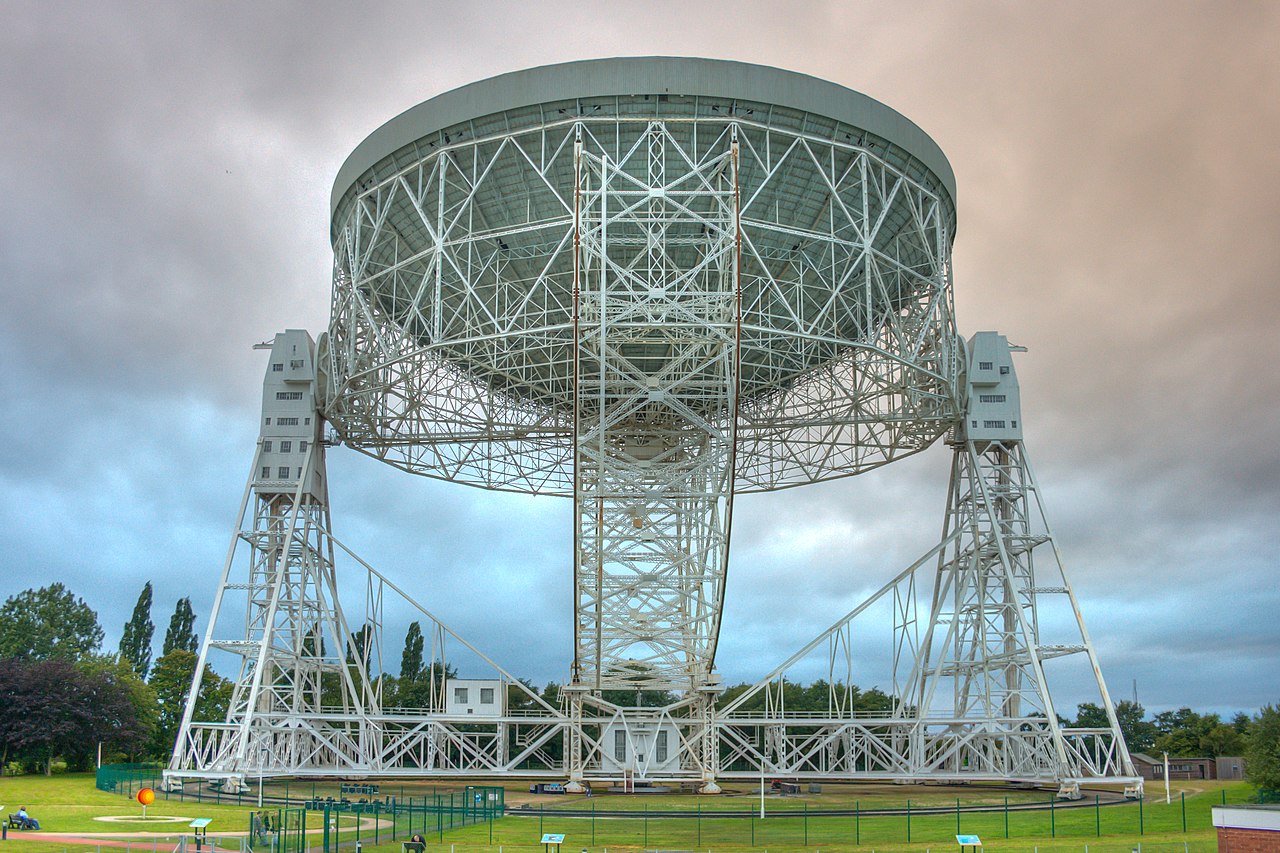




Main parts and how they work
A typical radio telescope includes a reflecting surface (usually a parabolic dish or a set of smaller antennas), a feed or receiver at the focal point, low-noise amplifiers, filters, and data acquisition systems. Incoming radio waves are concentrated by the reflector onto the feed, where they are converted to electrical signals. Receivers are often cryogenically cooled to reduce thermal noise, and analogue signals are digitized for processing by computers.
- Reflector: a solid surface or conductive mesh with hole sizes smaller than the wavelengths of interest;
- Feed and receiver: capture and convert radio power into measurable voltages;
- Low-noise amplifiers and filters: boost weak celestial signals while rejecting interference;
- Back-end processors: correlate, integrate and store data for analysis by scientists.
Frequency ranges and scientific uses
Radio astronomy covers a wide range of frequencies from long-wavelength metres to millimetre waves. Different bands reveal different physical processes: the hydrogen 21-centimetre line maps neutral gas in galaxies, molecular lines trace star-forming regions, and continuum emission reveals synchrotron radiation from relativistic particles near black holes and supernova remnants. Radio telescopes also monitor pulsars, study the cosmic microwave background at specific bands, and detect fast radio bursts and other transients.
Interferometry and high resolution imaging
Signals from multiple telescopes can be combined using interferometry to synthesize the resolving power of a much larger aperture. Very-long-baseline interferometry (VLBI) links widely separated antennas, often across continents, to achieve angular resolution equivalent to a dish as large as the distance between them. This technique enabled the Event Horizon Telescope to image the immediate surroundings of a supermassive black hole by combining many facilities into a single virtual instrument.
Observing challenges
Radio observations face several unique challenges. Radio-frequency interference (RFI) from human sources such as communications and radar can overwhelm faint astronomical signals; observatories use shielding, site selection and sophisticated filtering to mitigate RFI. At higher radio frequencies, atmospheric water vapour and oxygen produce absorption and phase fluctuations that limit sensitivity and resolution. Precise timing and stable frequency references—often atomic clocks—are required for interferometry and VLBI operations.
History, examples and roles
Radio astronomy emerged in the early 20th century when astronomers discovered that celestial objects emit radio-frequency energy. Since then, a variety of instruments—single large dishes, arrays of dishes, and aperture synthesis telescopes—have been built worldwide. The Parkes instrument in Australia, the Parkes Observatory, is a well-known example; it assisted NASA by receiving telemetry and televised signals during the Apollo 11 lunar mission. Other notable facilities include large steerable dishes and specialised arrays used for deep surveys, pulsar timing, and spacecraft tracking.
Practical and technological importance
Radio telescopes reveal cold, dusty, or non-thermal regions of the Universe invisible at optical wavelengths. They operate day and night and can study both steady and highly variable phenomena. In addition to pure research, radio observatories contribute to practical applications such as precise celestial reference frames, planetary radar studies at some sites, and support for space missions.
Future directions
Ongoing and planned projects aim to increase sensitivity, frequency coverage and survey speed. Advances in digital electronics, large-scale interferometric arrays, and international collaboration continue to expand the capability of radio astronomy to address questions about galaxy formation, extreme gravity, the interstellar medium, and transient astrophysical events.
Distinctions. Radio telescopes differ from optical observatories in wavelength, engineering challenges and observing strategies. Their ability to probe diverse physical conditions across the cosmos makes them essential instruments for modern astrophysics.
Related articles
Author
AlegsaOnline.com Radio telescope Leandro Alegsa
URL: https://en.alegsaonline.com/art/80763