
Radio galaxy
A radio galaxy is an active galaxy that emits powerful radio-frequency radiation from jets and lobes driven by a central black hole; important for jet physics, galaxy evolution and cluster feedback.
A radio galaxy is a type of active galaxy that produces exceptionally strong radio-frequency emission. The radio output is generated mainly by relativistic particles spiralling in magnetic fields (the synchrotron process), and it is often concentrated in a compact core plus extended jets and lobes that can span tens to millions of light-years. Radio galaxies are closely related to other radio-loud active nuclei such as radio-loud quasars and blazars, which are interpreted as the same basic phenomena seen from different viewing angles as part of unified models of active galactic nuclei (active galaxy).
Image gallery
5 Images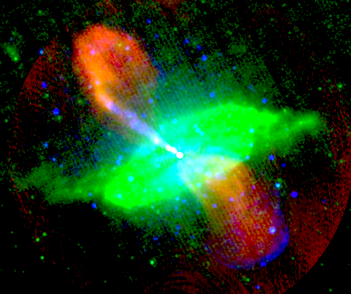




Key characteristics
Typical observational features include a bright, compact radio core coincident with a supermassive black hole, collimated twin jets that transport energy outward, and large lobes or hotspots where the jets terminate. The jets are relativistic near the nucleus, so their appearance is modified by Doppler beaming; this effect helps explain why some objects appear one-sided. The radio emission mechanism is dominated by synchrotron radiation (synchrotron process), and at higher energies inverse-Compton scattering of ambient photons can also be important. Interactions between the twin jets and the surrounding gas shape the observed morphology.
Classification and hosts
Radio galaxies are most commonly hosted by massive elliptical galaxies (elliptical galaxies), often in group or cluster environments. They are classified by radio morphology and brightness into types that range from core-dominated, jet-dominated, to lobe-dominated systems. Some widely used divisions separate edge-darkened, lower-power sources from edge-brightened, higher-power sources; these distinctions reflect differences in jet power and environment. Observed radio power can be very large — integrated luminosities across typical radio bands may reach extreme values (for example, measured across 10 MHz to 100 GHz) — and radio telescopes can detect such sources at great distances (10 MHz–100 GHz).
History and notable examples
Radio astronomy in the 20th century revealed the existence of strong extragalactic radio sources and led to the optical identification of host galaxies. Classic nearby examples of powerful radio galaxies include sources such as Cygnus A and Centaurus A, while the jet in M87 offers a nearby laboratory for studying jet structure, particle acceleration, and the connection to the central black hole. Long-baseline interferometry and sensitive surveys have progressively refined our understanding of jet speeds, magnetic field structure, and emission regions.
Role and importance
Radio galaxies are important astrophysical laboratories. Their jets transport enormous energy into the surrounding medium, carving cavities in hot intracluster gas and influencing star formation and gas cooling — processes often described as active galactic nucleus (AGN) feedback. Studies of radio galaxies illuminate particle acceleration, magnetic field evolution, and the physics of relativistic flows. In clusters and groups, the interaction of radio lobes with the ambient gas has been mapped with radio and X-ray observations, showing how radio jets heat and displace cluster plasma (galaxy clusters and groups).
Observational notes and resources
- Observable features: compact core, one-sided or two-sided jets, lobes, hotspots, and spectral aging signatures along the lobes.
- Orientation effects connect radio galaxies to quasars and blazars in unified schemes.
- Multiwavelength data (radio, optical, X-ray, gamma-ray) are essential to trace emission mechanisms and environmental impact; see review articles and survey catalogs for in-depth datasets (active galaxy resources).
Because radio galaxies are luminous and can be seen at large cosmological distances, they serve as probes of galaxy evolution, large-scale structure, and the intergalactic medium. Continuing radio surveys and high-resolution imaging are expanding the known population and improving constraints on jet physics and AGN feedback.
Related articles
Author
AlegsaOnline.com Radio galaxy Leandro Alegsa
URL: https://en.alegsaonline.com/art/80760
Sources
- ned.ipac.caltech.edu : Fanaroff-Riley classification