
Quark (elementary particle)
Quarks are fundamental constituents of matter that combine to form hadrons such as protons and neutrons. They carry fractional electric charge, color charge, and participate in strong and weak interactions.
Overview
A quark is a basic building block of matter in the Standard Model of particle physics. Quarks are never observed alone in isolation but instead occur bound together to form composite particles called hadrons. The best-known hadrons are the proton and the neutron, which in turn, with electrons, make up atomic nuclei and atoms. Historically, protons and neutrons were once considered fundamental particles until experiments with high-energy beams produced by particle accelerators showed substructure; electrons remained pointlike and indivisible in those tests and are still treated as elementary electrons in the Standard Model.
Image gallery
3 Images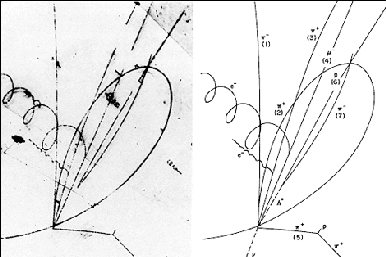


Flavours, charges and antiquarks
Quarks come in six types, conventionally called flavours. These are:
Each flavour carries a characteristic fractional electric charge: up, charm and top have +2/3 of the proton charge; down, strange and bottom have −1/3. For every quark there is a corresponding antiquark with the opposite electric charge. Flavour, electric charge and other quantum numbers distinguish one quark type from another and determine which combinations are allowed to form stable or short-lived particles.How quarks form matter
Quarks bind together via the strong interaction, mediated by gluons, to make hadrons. The fundamental force responsible for holding quarks inside hadrons is often called the strong nuclear force. Hadrons fall into two major families:
- Baryons — made of three valence quarks; protons and neutrons are examples.
- Mesons — made of a quark and an antiquark; examples include pions and kaons.
Color charge and confinement
Quarks possess a type of charge known as color charge, unrelated to visual color, that comes in three varieties commonly labeled red, green and blue. The theory of quantum chromodynamics (QCD) requires that observable particles be color-neutral (a combination of red+green+blue for baryons or color+anticolor for mesons). An important consequence of QCD is confinement: as quarks are pulled apart the force between them does not fall off but instead grows, and attempts to separate quarks produce new quark–antiquark pairs rather than isolated single quarks. This explains why free quarks are not seen and why quark interactions lead to the production of jets of hadrons in high-energy collisions.
Weak interactions and quark flavour change
In addition to the strong interaction, quarks participate in the weak force, which can change one flavour into another. The weak interaction is mediated by the charged and neutral weak bosons; quarks change type when they exchange a W boson or a Z boson. This mechanism underlies radioactive processes such as beta decay: a down quark inside a neutron can transform into an up quark while emitting a W− boson, which then decays into an electron and an electron antineutrino. The weak interaction also involves other particles such as neutrinos and can produce positrons or electrons in decay chains; for example a proton can convert to a neutron while emitting a positron and a neutrino in certain environments (positron emission) or the reverse process can occur elsewhere.
Historical context and discoveries
The quark model was proposed independently in 1964 by physicists Murray Gell‑Mann and George Zweig as a way to organize a rapidly growing list of hadrons. Early experimental evidence for pointlike constituents inside protons and neutrons came from deep inelastic scattering experiments in the late 1960s, which showed behavior consistent with smaller charged components. Subsequent development of quantum chromodynamics in the 1970s provided a quantum field theory framework that explains color charge, confinement and the running of the strong coupling with energy.
Significance and modern relevance
Quarks are central to our understanding of matter at the smallest scales. Studies of quark behaviour inform nuclear physics, high-energy collider experiments, and cosmology, including how the early universe evolved and how heavy elements form in stellar processes. While most practical technologies do not depend directly on quark properties, accelerator experiments that probe quarks and gluons have driven innovations in instrumentation, computing and medical imaging. Contemporary research continues to refine measurements of quark masses, interactions and the dynamics that bind them, while searches for physics beyond the Standard Model often focus on subtle effects in systems containing heavy flavours or on rare decay processes.
For concise introductions and further reading on related subjects, see entries on hadrons, the strong interaction, the weak force, and experimental techniques such as particle accelerators.
Related articles
Author
AlegsaOnline.com Quark (elementary particle) Leandro Alegsa
URL: https://en.alegsaonline.com/art/80397