
Top quark
The top quark is the heaviest known elementary particle, a third‑generation up‑type quark with a very short lifetime, distinctive decays, and an important role in testing the Standard Model and searching for new physics.
Overview
The top quark, sometimes historically called the truth quark, is the most massive of the six quark flavors in the Standard Model of particle physics. It is an elementary particle and a member of the family of quarks, which are a subset of particles that are not known to be divisible into smaller components. As with other quarks, the top is a fermion with intrinsic spin 1/2 and carries electric charge +2/3 e. The top quark interacts via the strong and weak nuclear forces and also couples to electromagnetism and, in principle, to gravity.
Image gallery
7 Images




Physical properties
The top quark has a very large rest mass compared with other fundamental particles; its mass is commonly quoted near 173 GeV/c2, making an individual top quark roughly comparable in mass to a heavy atom such as a single atom of tungsten for everyday intuition. Because of its large mass, the top quark has a strong Yukawa coupling to the Higgs sector and therefore plays an outsized role in quantum corrections within the Standard Model. Its lifetime is extremely short—on the order of 10−25 seconds—so short that the top typically decays before it can form bound states (hadrons) like other quarks.
Production and decay
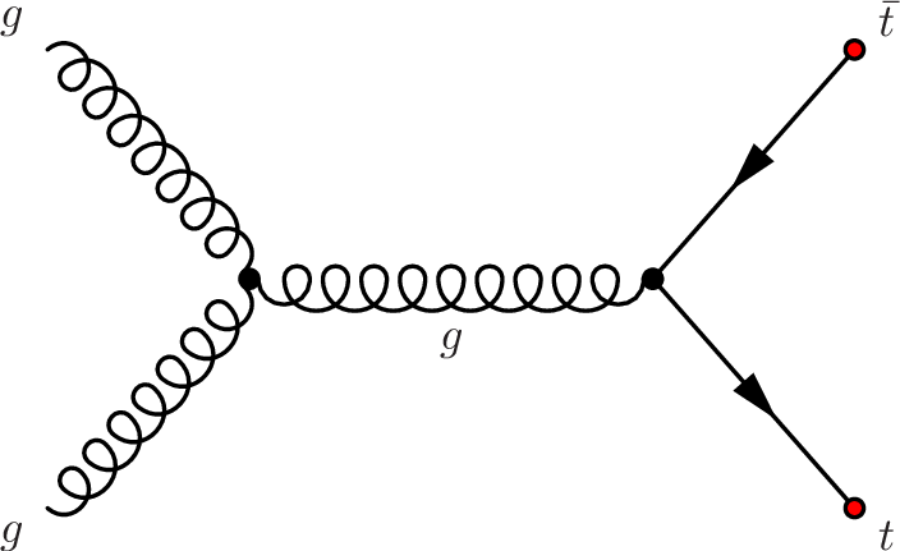
Top quarks are produced in high‑energy collisions, most commonly as top–antitop pairs in proton–proton or proton–antiproton interactions at particle accelerators. They can also be produced singly through electroweak processes. The top quark decays almost exclusively through the weak interaction. The dominant decay mode is to a bottom quark and a W boson; rarer transitions to a strange quark or a down quark plus a W boson are allowed but suppressed by mixing angles. Experimental signatures depend on how the W bosons decay and include dilepton, lepton+jets, and fully hadronic final states. Detectors reconstruct top events from combinations of jets, isolated leptons, and missing transverse energy that signals neutrinos.
Experimental identification and measurements
Because the top does not hadronize in the usual sense, its properties are inferred from the kinematics of its decay products and from sophisticated reconstruction algorithms. Mass measurements use methods such as template fits, matrix‑element techniques, and comparisons to theoretical predictions. Precision measurements of production cross sections, charge asymmetries, spin correlations and polarization probe both the strong and weak interactions at high energies and are sensitive to possible effects from physics beyond the Standard Model.
Role in the Standard Model and beyond
The top quark's large Yukawa coupling gives it a special role in electroweak symmetry breaking and in radiative corrections that affect precision observables. Accurate knowledge of the top mass and couplings is important for global fits that constrain the properties of the Higgs boson, a scalar boson responsible for generating masses in the Standard Model. Deviations from expected top production rates, decay patterns, or couplings could be indicators of new particles or interactions, so top physics is an active area in searches for new phenomena.
History
The existence of a heavy third‑generation up‑type quark was anticipated by the quark model and electroweak theory. The top quark was directly observed in 1995 by the CDF and DØ collaborations at the Fermilab Tevatron accelerator, completing the set of six quarks in the Standard Model and opening a dedicated program of precision top measurements that continues at modern colliders.
Notable experimental notes
- The top quark's extremely short lifetime prevents it from forming long‑lived bound states; instead, experiments observe its decay products directly.
- Single‑top production provides a direct probe of the weak interaction and the magnitude of the top‑bottom coupling and complements pair production studies.
- Top quark studies inform searches for rare decays and flavor‑changing neutral currents, which would signal physics beyond the Standard Model.
- Improved detector performance and higher collision energies allow more precise determinations of top properties and wider sensitivity to subtle deviations.
For introductory reviews and compiled experimental results consult general particle data and review sources, detector and collaboration pages, and pedagogical summaries available from major high‑energy physics resources: elementary particle overview, particle listings, quark family reviews, fermion properties, spin and quantum numbers, gravity and particle physics, electromagnetism basics, bottom quark information, strange quark notes, atomic scale analogies, tungsten reference, mass and mass schemes, Higgs boson resources, scalar boson notes.
Questions and answers
Q: What are top quarks?
A: Top quarks or truth quarks are the heaviest known elementary particles that cannot be divided.
Q: Are quarks elementary particles?
A: Yes, all quarks are elementary particles.
Q: What is the spin of quarks?
A: Quarks are fermions, which means that no two of them can exist in the same place at the same time, and they have a spin of 1/2.
Q: What fundamental forces do top quarks interact with?
A: Top quarks interact with all four of the fundamental forces, which are gravity, electromagnetism, strong force, and weak force.
Q: What do top quarks usually decay into?
A: Almost all of the time, top quarks will decay into a bottom quark and a W boson, although it can sometimes decay into a strange quark.
Q: How heavy is one top quark?
A: One top quark weighs about as much as one atom of tungsten.
Q: How long are top quarks believed to exist?
A: Unfortunately, top quarks are believed to be able to exist for only 5x10–25 seconds.
Related articles
Author
AlegsaOnline.com Top quark Leandro Alegsa
URL: https://en.alegsaonline.com/art/100640
Sources
- arxiv.org : hep-ex/0506005
- hyperphysics.phy-astr.gsu.edu : "Quarks"