
Quasar: powerful active galactic nuclei and their cosmic role
Quasars are extremely luminous active galactic nuclei powered by accretion onto supermassive black holes. This article explains their structure, observations, history, and importance in galaxy evolution.
Overview
A quasar, short for "quasi-stellar object," is an extraordinarily luminous active galactic nucleus (AGN) powered by matter falling onto a supermassive black hole at the center of a galaxy. From Earth they often appear point-like, similar to stars, yet they can emit more energy than the billions of stars in their host galaxy. Quasars were first detected as unusual radio and optical sources, and later identified by their distinctive spectra and extreme brightness.
Image gallery
10 Images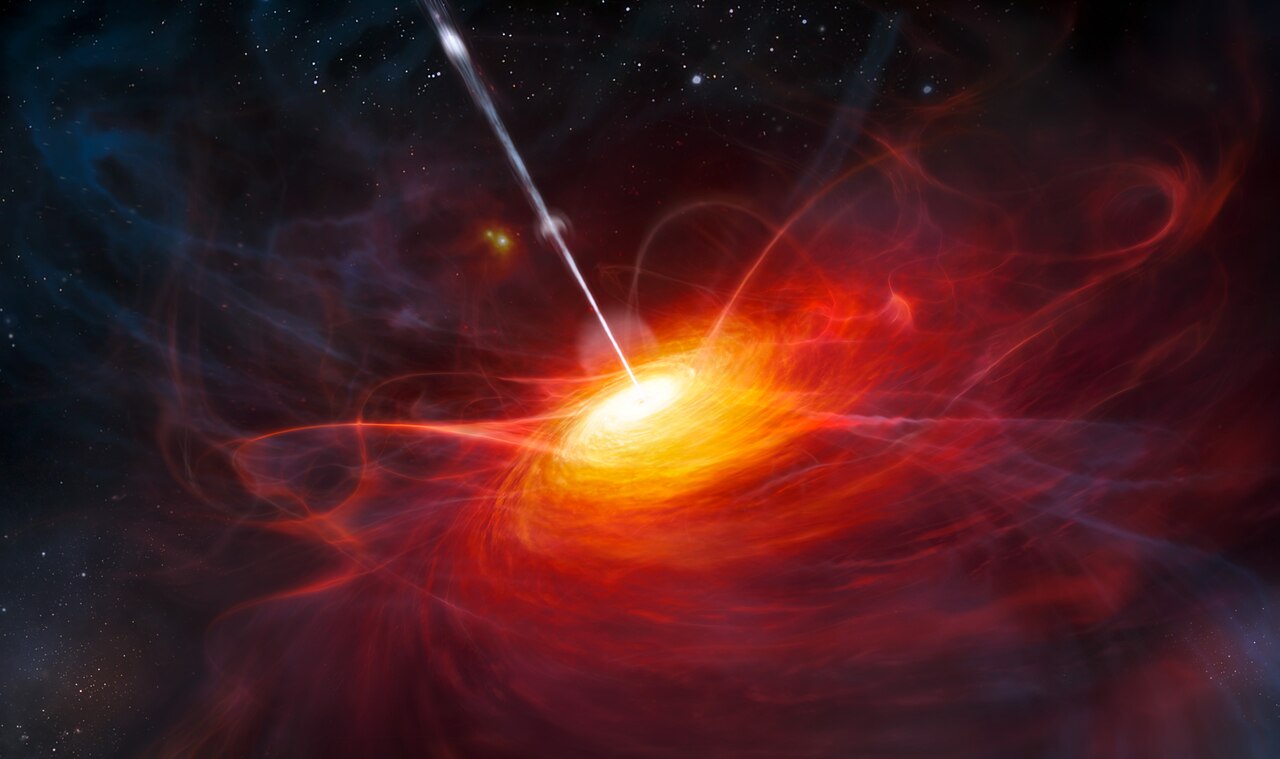




Structure and power source
At the heart of a quasar is a supermassive black hole surrounded by an accretion disc of infalling gas and dust. Viscous heating in this disc converts gravitational potential energy into electromagnetic radiation with an efficiency far higher than nuclear fusion: a commonly cited figure is that roughly ten percent of the rest mass of accreted matter can be radiated away. Surrounding regions produce additional spectral features: a dense broad-line region close to the disc, a more extended narrow-line region, and often a dusty molecular torus. Many quasars also launch relativistic jets, narrow beams of particles and magnetic fields that can extend well beyond the host galaxy.
Observational properties
Quasars exhibit several distinctive observational signatures. Their spectra show strong, often very broad emission lines produced by gas moving at thousands of kilometers per second. They vary in brightness on timescales from days to years, indicating a compact emission region. Quasars are classified by radio emission into radio-loud and radio-quiet types, and when a jet is oriented close to our line of sight the source may appear as a blazar due to relativistic beaming. Redshift measurements place many quasars at great cosmological distances, making them valuable probes of the early universe.
- Broad and narrow emission lines: signatures of high-velocity gas near the nucleus.
- Variability: rapid changes imply a compact emitting region.
- Radio jets: present in a subset and responsible for extended radio lobes.
- High luminosity: occasional outshining of the host galaxy across many wavelengths.
History and cosmic importance
Quasars were first recognized in the mid-20th century as strange point-like sources with unusual spectral lines; once their high redshifts were understood, it became clear they lie at cosmological distances and therefore must be extraordinarily luminous. Surveys have shown that quasars were far more common in the early universe; peak activity occurred when galaxies still contained abundant cold gas that could feed their central black holes. Because of their brightness and high redshift, quasars serve as beacons for studying the intergalactic medium, chemical enrichment, and the growth of structure across cosmic time.
Distinctions and notable facts
Not every active galactic nucleus is called a quasar: the label usually applies to the most luminous AGN. Lower-luminosity analogs include Seyfert galaxies. Modern AGN unification models explain many observed differences by a combination of intrinsic power, orientation, and intervening material. Many present-day galaxies, including the Milky Way, host dormant supermassive black holes that may have been active quasars in the past but now lack a supply of infalling gas.
Related topics and resources
- Active galactic nuclei (general overview)
- Size scales compared to the Solar System
- Cosmological distance measures
- Supermassive black holes
- Schwarzschild radius and black hole metrics
- Accretion physics around compact objects
- Gravitational energy conversion
- Mass accretion processes
- Electromagnetic spectrum of astronomical sources
- Radio astronomy and jet observations
- Optical spectroscopy techniques
- Stellar spectra vs. quasar spectra
- Galaxy classifications and components
- The Milky Way and its central black hole
Questions and answers
Q: What is a quasar?
A: A quasar, or quasi-stellar radio source, is an active galactic nucleus (AGN) that is the most energetic and distant type of AGN. They are quite small in comparison with the energy they put out, and are not much larger than the Solar System.
Q: How far away can quasars be found?
A: The highest redshift quasar known as of June 2011 was about 29 billion light-years from Earth.
Q: What is the mechanism behind their brightness changes?
A: The mechanism of brightness changes probably involves relativistic beaming of jets pointed nearly directly toward us.
Q: What is believed to be at the center of a quasar?
A: Scientists now agree that a quasar is a compact region in the center of a massive galaxy surrounding a central supermassive black hole. Its size is 10–10,000 times the Schwarzschild radius of this black hole.
Q: Where does its energy come from?
A: The energy emitted by a quasar comes from gravitational energy created from mass falling onto an accretion disc around the black hole.
Q: How luminous are they compared to other galaxies?
A: Quasars are extremely luminous and can be 100 times greater than that of our Milky Way galaxy.
Q: Why were they more common in early universe?
A: Quasars were more common in early universe because this energy production ends when the supermassive black hole consumes all of the gas and dust near it, meaning most galaxies may have gone through an active stage as one or some other class of active galaxy before becoming dormant due to lack of matter to feed into their central black holes for radiation production.
Related articles
Author
AlegsaOnline.com Quasar: powerful active galactic nuclei and their cosmic role Leandro Alegsa
URL: https://en.alegsaonline.com/art/80414
Sources
- eso.org : "Most distant quasar found"
- spacetelescope.org : "http://www.spacetelescope.org/images/heic1116a/"
- hubblesite.org : "Hubble surveys the "homes" of quasars"
- secure-site.ckmedia.com : "A quasar in every galaxy?"
- adsabs.harvard.edu : "The quasi-stellar radio sources 3C 48 and 3C 273"