
Pulsar
A pulsar is a rapidly rotating neutron star that emits concentrated beams of electromagnetic radiation seen as regular pulses; used to study extreme physics, test relativity, and probe interstellar space.
Overview
A pulsar is a highly magnetized, rotating neutron star that produces focused beams of electromagnetic radiation. As the star spins, these beams sweep across space like a cosmic lighthouse. When a beam crosses the line of sight of an observer on Earth, the object appears to pulse at very regular intervals. Pulsars are notable for their clock-like regularity: individual objects can show pulses separated by intervals ranging from a few milliseconds to several seconds.
Image gallery
10 Images






Formation and basic characteristics
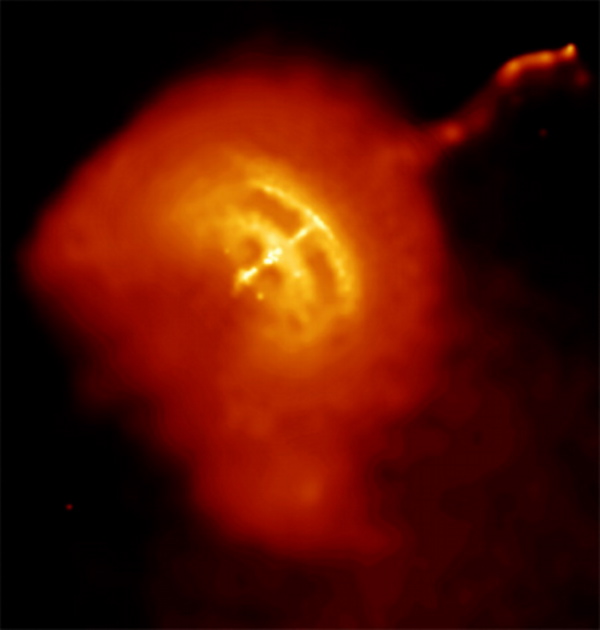
Pulsars form from the collapsed cores of massive stars following supernova explosions. The collapse packs a mass greater than the Sun's into a sphere about 10–20 kilometers in diameter, producing extreme density, rapid rotation, and intense magnetic fields. Key observable properties include rotation period, pulse shape, polarization, and spectral emission. Periods can be very short (millisecond pulsars) or longer (classical pulsars), and magnetic field strengths span many orders of magnitude.
Emission mechanism and the lighthouse model
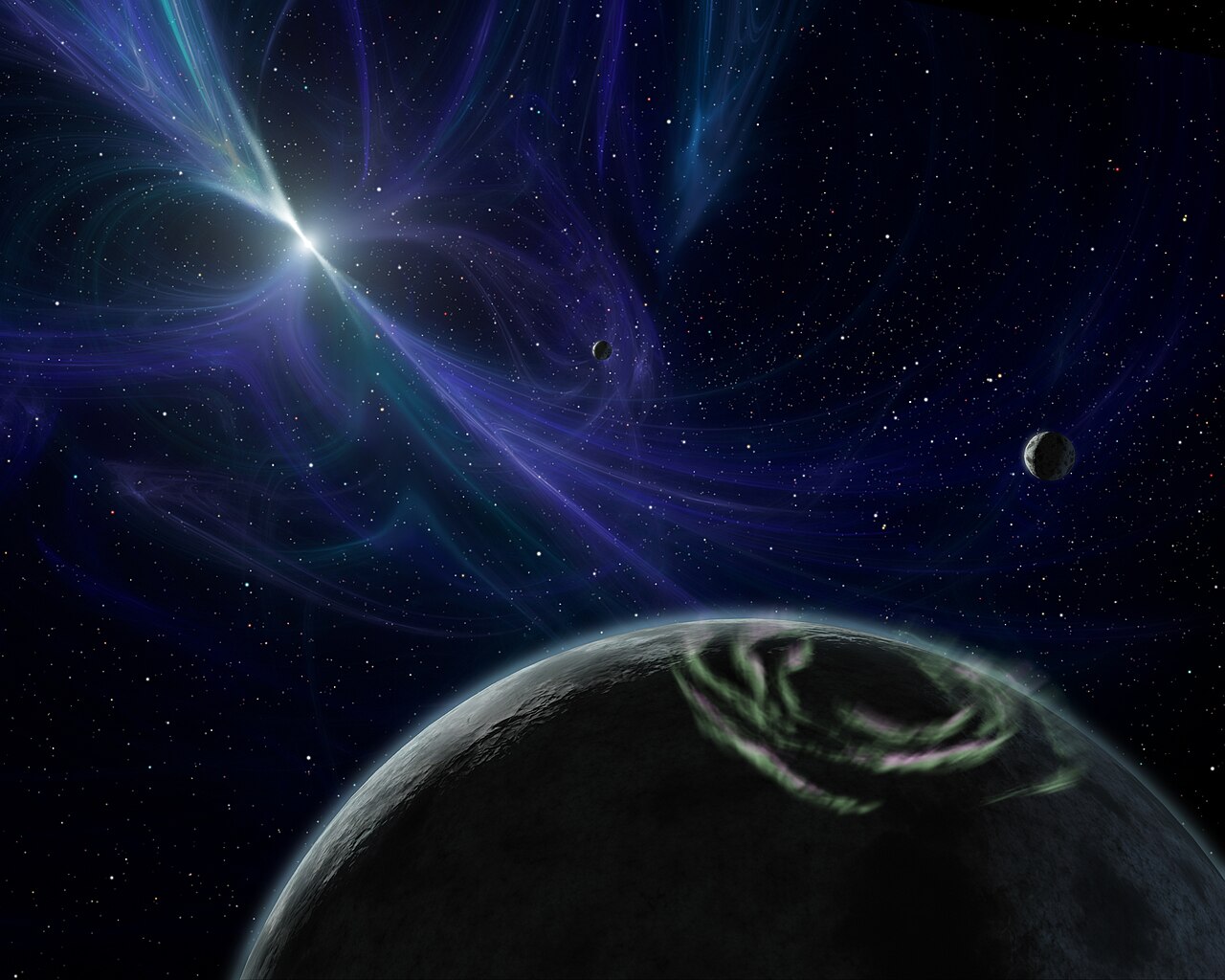
The commonly accepted model explains pulses as radiation emitted along the magnetic axis of the star, which is generally misaligned with the rotation axis. Charged particles accelerated along magnetic field lines produce radiation in radio, X-ray, and gamma-ray bands; the pulse profile depends on magnetic geometry, emission altitude, and observer orientation. Millisecond pulsars are thought to be spun up by accreting matter from a companion star, while younger, slower pulsars lose rotational energy and slow down over time.
Observational features and behaviors
- Pulse timing: many pulsars exhibit extremely stable pulse intervals used as precise astrophysical clocks.
- Glitches: sudden small increases in rotation rate that reveal interior dynamics such as superfluidity in the neutron star crust.
- Multiwavelength emission: some pulsars are bright at radio wavelengths, others at X-rays or gamma rays; a few are visible in optical light.
- Binary systems: pulsars in binary orbits provide laboratories for gravitational physics and can be recycled into millisecond pulsars.
Scientific importance and applications
Pulsars serve as tools for a variety of investigations. Precision timing enables tests of general relativity, measurement of neutron star masses, and detection efforts for low-frequency gravitational waves through networks known as pulsar timing arrays. Observations constrain the state of matter at extreme densities and inform models of stellar evolution and supernova remnants. In addition, pulsar timing can aid spacecraft navigation and probe the interstellar medium via dispersion and scattering of pulses.
History and notable examples
The first pulsar was discovered in 1967, revealing a previously unknown class of compact objects and stimulating rapid development of neutron star theory. Well-known examples include the Crab and Vela pulsars, both young and energetic, and the fast-spinning millisecond pulsars found in globular clusters and binary systems. Variants related to but distinct from ordinary pulsars include magnetars—objects with exceptionally strong magnetic fields that show different high-energy behavior—and intermittent sources such as rotating radio transients.
Distinctions and terminology
Not all neutron stars behave as classical radio pulsars. Terminology distinguishes ordinary (rotation-powered) pulsars, millisecond pulsars, and magnetars (often X-ray or gamma-ray bright). Some objects are detectable only sporadically or at specific wavelengths. Understanding these categories helps astronomers map the life cycles of neutron stars and connect observational classes to underlying physical differences.
For further technical summaries and observational catalogs see specialized reviews and databases maintained by observatories and research groups.
Questions and answers
Q: What are pulsars?
A: Pulsars are neutron stars that spin rapidly and produce huge electromagnetic radiation along a narrow beam.
Q: How dense are neutron stars?
A: Neutron stars are very dense.
Q: What is the interval between pulses of a pulsar?
A: The interval between pulses of a pulsar ranges from roughly milliseconds to seconds.
Q: When can a pulse of a pulsar be seen?
A: A pulse of a pulsar can only be seen if the Earth is close enough to the direction of the beam.
Q: Can the pulse of a pulsar be seen from any direction?
A: No, the pulse of a pulsar can only be seen if the Earth is close enough to the direction of the beam.
Q: What causes the lighthouse effect in pulsars?
A: The lighthouse effect in pulsars is caused by the spinning of the neutron star, which causes the radiation to be seen only at short intervals.
Q: Who recently made a statement about pulsars?
A: Werner Becker of the Max Planck Institute for Extraterrestrial Physics recently made a statement about pulsars.
Related articles
Author
AlegsaOnline.com Pulsar Leandro Alegsa
URL: https://en.alegsaonline.com/art/80031
Sources
- esa.int : Old pulsars still have new tricks to teach us
- adsabs.harvard.edu : Observation of a rapidly pulsating radio source
- bigear.org : bigear.org/vol1no1/burnell.htm
- bbc.co.uk : BBC Radio 4 – The life scientific: Dame Jocelyn Bell Burnell
- iopscience.iop.org : "Timing measurements of the relativistic binary pulsar PSR B1913+ 16"
- nobelprize.org : "The Nobel Prize in Physics 1993"
- aa.springer.de : "A statistic for describing pulsar and clock stabilities"
- ui.adsabs.harvard.edu : 1997A&A...326..924M
- www3.interscience.wiley.com : "The 1.5 millisecond pulsar"
- ui.adsabs.harvard.edu : 1984NYASA.422..180B
- doi.org : 10.1111/j.1749-6632.1984.tb23351.x
- naukawpolsce.pap.pl : "World's most accurate clock to be built in Gdańsk"
- saao.ac.za : African Skies 4 - Radio Pulsar Glitch Studies