
Presumption of Innocence
Legal principle that an accused person is regarded as innocent until proven guilty; places burden of proof on the prosecution and is recognized by major human rights instruments.
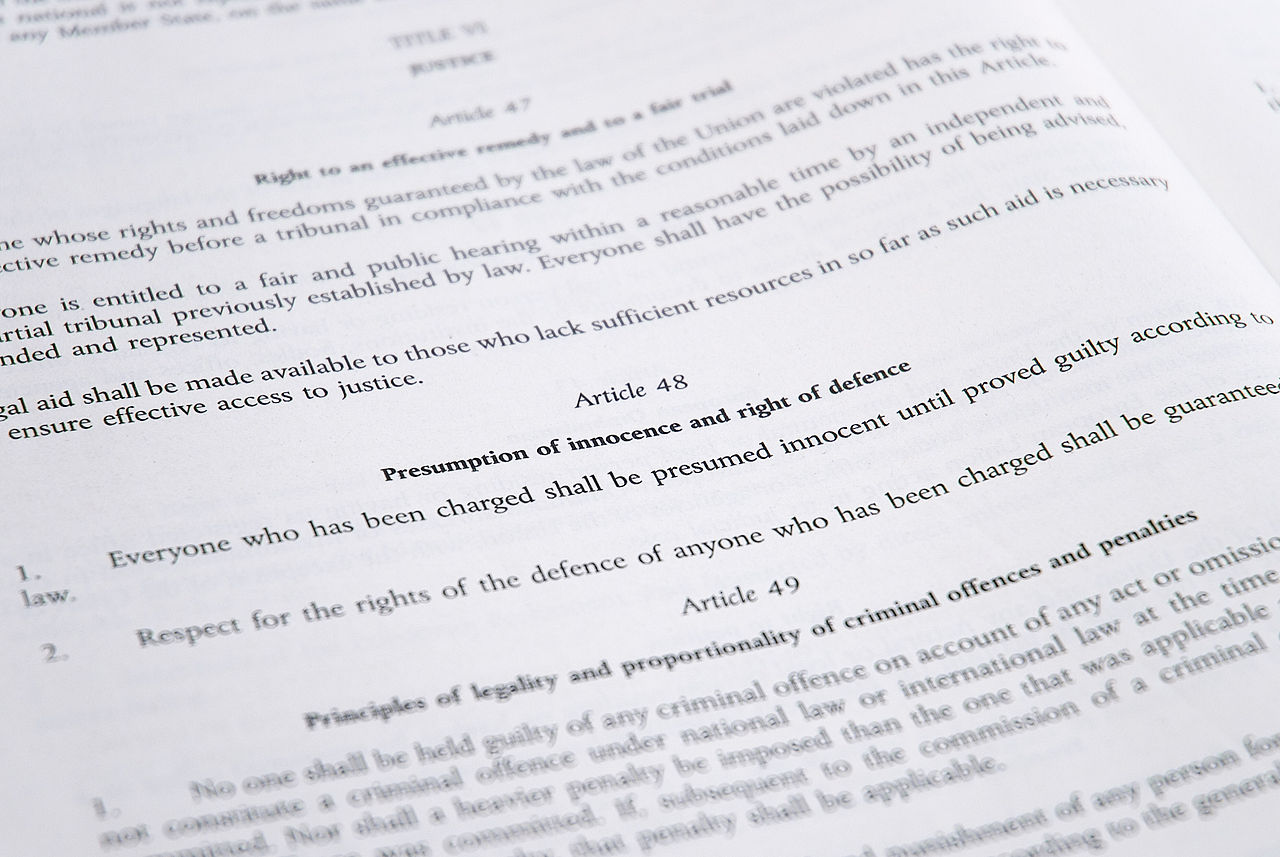
The presumption of innocence is the legal principle that a person charged with a crime is to be treated as innocent until a competent court establishes guilt. Its classic expression is the Latin maxim Ei incumbit probatio qui dicit, non qui negat. This idea functions both as a rule of evidence and a procedural protection: the state must demonstrate a defendant's culpability, rather than the defendant having to prove a lack of culpability. Many national constitutions, statutes and international instruments recognize it as a fundamental legal right.
Image gallery
2 Images
Core features
The concept has several practical components that shape criminal procedure. First, the burden of proof lies with the prosecution, not with the accused; this is often described as the burden of proof. Second, in criminal cases the factfinder — whether a jury or a judge — must be convinced to the criminal standard, commonly expressed as "beyond reasonable doubt", before returning a verdict of guilt. Third, in many systems the accused need not testify or produce evidence, and negative inferences from silence are limited or forbidden.
Historical and international context
The presumption of innocence has deep roots in Western legal history and appears in Roman legal writings and later compilations such as the Justinian Codes and English Common law. In the 20th century it gained explicit international recognition: the principle is stated as a right within the Universal Declaration of Human Rights and elaborated in the International Covenant on Civil and Political Rights. International bodies and national courts have repeatedly affirmed that it is central to a fair trial and to criminal justice legitimacy; human rights instruments often describe it as an international human right.
How it operates in different legal systems
Procedure varies between adversarial systems (where parties contest facts before a neutral trier) and inquisitorial systems (where judicial actors play an active investigative role), but the underlying presumption is present in both traditions. In criminal trials (criminal trial) the prosecution must present admissible evidence tying the accused to the offense. By contrast, in many civil proceedings the standard is lower — typically the balance of probabilities — and each party bears responsibility for proving elements of its claim.
Limits, exceptions and practical effects
- Some regulatory or strict-liability offenses reduce or remove fault elements; courts then interpret protections to avoid unfairness, but results vary by jurisdiction.
- Pretrial publicity, public statements by officials, or political pressure can undermine the presumption in practice even where law protects it.
- The principle affects other stages of process: decisions about bail, detention, and plea bargaining are informed by presumptive innocence but also by public-safety considerations.
Importance and key distinctions
The presumption of innocence distinguishes criminal law from civil adjudication and serves several policy aims: it protects individuals against wrongful conviction, preserves liberty pending proof, and imposes on the state the duty to investigate and prove alleged crimes. While broadly entrenched, it coexists with procedural mechanisms designed to balance rights and public order. Legal reforms, court rulings and international guidance continue to refine how the principle is applied and enforced.
For concise reference: the presumption places the evidentiary burden on the state, requires a high standard of proof in criminal cases, and functions as both a rule of procedure and a human right. Readers seeking primary sources or doctrinal analysis can consult relevant international instruments, comparative law texts and leading court decisions for jurisdiction-specific applications.
Relevant links: legal right, criminal trial, international human right, Universal Declaration, ICCPR, burden of proof, prosecution, jury, judge, guilty, beyond reasonable doubt, Justinian Codes, civil proceedings, Latin maxim.
Related articles
Author
AlegsaOnline.com Presumption of Innocence Leandro Alegsa
URL: https://en.alegsaonline.com/art/78960
Sources
- legal-dictionary.thefreedictionary.com : "Ei incumbit probatio qui dicit"
- law.cornell.edu : "presumption of innocence"
- ccnmtl.columbia.edu : "The Universal Declaration of Human Rights"
- dictionary.law.com : "burden of proof"
- hziegler.com : "Shariah Law"
- commons.wikimedia.org : Presumption of innocence