
Polar bear (Ursus maritimus)
Large Arctic bear species adapted to sea ice; overview of appearance, behavior, habitat, threats, and conservation, with links for further reading.
Overview
The polar bear (Ursus maritimus) is a large carnivorous mammal native to the circumpolar Arctic. It is closely related to other bear species and is specially adapted for life on sea ice and along Arctic coasts. Popular common names include polar bear, white bear, and northern bear. For general context about bears, see bears. For information about its home region, see the Arctic.
Image gallery
10 Images




Physical characteristics
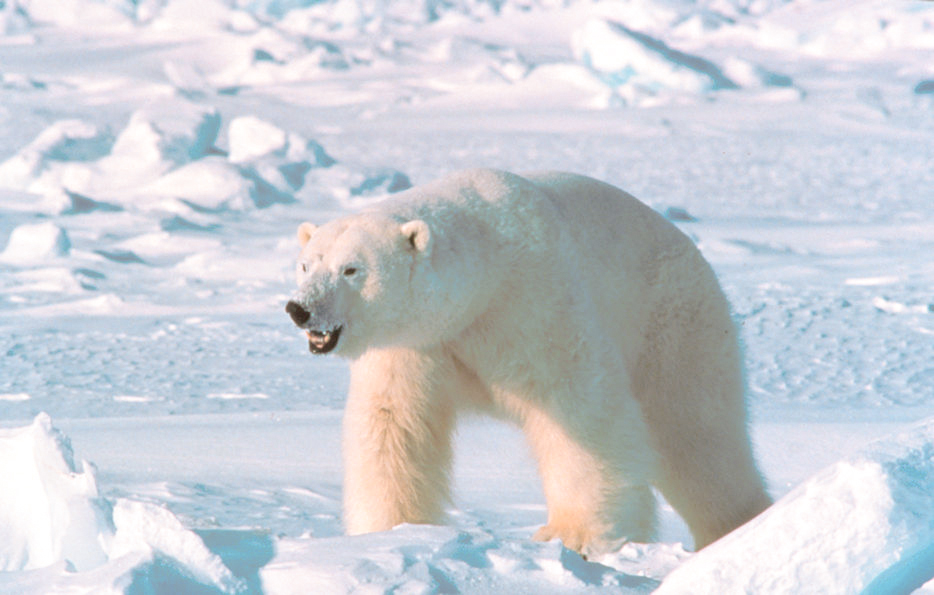
Polar bears are among the largest bear species. They have a thick layer of insulating fat and dense fur that appears white but is translucent; their skin beneath the fur is black, which helps absorb heat from sunlight. Their large paws are adapted for swimming and for walking on ice: semi-webbed toes and broad pads distribute weight and provide traction. Adults can move quickly in short bursts and are also strong swimmers, capable of covering long distances in cold water.
Distribution and habitat
Polar bears are found throughout the circumpolar Arctic in areas with sea ice, which they use as platforms for hunting seals. Their distribution follows the seasonal advance and retreat of ice, and they occur in coastal regions and on pack ice across Canada, Greenland, Norway (Svalbard), Russia, and Alaska. Individuals may travel great distances in search of food or suitable denning sites.
Behavior and diet
Polar bears are primarily carnivorous; their diet is dominated by marine mammals, especially seals, which they hunt by waiting at breathing holes or stalking on ice. They are solitary for most of the year except for mothers with cubs and occasional aggregations at rich feeding sites. Reproductive females dig dens in snow drifts or coastal snow banks to give birth and rear cubs through the harsh first months of life.
Conservation and threats
Polar bears are recognized as vulnerable in many assessments because they rely on sea ice for hunting and reproduction. The principal threat is the loss of sea ice due to climate warming, which reduces access to prey and can increase energy costs for travel and hunting. Other threats include pollution, oil and gas development, and localized human-bear conflicts. Estimates of global population size vary by source; assessments in recent years have placed the total in the tens of thousands, with a commonly cited estimate of around 26,000 individuals in 2021, though numbers differ among the 19 recognized management subpopulations.
Importance and notable facts
Polar bears are apex predators in the Arctic marine ecosystem and are culturally and economically significant to many indigenous peoples. They are often used as indicators of the broader impacts of Arctic climate change. Notable biological facts include their reliance on blubber and fat reserves to survive fasting periods, their remarkable sense of smell for detecting prey, and their role in international conservation agreements and research programs.
Quick facts
- Scientific name: Ursus maritimus
- Range: Circumpolar Arctic, associated with sea ice
- Diet: Primarily seals and other marine mammals
- Conservation concerns: Sea ice loss, human activities, pollution
For more general reading about polar bears and Arctic ecology, follow the links above to broader resources on bears and the Arctic: bears overview and Arctic environment.
Related articles
Author
AlegsaOnline.com Polar bear (Ursus maritimus) Leandro Alegsa
URL: https://en.alegsaonline.com/art/77694
Sources
- doi.org : 10.1111/j.1751-8369.2008.00087.x
- iucnredlist.org : "Ursus maritimus"
- doi.org : 10.2305/IUCN.UK.2015-4.RLTS.T22823A14871490.en
- biodiversitylibrary.org : A voyage towards the North Pole undertaken by His Majesty's command, 1773
- doi.org : 10.2307/3503828
- jstor.org : 3503828
- worldcat.org : 46381503
- seaworld.org : "POLAR BEARS"
- wwf.panda.org : "WWF - Facts about polar bears"
- zoo-hannover.de : Polar bear
- ncbi.nlm.nih.gov : "Vitamin A in Bear Liver"
- wikidata.org : Q33609
- species.wikimedia.org : Ursus maritimus
- animaldiversity.org : Ursus_maritimus · web.archive.org