
Polecat: overview, species, behavior, and relationship to ferrets and skunks
Polecat refers to several medium-sized mustelid mammals, notably the European polecat and its domesticated form the ferret. The name applies to different species and is sometimes used colloquially for skunks in the U.S.
Overview
The word "polecat" is a common name applied to several medium-sized members of the mustelid family rather than to a single, closely related group. These animals share a mustelid body plan—elongated bodies, short legs and a carnivorous diet—but the label is vernacular and covers multiple species with similar appearance and habits. For general background on the family they belong to, see Mustelids. The term is also used in broad senses to refer to several species that are not all each other's closest relatives.
Image gallery
5 Images


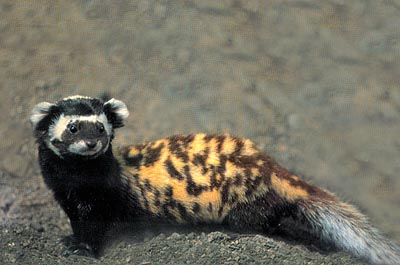
Physical traits and behavior
Polecats are typically small to medium-sized predators. Common characteristics include a slender, muscular build; a coat that may be patterned or uniformly colored; and well-developed anal scent glands used for defense. They are mainly nocturnal or crepuscular and are solitary hunters that feed on small mammals, birds, eggs, amphibians and invertebrates. Breeding and denning habits vary by species, but many use burrows or rock crevices for shelter.
Notable species and taxonomy
The European polecat (Mustela putorius) is the species most often associated with the name in Europe; it is the wild ancestor of the domestic ferret. See more on the European species at European polecat. The domesticated form, kept as a working animal and companion, is the ferret (ferret), derived primarily from European polecats and bred for temperament and patterning. Other animals called polecats include the steppe polecat, the marbled polecat and the African "striped polecat"; these names reflect common usage rather than a strict taxonomic grouping.
Confusion with skunks
In parts of North America the word "polecat" is often used informally to mean a skunk. Skunks are not true mustelids but belong to a related group and are better known for their powerful spray. To avoid confusion, use the specific common or scientific name: for example, reserve "polecat" for the mustelid species and "skunk" for the animals commonly called that in the U.S. (see skunks).
Human interactions, uses and conservation
Polecats have long interacted with people. The domesticated ferret was bred for hunting and pest control and is today a common pet in many countries. Wild polecats have been hunted and persecuted for fur or as predators, and some populations have declined due to habitat loss, pollution and hybridization with escaped or released ferrets. Conservation status varies by species and region: some populations are stable, while others face pressures that require monitoring and management.
Key points
- "Polecat" is a vernacular name for several mustelid species, not a single clade.
- The European polecat is closely linked to the domestic ferret.
- In U.S. colloquial usage, "polecat" often refers to skunks, which are distinct from true polecats.
- These animals play an ecological role as mesopredators, helping control rodent populations.
Questions and answers
Q: What is a polecat?
A: A polecat is a medium-sized Mustelid, which is a term for a family of carnivorous mammals that includes weasels, ferrets, and otters.
Q: Are there different species of polecats?
A: Yes, there are several similar species of polecats, and they do not form a single clade.
Q: Which polecat species is native to the British Isles?
A: The European polecat is the only polecat species native to the British Isles.
Q: What are ferrets?
A: Ferrets are the domesticated form of European polecats.
Q: What is the reason why skunks are sometimes referred to as polecats in the U.S.?
A: Skunks are only distantly related to the European polecat, but the term polecat is often applied to them in the U.S. because polecats give off a scent which some people think is offensive.
Q: Are polecats and skunks the same animal?
A: No, polecats and skunks are not the same animal, although they are both carnivorous mammals and are sometimes confused due to the common use of the term polecat to refer to skunks in the U.S.
Q: Do all polecats give off an offensive scent?
A: It is not specified whether all polecats give off an offensive scent, but some people think that the scent emitted by polecats is unpleasant.
Related articles
Author
AlegsaOnline.com Polecat: overview, species, behavior, and relationship to ferrets and skunks Leandro Alegsa
URL: https://en.alegsaonline.com/art/77714
Sources
- biomedcentral.com : "Multigene phylogeny of the Mustelidae: resolving relationships, tempo and biogeographic history of a mammalian adaptive radiation"
- doi.org : 10.1186/1741-7007-6-10
- pubmed.ncbi.nlm.nih.gov : 18275614