
Period (physics)
The period is the time required for one complete cycle of a repeating motion or wave. It is measured in seconds and is the reciprocal of frequency.
Overview
In physics, the period of a periodic process is the time taken for one complete cycle of motion or oscillation to pass a given point. Examples include one swing of a pendulum, one vibration of a mass on a spring, or one complete crest-and-trough of a wave. The period is a fundamental descriptor of repeating phenomena and is measured in seconds (s).
Image gallery
3 Images

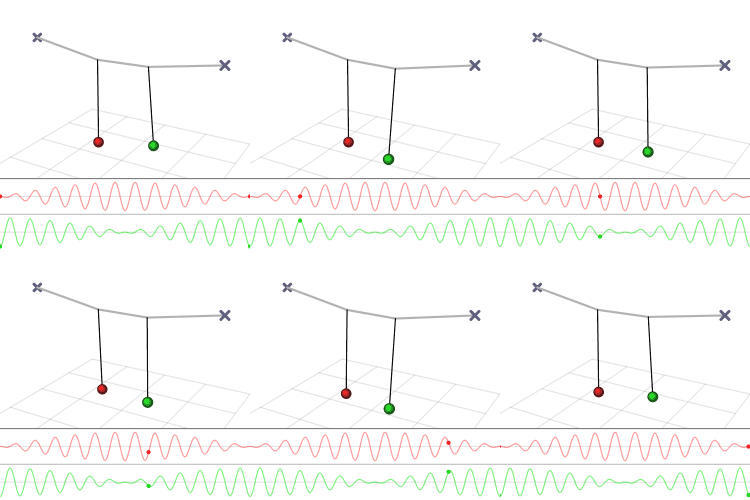
Mathematical definition and relations
For a strictly periodic signal x(t), the period T satisfies x(t + T) = x(t) for all times t. The period is closely tied to frequency f by the reciprocal relationship T = 1/f and f = 1/T. It is common to use angular frequency ω, defined by ω = 2πf = 2π/T, when describing oscillatory motion in radians per second. The reciprocal nature of the two quantities means that as frequency increases, the period decreases, and vice versa; this reciprocal connection is often described simply as a reciprocal relationship.
Typical formulas and examples
- Simple harmonic oscillator (mass-spring): T = 2π√(m/k), where m is mass and k the spring constant.
- Simple pendulum (small-angle approximation): T = 2π√(L/g), where L is length and g gravitational acceleration.
- For electromagnetic or sound waves, period and wavelength λ combine with wave speed v by v = λ/T = λf.
Measurement and practice
Periods are often measured by timing many consecutive cycles and dividing by the number of cycles to reduce random error. Instruments such as oscilloscopes, frequency counters, and stroboscopes provide direct readings of period or frequency. In engineering and signal processing, the period determines sampling requirements and is central to avoiding aliasing when converting analog signals to digital.
History, uses and notable distinctions
Studies of periodic motion date back to early observations of pendulums; precise use of the pendulum in timekeeping was advanced by early clockmakers and scientists. The period is distinct from wavelength: period is a time interval, while wavelength is a spatial length. A process may be periodic (repeats exactly each T) or quasi/aperiodic (no single T applies). The concept of period appears across physics, from classical mechanics and acoustics to optics and quantum systems, and is critical in understanding resonance, tuning, and synchronization phenomena. For introductory discussions and further reading see general resources on oscillations and waves, or use reference material linked here: vibration basics and reciprocal relationships or cycle definitions.
Period remains a simple but powerful concept: it quantifies how fast something repeats and, together with frequency and phase, fully characterizes many steady-state periodic behaviors.
Related articles
Author
AlegsaOnline.com Period (physics) Leandro Alegsa
URL: https://en.alegsaonline.com/art/75824
Sources
- commons.wikimedia.org : Mechanical vibrations