
Paraná River
Major South American river flowing through Brazil, Paraguay and Argentina; known for its length, hydropower, biodiversity and the Paraná Delta leading to the Río de la Plata.
The Paraná River is one of South America's principal waterways, running generally southward through parts of Brazil, Paraguay and Argentina. It is widely recognized as the continent's second‑longest river after the Amazon River. The river's name derives from a Tupi phrase meaning "like the sea," a reference to its broad, open stretches and the tidal influence near its mouth.
Image gallery
10 Images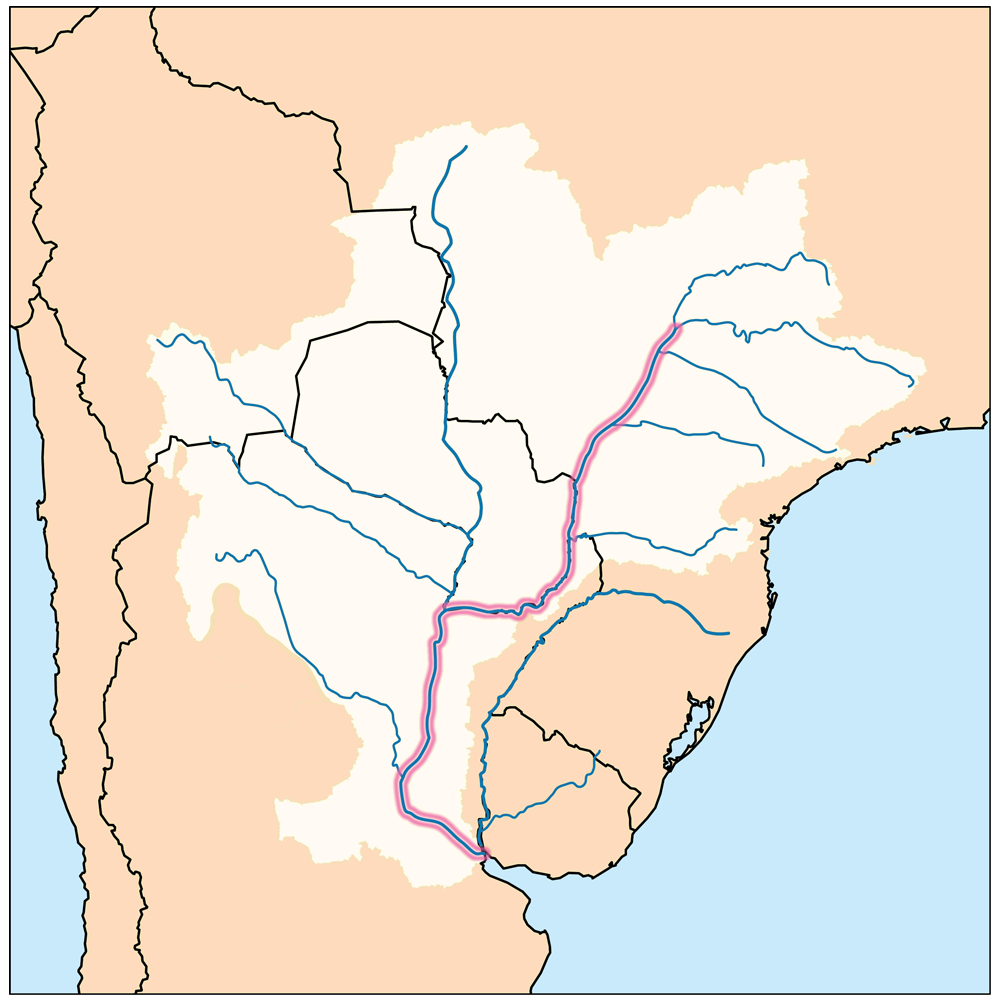


Course and physical characteristics
The Paraná is born in southern Brazil at the junction of the Paranaíba and Grande rivers. From that confluence it follows a long course, forming important sections of national boundaries and collecting many tributaries before turning into the estuarine system that reaches the Atlantic. Along its way the Paraná meets the Paraguay River, and farther downstream it joins the Uruguay River to form the Río de la Plata estuary, which opens into the Atlantic Ocean. The river traverses or borders the countries of Brazil, Paraguay and Argentina.
Major tributaries, delta and features
- Principal tributaries include the Paraguay River and rivers that drain the Brazilian highlands.
- The lower Paraná forms an extensive delta — the Paraná Delta — consisting of islands, channels and wetlands that are ecologically rich and seasonally flooded.
- Notable landmarks along the system include several falls and rapids on tributaries, and wide navigable stretches used by commercial shipping.
Ecology, fisheries and human uses
The Paraná basin supports a diversity of freshwater habitats and a range of fish species. Local fisheries target species such as the surubí (a large catfish) and the sábalo (a schooling migratory fish), which are important for subsistence and commercial fishing. The river's floodplains and wetlands provide habitat for birds, amphibians and aquatic plants, and they act as natural buffers that absorb floodwaters.
Humans rely on the Paraná for navigation, irrigation, water supply and energy. Large hydroelectric complexes built on the river and its tributaries generate substantial electricity for the region. One of the best known dams on the river system is Itaipu, built on the border between Brazil and Paraguay; other major projects include binational plants farther downstream. Navigation channels connect inland ports and support grain and commodity transport to Atlantic markets.
History, cultural significance and impacts
Indigenous peoples inhabited the Paraná basin long before European contact and named many places with Tupi and Guaraní words. European exploration and colonial competition in the Río de la Plata region shaped the political map of the river's lower reaches. Over the centuries the Paraná has served as a transportation corridor, a frontier for settlement and an arena for economic development.
Large-scale engineering, agriculture and dam construction have altered flow regimes, sediment transport and habitats. These changes have benefited energy production and navigation while also raising concerns about biodiversity loss, altered flood cycles and resettlement. Contemporary management efforts increasingly balance development needs with conservation of wetlands and fisheries.
Notable facts and distinctions
- The Paraná is commonly cited as the second-longest river in South America and one of the continent's most important inland waterways.
- Its delta and lower reaches feed into the Río de la Plata estuary, a major Atlantic inlet that supports large ports and cities.
- The river links three countries—Brazil, Paraguay and Argentina—making its management a transboundary priority.
For further general information consult regional hydrology and conservation resources or national agencies responsible for navigation, fisheries and energy planning. Additional reading and data can be found through specialized sources and governmental publications on the Paraná basin.
Brazil | Paraguay | Argentina | Amazon River | Paraguay River | Uruguay River | Atlantic Ocean | Itaipu
Related articles
Author
AlegsaOnline.com Paraná River Leandro Alegsa
URL: https://en.alegsaonline.com/art/74562
Sources
- aguas.igam.mg.gov.br : "Monitoramento da Qualidade das Águas Superficiais da Bacia do Río Paranaíba: Relatório Annual 2007"
- britannica.com : "Río de la Plata"
- geonames.nga.mil : Río Paraná Guazú