
Parallel ATA (PATA): legacy parallel storage interface for PCs
Parallel ATA (PATA) is a legacy parallel interface for connecting internal storage devices in personal computers. It evolved from IDE/ATA, later branded PATA after Serial ATA's introduction.
Parallel ATA, commonly abbreviated PATA and historically known as ATA/ATAPI or IDE, is a family of standards for connecting storage devices inside personal computers. The specifications are managed by the X3/INCITS committee T13. PATA describes a parallel bus architecture that carries data, control and power to devices such as hard disks, optical drives and early solid-state devices. Though largely superseded by Serial ATA (SATA) in modern consumer systems, PATA played a dominant role in PC storage for several decades and remains present in some legacy, embedded and industrial systems.
Image gallery
9 Images


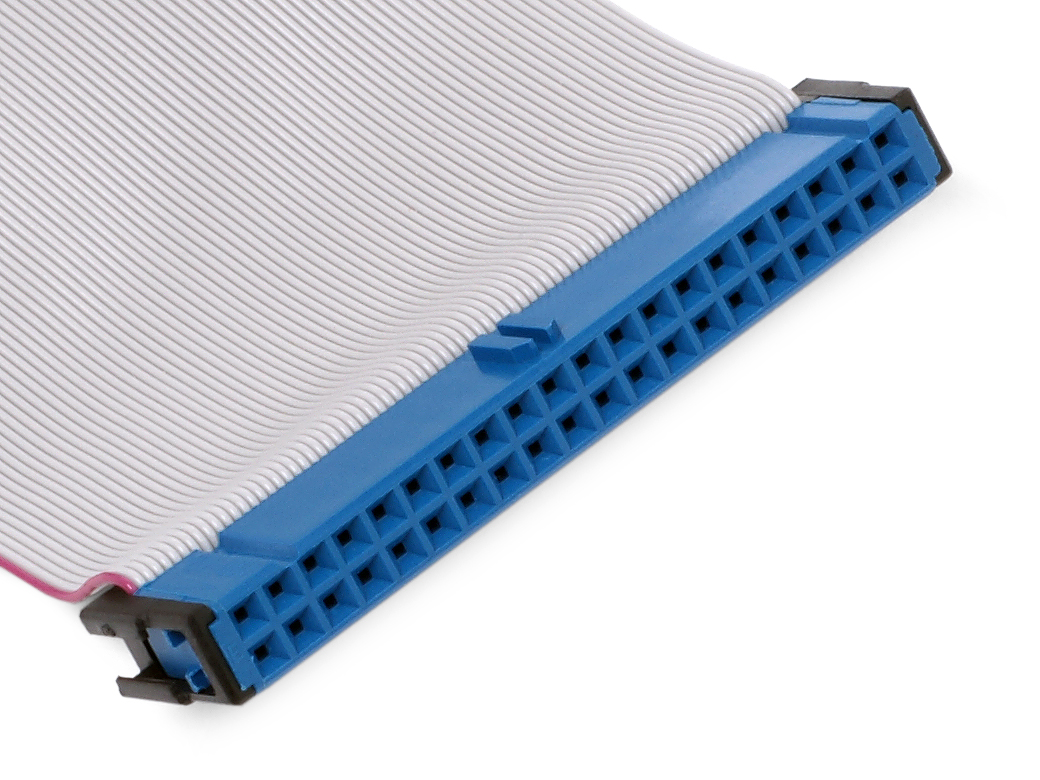
Key characteristics and components
PATA uses a 40-pin (40-pin logical) edge connector on the drive and a ribbon cable to connect devices to the host controller. Higher-speed implementations introduced an 80-conductor ribbon cable that retained the same 40-pin connector but added grounded wires between signal lines to reduce crosstalk. Drives are configured on a shared channel: a single cable can carry up to two devices (commonly called master and slave), with device selection set by jumpers or by the cable-select feature. Power is supplied by a separate 4-pin peripheral connector on many older desktop drives.
- Data interface: parallel 16-bit data bus shared by up to two devices
- Connectors: 40-pin ribbon cable (standard), 80-conductor ribbon for higher speeds
- Device selection: master/slave jumpers or cable select
- Control protocols: ATA command set and ATAPI packet commands for optical drives
Historical development
PATA evolved from the original Integrated Drive Electronics (IDE) design, which integrated the drive controller onto the drive itself. Over time the interface was standardized and expanded under the ATA/ATAPI name to support new device types and faster transfer modes. Informal terms such as IDE and ATA persist in common usage. When a serial point-to-point successor arrived in the early 2000s, the parallel versions were retroactively distinguished as Parallel ATA (PATA).
Performance, modes and cable considerations
Early PATA implementations used Programmed Input/Output (PIO) transfers, which place a CPU burden on data movement. Direct Memory Access (DMA) and later Ultra DMA (UDMA) modes reduced CPU overhead and raised transfer rates. To reach higher UDMA speeds, the move to 80-conductor cables became common: the extra conductors are grounded wires that reduce electrical interference and allow reliable operation at faster signaling rates. Because multiple devices share the same cable, the parallel bus design imposes limits on maximum cable length and electrical topology, which is why PATA cables are short and confined to internal use.
Uses, decline and legacy
For many years PATA provided the most cost-effective way to attach hard drives and optical drives to desktop and laptop PCs, and it was used widely in servers, workstations and consumer systems. The emergence of Serial ATA (SATA) with slender cables, point-to-point links and scalable performance led to rapid adoption in new systems beginning in the 2000s; as a result PATA is now uncommon in modern consumer PCs. Nevertheless, PATA remains relevant in older machines and in specialized devices where proven compatibility, legacy firmware or board-level integration matter.
Devices and related terms
Typical devices historically attached via PATA include hard disk drives, some early solid-state drives and optical drives and controllers found in personal computers (PCs). The interface traces its lineage to vendor implementations such as those by Western Digital and was formally standardized by committees that produced the ATA/ATAPI family of specifications. The market introduction of Serial ATA led to the common distinction between PATA (parallel) and SATA (serial).
Although PATA is largely legacy technology, understanding its physical connectors, cable types, device-configuration methods and transfer modes is important for maintaining or upgrading older systems and for working with legacy storage in data-recovery, industrial and embedded contexts.
Related articles
Author
AlegsaOnline.com Parallel ATA (PATA): legacy parallel storage interface for PCs Leandro Alegsa
URL: https://en.alegsaonline.com/art/74531