
Palace of Caserta (Reggia di Caserta)
Eighteenth‑century Bourbon royal palace near Naples, Italy. Designed by Luigi Vanvitelli, it has about 1,200 rooms, vast formal gardens and hydraulic works, and was inscribed as a UNESCO World Heritage Site.
Overview
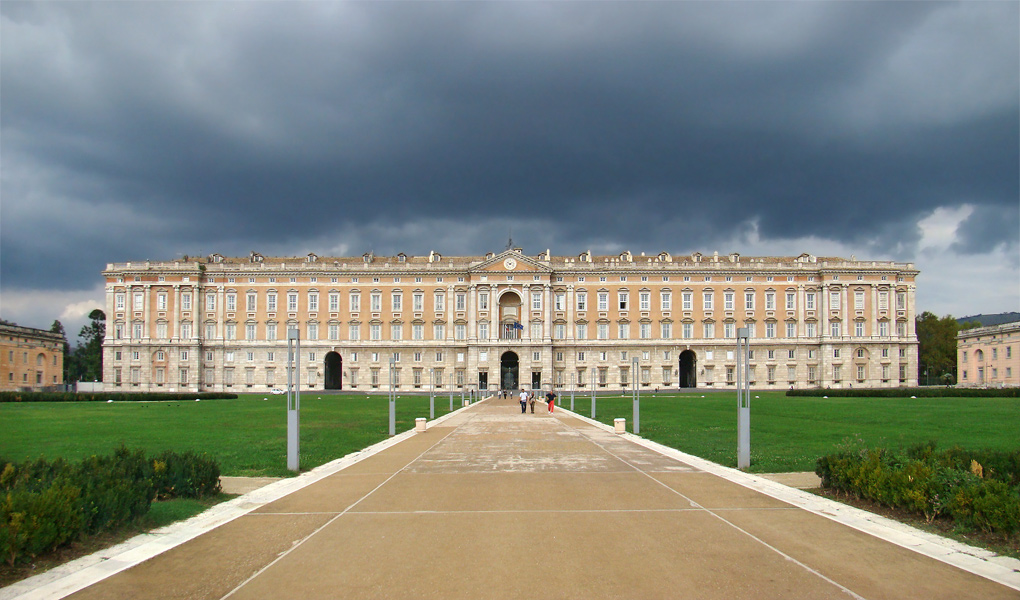
The Palace of Caserta, known in Italian as the Reggia di Caserta, is a monumental royal residence in Caserta, in southern Italy, a short distance inland from Naples. Commissioned in the mid‑18th century by King Charles of Bourbon as a new seat for his court and government, the complex was conceived as both a palace and an administrative centre for the Kingdom of the Two Sicilies. It is noted for its extraordinary scale, lavishly decorated interiors and an extensive landscaped park served by an elaborate hydraulic system.
Image gallery
10 Images




Architecture and principal features
The palace was designed by the architect Luigi Vanvitelli and construction began in the mid‑1700s. The main block is a vast rectangular volume organized around courtyards and state apartments, and contains approximately 1,200 rooms. Visitors encounter monumental elements such as the grand staircase, long enfilades of reception rooms, richly frescoed ceilings and marble floors. The complex also houses a court theatre modelled on the celebrated Teatro San Carlo of Naples and rooms intended for ceremonial, private and administrative use. Because of its scale, formal composition and function as a royal residence it is often compared to the Palace of Versailles, earning the nickname "the Italian Versailles."
Gardens, waterworks and landscape
The palace stands at the head of an extended park laid out with terraces, fountains, cascades and broad axial vistas that lead the eye toward the surrounding countryside. Vanvitelli planned an integrated hydraulic infrastructure — aqueducts, reservoirs and channels — to supply a sequence of spectacular water features. Sculptural groups, stepped fountains and long canals punctuate the route from the palace down through the gardens, where formal baroque geometry gradually gives way to more naturalistic landscape elements.
History and later uses
Built as a royal residence and administrative centre in the second half of the 18th century, the Reggia remained associated with the Bourbon dynasty and experienced changes of use through the Napoleonic era, the Risorgimento and the eventual unification of Italy. Construction and decoration continued over many decades into the 19th century under the direction of Vanvitelli's collaborators and successors. In the 20th and 21st centuries the palace has been conserved and adapted as a cultural site, housing museum displays, temporary exhibitions and official events while remaining open to the public for guided visits.
Cultural significance
In 1997 the palace and its park were inscribed on the UNESCO World Heritage List. The nomination praised the site as "the swan song of the spectacular art of the Baroque, from which it adopted all the features needed to create the illusions of multidirectional space." The ensemble is valued both for its artistic achievements and for the technical ambition of its hydraulic and landscape works. Its scale and courtly programme make it a key example of late‑Baroque court architecture in Europe.
Modern role and popular culture
Today the Palace of Caserta is one of Italy's major cultural attractions, drawing visitors to its state apartments, the historic theatre, and the dramatic sequence of fountains and terraces. The site is also used for cultural events, concerts and exhibitions. Its richly representative interiors and monumental exteriors have attracted filmmakers: sections of the palace and park were used as locations in major motion pictures, including scenes featured in the Star Wars films.
Visiting and further reading
- The complex combines ceremonial halls, private apartments and offices organized around a monumental central axis.
- The park blends formal terraces and long sightlines with sculpted fountains and cascades supplied by a purpose‑built hydraulic network.
- The Reggia is widely regarded as a late flowering of Baroque court architecture and landscape planning in Italy.
For authoritative information and visitor details consult regional and heritage resources: Palace overview, Italian cultural heritage, Naples and Campania, Bourbon dynasty, Two Sicilies, Reggia di Caserta, Teatro San Carlo reference, comparative palaces.
Questions and answers
Q: What is the Palace of Caserta?
A: The Palace of Caserta is a palace in Italy near Naples. It was built by King Carlo VII of Naples and was mainly used as a summer home for the royal family of the Two Sicilies.
Q: How many rooms does it have?
A: The palace has about 1,200 rooms, including two dozen state apartments and a large theatre modelled after the Teatro San Carlo of Naples.
Q: What is it often compared to?
A: The Palace of Caserta is often compared to the Palace of Versailles and is called the "Italian Versailles".
Q: When did it become a UNESCO World Heritage Site?
A: In 1997, the palace was made a UNESCO World Heritage Site.
Q: Why was it built?
A: The king wanted to create a magnificent new royal court and administrative center for his kingdom in an area that would be protected from sea attack.
Q: What films were shot at this location?
A: Parts of Star Wars Episode II : Attack of the Clones and Star Wars Episode I : The Phantom Menace were filmed at this location.
Related articles
Author
AlegsaOnline.com Palace of Caserta (Reggia di Caserta) Leandro Alegsa
URL: https://en.alegsaonline.com/art/74099
Sources
- whc.unesco.org : UNESCO