
Ostracoderms: Armoured Jawless Fishes of the Early Paleozoic
Ostracoderms were extinct, armored jawless vertebrates that lived from the Silurian to the Devonian. Their head shields and scales provide key evidence on the origin of bone, gill function, and early vertebrate evolution.
Overview: Ostracoderms is a traditional name applied to several groups of extinct, bony-armoured, jawless vertebrates that flourished in the early Paleozoic. These animals are best known from fossils of broad head shields and plated bodies preserved in sedimentary rocks. Although once treated as a single natural class, the term now usually refers to a paraphyletic assemblage rather than a single lineage.
Image gallery
10 Images


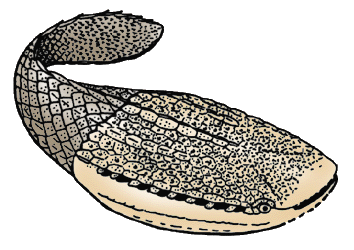


Anatomy and distinctive features
Most ostracoderms bore heavy dermal armour made of mineralized bone-like tissue, especially over the head and anterior trunk. They lacked true jaws and are therefore classified among the jawless fishes; feeding adaptations ranged from bottom-feeding to filter-feeding. Many show a well-developed sensory-line system in the shield and paired fin-like appendages in some groups. Internal anatomy known from exceptional fossils reveals gill structures that appear to have been used primarily for respiration, a shift from earlier multifunctional gill arrangements noted in more primitive forms (gills).
Classification and major groups
Historically the label has included several distinct lineages of early vertebrates. Representative groups often placed in the assemblage include the Osteostraci (bony head shields), Heterostraci, Thelodonti and Anaspida. These groups differ in shield shape, scale microstructure and the arrangement of gill openings. As paleontologists refined vertebrate relationships, ostracoderms came to be treated as an informal grouping that highlights ecological and anatomical similarities rather than strict kinship.
Time range and fossil record
Fossils assigned to ostracoderm groups are known from roughly the Middle Silurian through the Upper Devonian. They are found across many Paleocontinents, including deposits now in North America, northern Europe and Russia. Early discoveries in 19th-century sedimentary rocks helped establish the study of fossil fish: specimens of the common form Cephalaspis from the Old Red Sandstone of Scotland provided some of the first recognized evidence of ancient vertebrates.
Ecology and evolutionary importance
Ostracoderms occupied a variety of nearshore and freshwater habitats. Many were bottom-dwellers with flattened heads adapted to feeding on or near the substrate, while others had more streamlined bodies for active swimming. Their dermal bones represent some of the earliest extensive mineralized tissues in vertebrates and are central to understanding the origin of bone and scales. Study of their gills, sensory systems and fin structures has informed hypotheses about how jaws and paired appendages evolved in later vertebrates.
Notable facts and distinctions
- "Ostracoderm" is not related to modern ostracods (small crustaceans); the resemblance is only linguistic.
- Because the grouping is paraphyletic, modern classifications place emphasis on individual lineages such as the Osteostraci rather than on "ostracoderms" as a single class (class).
- Fossils of these fishes, once among the first to be collected and described, continue to be important in museum collections and research.
For summaries of particular genera, fossil sites and up-to-date classifications see general paleontology overviews and specialist literature (fish references and reviews).
Related articles
Author
AlegsaOnline.com Ostracoderms: Armoured Jawless Fishes of the Early Paleozoic Leandro Alegsa
URL: https://en.alegsaonline.com/art/73447