
Old Red Sandstone
A widespread sequence of Devonian-age red-bed rocks deposited on the ancient continent Laurussia; notable for terrestrial sediments, early vertebrate fossils and its role in geological history.
Overview
The Old Red Sandstone is a widely recognized set of red-colored sedimentary rocks that accumulated mainly during the Devonian period but with portions that began in the late Silurian and continued into the early Carboniferous. It is best known from parts of northern Europe, Greenland and eastern North America where continental basins preserved thick sequences of sandstones, conglomerates, mudstones and occasional volcanic layers. The red hue commonly reflects iron oxide staining within the sediments.
Image gallery
10 Images




Composition and depositional environments
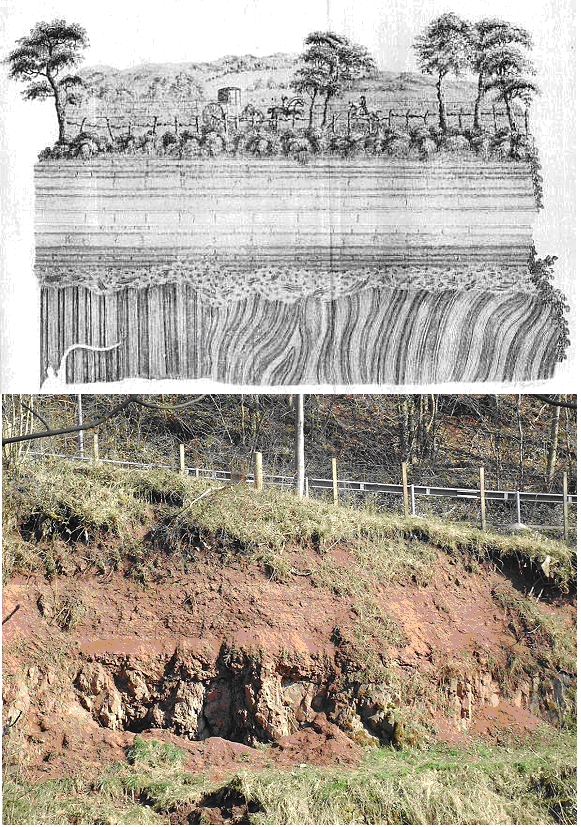
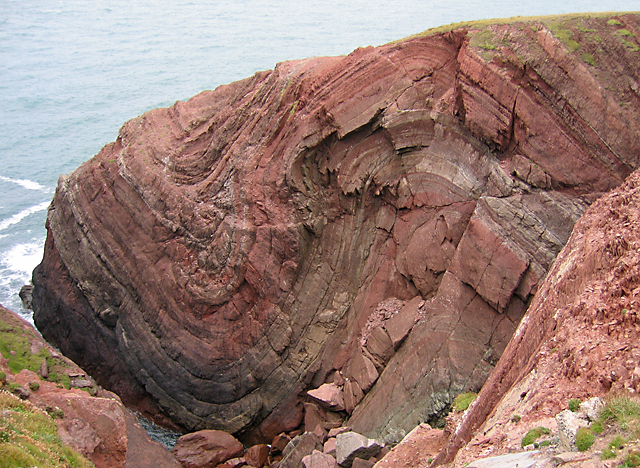
These rocks are predominantly rounded and angular sandstones and related coarse-grained deposits indicating transport by rivers and alluvial fans. Finer-grained mudstones and siltstones record overbank, floodplain and lake deposition. In several regions interbedded volcanic rocks and paleosols (ancient soils) appear, showing that deposition occurred in continental settings rather than in open marine conditions. The assemblage preserves evidence of arid to seasonally wet climates in many basins.
Stratigraphy and age
Although classically associated with the Devonian, the base of the sequence can extend into the late Silurian and its upper parts grade into Carboniferous strata in some areas. Geologists therefore treat the Old Red Sandstone as a broad lithostratigraphic unit rather than a single narrow time slice. Regional names and subdivisions vary between Britain, Greenland and North America, but they represent related episodes of erosion, transport and sedimentation across the ancient landmass.
Geographic extent and tectonic setting
The deposits formed on and around the continental block often called Laurussia or Euramerica, which united parts of what are now northern Europe, Greenland and eastern North America. This paleocontinent occupied low southern latitudes during much of the Devonian. Basin development and sediment supply were closely linked to uplift and erosion of nearby landmasses during the assembly of that continent.
Fossils, scientific importance and uses
Although largely terrestrial, Old Red Sandstone deposits have preserved important fossils, including early freshwater fishes, plant fragments and trace fossils that document evolving ecosystems on land and in fresh water. These records were crucial for 19th-century studies of early vertebrate evolution and for establishing the Devonian as an important geologic interval. Locally the durable sandstones have been quarried as building stone and aggregate.
Notable distinctions and historical study
- The term distinguishes these Devonian red beds from younger red units sometimes called the "New Red Sandstone" of Permian–Triassic age.
- Classic exposures and type areas in Britain and adjacent regions were central to early geological mapping and stratigraphic work.
- Modern research combines field mapping with fossil studies and geochronology to refine correlations between basins.
For regional overviews and maps of distribution see Laurussia and plate reconstructions, Devonian stratigraphy summaries at Devonian resources and lithology descriptions at red sandstone references. Additional background on Silurian–Carboniferous boundaries is available via Silurian and Carboniferous summaries. Regional geology sites for northern Europe, Greenland and North America can be consulted at northern Europe, Greenland and North America. Paleolatitude and paleoclimate context are discussed in resources linked at paleogeography.
Questions and answers
Q: What is the Old Red Sandstone?
A: The Old Red Sandstone is a type of dark red sandstone that was deposited mainly during the Devonian period over a significant portion of the continent of Laurussia.
Q: In what geologic time period was the Old Red Sandstone laid down?
A: The Old Red Sandstone was mainly laid down during the Devonian period.
Q: Where is the base of the Old Red Sandstone located?
A: The base of the Old Red Sandstone is now known to be in the Silurian period.
Q: Where is the top of the Old Red Sandstone located?
A: The top of the Old Red Sandstone is now known to be in the Carboniferous period.
Q: What is Laurussia?
A: Laurussia is a continent that was located between 0o and 30o south of the equator during the Devonian period. It was also known as the Old Red Continent or Euramerica and included what is now much of northern Europe, Greenland, and North America.
Q: What is the significance of the Old Red Sandstone?
A: The Old Red Sandstone is an important geologic formation because it contains a variety of fossils from the Devonian period and offers insight into the ancient environments and ecosystems of Laurussia during that time.
Q: Is the Old Red Sandstone found anywhere else besides Laurussia?
A: Yes, the Old Red Sandstone has also been found in some other parts of the world, including China and New Zealand.
Related articles
Author
AlegsaOnline.com Old Red Sandstone Leandro Alegsa
URL: https://en.alegsaonline.com/art/72296
Sources
- geos.ed.ac.uk : "Siccar Point"
- james-hutton.org : Hutton’s journeys to prove his theory
- geowords.com : "Hutton's unconformities"
- jncc.gov.uk : The Old Red Sandstone of Great Britain
- bgs.ac.uk : bgs.ac.uk