
Cephalaspis — early armored jawless fish of the Devonian
Cephalaspis is a genus of armored, jawless vertebrates (osteostracans) from Early Devonian freshwater and nearshore environments. Its head shield and sensory systems illuminate early vertebrate anatomy and evolution.
Overview
Cephalaspis (literally "head shield") is a genus of armored, jawless vertebrates that lived in freshwater and nearshore environments during the Early Devonian, about 400 million years ago. Historically treated as one of the broad group of armored jawless fishes known as ostracoderms, Cephalaspis is now placed among the osteostracans, a clade important for studies of early vertebrate head armor and the origin of paired appendages.
Image gallery
7 Images


Anatomy and morphology
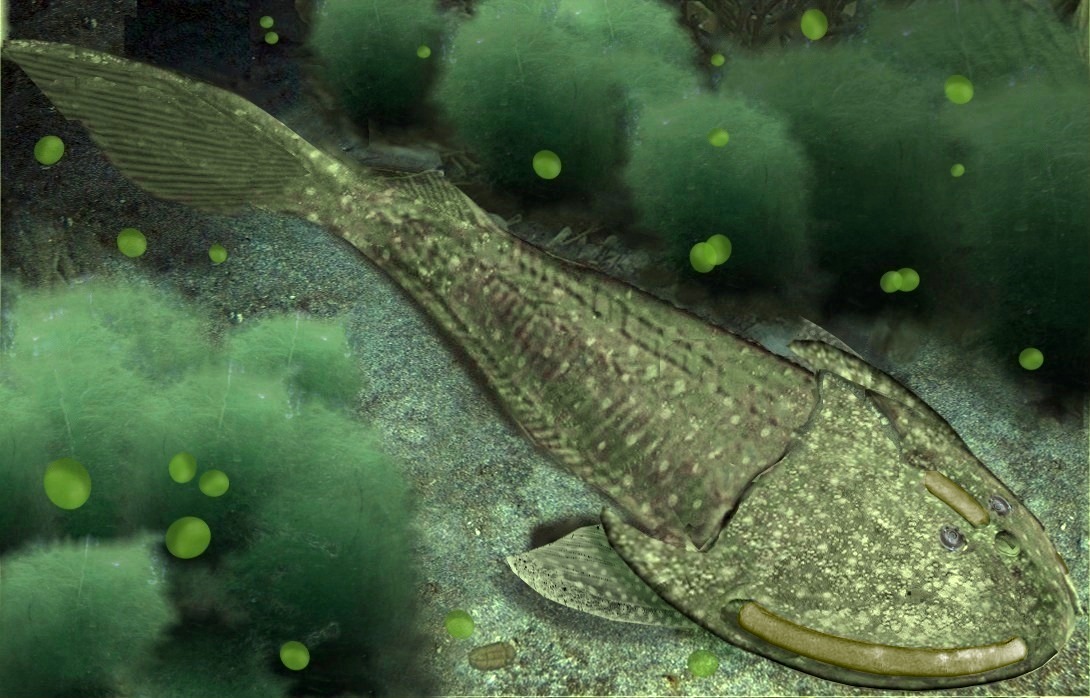
Fossils of Cephalaspis are distinguished by a broad, flattened bony head shield that extended over the anterior part of the body. The shield commonly preserves a network of grooves interpreted as canals of a lateral-line type sensory system. Eyes were relatively small and set dorsally on the shield, while the mouth lay on the underside, consistent with a benthic lifestyle. Skeletal remains and impressions indicate fin-like lateral projections interpreted as paired pectoral elements; these structures are of interest because they show a degree of control and locomotory refinement not present in the most primitive jawless vertebrates.
Fossil discovery and taxonomic history
Early specimens came from the well-known Old Red Sandstone deposits of Britain and from collections made in Scotland. The genus name was introduced by Louis Agassiz in 1835, based on material then available to 19th-century naturalists and collectors. Subsequent study has shown that what Agassiz and his contemporaries treated as a single species actually represents a more diverse assemblage. Numerous species once placed in Cephalaspis have been split apart or reassigned, and some taxa formerly labelled Cephalaspis are now placed in a different genus as osteostracan taxonomy has been revised.
Distribution and geological context
Most classic Cephalaspis specimens derive from Early Devonian strata of northern Europe, particularly the Old Red Sandstone facies. Similar-aged continental and marginal-marine deposits elsewhere have produced related osteostracan remains, showing that armored jawless vertebrates were widespread in suitable habitats during the Early Devonian. Preservation is often of the dermal head shield and associated impressions of the anterior body; complete skeletons are rarer but have been important for reconstructing life appearance.
Ecology and behavior
Cephalaspis is generally interpreted as a bottom-dwelling (benthic) animal that fed on small invertebrates, organic detritus, or other food items from the substrate. The flattened body and ventral mouth suggest a lifestyle close to the sediment surface. The sensory canals on the head shield would have helped detect water movements and locate prey or sense predators in turbid conditions. Although jawless, the combination of armor, sensory specialization, and paired fin-like structures represents a set of adaptations that foreshadow later innovations in jawed vertebrates.
Scientific significance and research
Cephalaspis and other osteostracans are important for understanding the early evolution of vertebrate cranial anatomy, dermal bone organization, and the appearance of paired appendages. Modern studies use careful morphological description, comparative anatomy, and techniques such as high-resolution imaging and three-dimensional reconstruction to clarify relationships among early vertebrates. Museum collections and regional stratigraphic studies continue to refine the taxonomy, paleoecology, and geographic distribution of these animals.
Specimens and further resources
Specimens of Cephalaspis are held in national and regional museum collections, and many general references on Devonian vertebrates and fossil fish provide accessible introductions. For contextual information on age and stratigraphy consult sources on the Early Devonian and on the Old Red Sandstone. For historical background see accounts of early fossil collectors in Scotland and the work of Louis Agassiz. Discussions of the former broad grouping of armored jawless fishes appear under the term ostracoderms, while taxonomic revisions and genus reassignments are noted where some species have been placed in a different genus.
Note: Because the taxonomy of early fossil vertebrates has been revised repeatedly as new material and methods become available, names and species assignments for Cephalaspis and related osteostracans are subject to further refinement by specialists.
Questions and answers
Q: What is Cephalaspis?
A: Cephalaspis is a genus of armoured fish that existed in the early Devonian about 400 million years ago.
Q: What type of fish is Cephalaspis?
A: Cephalaspis is one of the jawless fishes, also known as ostracoderms, which were common during that time.
Q: When were the first discoveries of Cephalaspis made?
A: The first discoveries of Cephalaspis were made in the first half of the 19th century in the Old Red Sandstone of Britain.
Q: Who named Cephalaspis?
A: Louis Agassiz named Cephalaspis in 1835 after seeing Hugh Miller's collection in Scotland.
Q: Has Cephalaspis undergone taxonomic revisions?
A: Yes, Cephalaspis' original single species has now been split into more species, some of which have been moved into a different genus.
Q: What is the meaning of Cephalaspis?
A: Cephalaspis means 'head shield.'
Q: How long ago did Cephalaspis exist?
A: Cephalaspis existed in the early Devonian about 400 million years ago.
Related articles
Author
AlegsaOnline.com Cephalaspis — early armored jawless fish of the Devonian Leandro Alegsa
URL: https://en.alegsaonline.com/art/18141