
Osprey (Pandion haliaetus): the fish-eating raptor
A widespread bird of prey specialized for catching fish. Describes appearance, hunting adaptations, breeding, distribution, migration and conservation.
Overview
The osprey (Pandion haliaetus) is a large raptor known primarily for eating fish, and is commonly called the fish hawk, sea hawk or fish eagle. It occurs on coasts, rivers and lakes across much of the globe and is notable for its close relationship with aquatic habitats. Adults typically measure up to about 60 cm from beak to tail and have a broad wingspan, making them powerful, agile hunters.
Appearance and identifying features: ospreys have dark brown upperparts and predominantly white underparts with a distinctive dark eye stripe or "mask" across the face. Their wings show a characteristic bend in flight and underwing patterning that helps distinguish them from other raptors. The beak is hooked for tearing, and the feet are large and adapted for grasping slippery prey.
Image gallery
10 Images


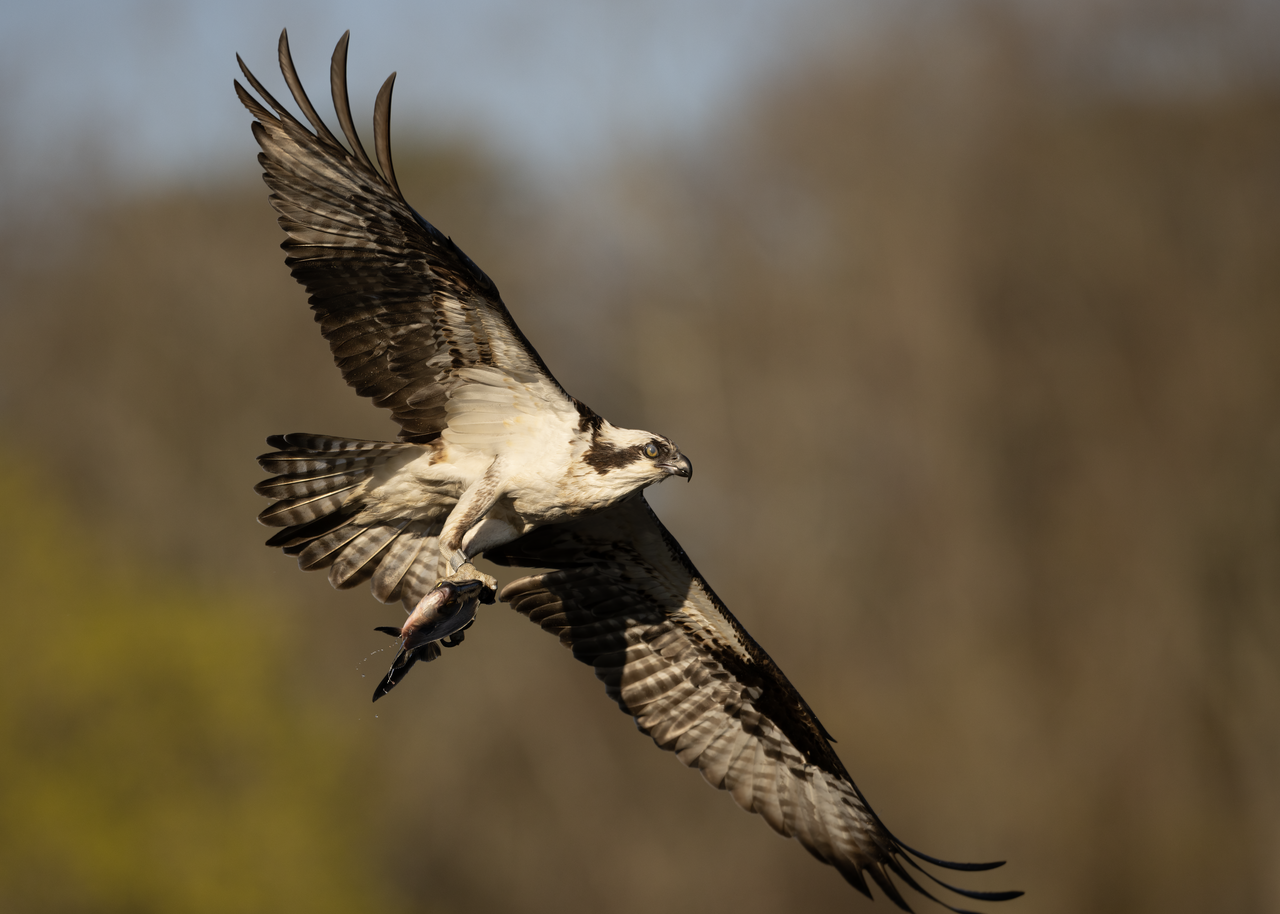


Adaptations for fishing
Ospreys possess several special adaptations that suit an almost exclusively piscivorous diet. Key features include:
- Reversible outer toe that can be adjusted to hold prey with two toes in front and two behind.
- Rough, spiny pads on the soles of the feet to improve grip on fish.
- Long, curved talons for piercing and holding slippery bodies.
- Specialized nostrils that close during dives to keep out water.
These traits enable spectacular plunge-dives from height, after which the bird rises carrying the catch, often oriented head-first to reduce drag.
Breeding, nests and behaviour
Ospreys build large stick nests on high sites such as trees, cliffs, utility poles or artificial platforms. Nests are reused and added to year after year. Pairs typically cooperate in incubation and feeding; clutches commonly contain two to four eggs. Young fledge after several weeks but may remain dependent on parents for some time.
Distribution, migration and conservation
The species has a nearly cosmopolitan distribution, breeding across temperate and tropical regions except Antarctica. Many northern populations migrate to warmer areas for the nonbreeding season. Ospreys suffered declines in the mid-20th century from pesticides such as DDT, but many populations have recovered following chemical restrictions and active conservation, though they still face threats from habitat loss, pollution and disturbance.
Distinctions and human interest
Ospreys are often confused with other sea-going raptors but can be separated by their white underparts and distinctive flight silhouette. They are popular subjects of birdwatching and conservation programs; artificial nesting platforms have helped boost local numbers. For further reading see species overview, field identification guides at identification resources, conservation organizations at conservation links, migration studies at migration research, and habitat restoration projects at restoration efforts.
Related articles
Author
AlegsaOnline.com Osprey (Pandion haliaetus): the fish-eating raptor Leandro Alegsa
URL: https://en.alegsaonline.com/art/73401
Sources
- species.wikimedia.org : Pandion haliaetus
- ospreys.org.uk : The osprey in Scotland